100% tevredenheidsgarantie Direct beschikbaar na je betaling Lees online óf als PDF Geen vaste maandelijkse kosten 4.2 TrustPilot
logo-home
Tentamen (uitwerkingen)

LSU ME 3701 final (quizzes and homeworks) Assessment Test Questions And Answers 100% Verified.

Beoordeling
-
Verkocht
-
Pagina's
8
Cijfer
A+
Geüpload op
29-12-2024
Geschreven in
2024/2025

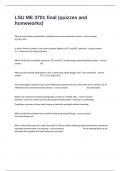
What are the three characteristic crystal structures encountered in metals - correct answer FCC,BCC,HCP In which family of planes is the atomic density highest in FCC and BCC materials - correct answer {1,1,1} because it is family of planes Which of the two crystalline structures: FCC and BCC, has the largest atomic packing fraction - correct answer FCC What are the possible (hkl) planes in FCC crystals that satisfy Bragg's law? ( two examples) - correct answer FCC (1,1,1) and (2,0,0) The wavelength of typical X-rays used in diffraction experiments are of the order of (or fraction of): A) millimeters B) nanometers C)micrometers - correct answer B) nanometers Define two materials mechanical properties of metal or metallic alloy - correct answer Hardness: measure of how much localized plastic deformation a material can withstand Toughness: measure of how much energy a material can absorb before fracturing What are the two standard tests used for measuring Impact Energy - correct answer Izod and Charpy test What is the main reason for using Chauvenet's Criterion when analyzing experimental data consisting a repeated measurement of a property - correct answer So the outlying data can be discarded from graphs and make data more accurate briefly describe the measurement of Rockwell hardness of a material - correct answer measures the depth of penetration of an indenter under a large load (major load) compared to the penetration made by a preload (minor load). Why do we apply the minor load during a Rockwell hardness measurement - correct answer to allow the indenter to penetrate the material surface, thus eliminating any errors causes by surface roughness. Briefly explain the differences between [1 1 1], (1 1 1), <1 1 1> and {1 1 1}. - correct answer (111)-coordinates of specific plane [111]-specific direction {111}-family of planes <111>-family of directions Expressions for engineering stress(o-) and engineering strain(e): load(force) P, the initial cross-sectional area Ao, initial length Lo, final Length L. - correct answer o- = P/Ao e = L - Lo/Lo What is the modulus of elasticity (E) and how would you calculate its value - correct answer E = o-(engineering stress) / e(engineering strain) the ratio of stress, below the proportional limit, to the corresponding strain. Define the Yield strength of the steel specimen and describe the procedure you would use to find the yield strength from stress-strain graph - correct answer the stress at which a predetermined amount of permanent deformation occurs. The results of the test are plotted on stress-strain curve. The stress at the point where the stress-strain curve deviates from proportionality is the yield strength of the material. What is the modulus of resilience - correct answer the area under the curve up to the yield strength When loading a specimen in tension what do we call the stress level beyond which the necking starts to occur - correct answer Ultimate or Tensile Strength The two components of pearlite are - correct answer ferrite and cementite How would you perform a normalizing heat treatment of a steel specimen - correct answer heat treating the specimen then allowing it to air cool Jominy end-quench test consists of: - correct answer Selectively water cooling of a standard size bar of steel Which of the two processes will yield a higher value of toughness: quenching or annealing - correct answer Annealing What are the characteristic features of martensite - correct answer high hardness and good toughness Describe briefly the process of precipitation hardening heat treatment process - correct answer solution treatment which heats the material above solvus temp then moves to quenching which cools the material and then it is age hardened which heats the material to below solvus temp which produces a precipitate What are the three heat treatment steps involved in precipitation hardening process of Aluminum alloys - correct answer 1. solution treatment 2. Quenching 3. Age hardening Briefly describe what happens in the alloy during the solution treatment process - correct answer alloy is heated to above the solvus temp and soaked there until a homogeneous solid solution (a) is produced. Why does the formation of precipitates strengthen the heat treated alloys - correct answer blocks dislocations from moving What are the materials we call polymers and how are they obtained - correct answer high molecular weight materials (rubbers and plastics) that are synthesized from simple organic compounds. typically low strength and ductile What are the major differences between a thermosetting ,thermoplastics , and elastomers - correct answer The way they are linked together. Thermosetting - composed of cross-linked space networks. Crosslinks form between chains when the material is cured. Thermoplastics - composed of long coiling chains which are NOT cross-linked. Elastomers - long chained elastomers do not crosslink Which of the following is NOT a property characterizing teflon: a) teflon has fluorine in its composition b) teflon has chlorine in its composition c) teflon has good sealing characteristics - correct answer b) teflon has chlorine in its composition Which of the three types of polymers (thermosetting ,thermoplastics , and elastomers) forms permanent cross-links between chains and can not be recycled - correct answer Thermosettings What is the stress relaxation in polymers and how does it differ from creep - correct answer stress relaxation - decrease in the amount of stress required to maintain a specific strain Creep - deformation continues to occur under conditions of constant stress. What is ductile to brittle transition - correct answer transition of a metal being heated or cooled and having different fractures at different temps Describe the ductile fracture - correct answer cup and cone fracture which means there is a lot of plastic deformation leading up to the fracture describe brittle fracture - correct answer a clean, fine fracture with little to no plastic deformation before fracture How does the impact energy depend on temperature for a specimen undergoing ductile to brittle transition - correct answer As temperature increases, impact energy increase Which of the following metals are likely to undergo ductile to brittle transition when cooled down well below 0 C: a) BCC low-carbon steels b) FCC metals - correct answer a) BCC low-carbon steels What is the purpose of preparing and examining metallographic specimens - correct answer to make observations on the microstructure content During the preparation of a metallographic sample, what does specimen mounting mean and why is it necessary - correct answer The specimen is mounted in plastic for connivence in handling and to protect the specimen being prepared Why is it necessary to wash thoroughly the samples before proceeding from one grinding stage to the next - correct answer Washing the sample gets rid of excess material that was grinded off so you are not grinding the same material in the next step What is the proper sequence of metallographic specimen preparation beginning with the first step: Fine grinding, Sectioning, Etching, Polishing, Microscopy, Course Grinding, Mounting - correct answer 1. Sectioning 2. Mounting 3. Course Grinding 4. Fine Grinding 5. Polishing 6. Etching 7. Microscopy What is the purpose of etching metallographic samples - correct answer used to highlight, and sometimes identify, microstructural features or phases present Miller indices characterizing the X-ray diffraction peaks for a FCC crystal satisfy the following constructing interference condition: a) (h, k and l) can assume any integer values b) (h + k + l) is even c) (h, k, l) are all odd or all even d) b and c e) none of the above - correct answer c) (h, k, l) are all odd or all even The wavelength of typical X - rays used in diffraction experiments are of the order of: a) micrometers b) millimeters c) meters d) nanometers e) femtometers - correct answer d) nanometers During deformation which of the following material property characterizes the beginning of plastic deformation: a) yield strength b) young modulus c) tensile strength d) modulus of resistance - correct answer a) yield strength Charpy and Izod mechanical testing methodologies are conducted to measure: a) toughness b) hardness c) resilience d) ductility - correct answer a) toughness What experimental method was used in the lab to determine the hardness of a steel specimen: a) Rockwell b) chauvenet c)jominy d)charpy - correct answer A) rockwell Which of the following heat treatment of steels is used to facilitate formation of bainite (hard and brittle microstructure): a) normalizing b) quenching c) tempering d) austempering e) annealing - correct answer d) austempering Which of the following heat treatment of steels is used to facilitate formation of coarse pearlite (soft and ductile microstructure): a) normalizing b) quenching c) tempering d) austempering e) annealing - correct answer e) annealing Which of the following is not one of the basic steps of precipitation hardening process: a)solution treatment b)normalizing c)quenching d)age hardening - correct answer b)normalizing Which of the following is true with respect to age hardening(without over aging): a)formation of incoherent precipitates increases hardness of material b) formation of incoherent precipitates decreases hardness and increases strength c) formation of coherent precipitates increases hardness and increases strength d) coherent precipitates increases hardness and decrease strength - correct answer c) formation of coherent precipitates increases hardness and increases strength Thermoplastics are generally: a)not recyclable and highly elastic b)recyclable and highly elastic c)not recyclable and composed of cross linked chains or networks d) recyclable and composed of cross linked chains or networks e)none of the above - correct answer e) none of the above define hardness - correct answer material resistance to localized plastic deformation at the surface What is hardenability? What test do we use to find it? - correct answer materials ability to become more and more hard

Meer zien Lees minder
Instelling
ENGR 3701
Vak
ENGR 3701


Oeps! We kunnen je document nu niet laden. Probeer het nog eens of neem contact op met support.

Geschreven voor

Instelling
ENGR 3701
Vak
ENGR 3701

Documentinformatie

Geüpload op
29 december 2024
Aantal pagina's
8
Geschreven in
2024/2025
Type
Tentamen (uitwerkingen)
Bevat
Vragen en antwoorden

Onderwerpen

Voorbeeld van de inhoud

LSU ME 3701 final (quizzes and
homeworks)

What are the three characteristic crystal structures encountered in metals - correct answer
FCC,BCC,HCP


In which family of planes is the atomic density highest in FCC and BCC materials - correct answer
{1,1,1} because it is family of planes


Which of the two crystalline structures: FCC and BCC, has the largest atomic packing fraction - correct
answer FCC


What are the possible (hkl) planes in FCC crystals that satisfy Bragg's law? ( two examples) - correct
answer FCC (1,1,1) and (2,0,0)


The wavelength of typical X-rays used in diffraction experiments are of the order of (or fraction of): A)
millimeters B) nanometers C)micrometers - correct answer B) nanometers


Define two materials mechanical properties of metal or metallic alloy - correct answer
Hardness: measure of how much localized plastic deformation a material can withstand

Toughness: measure of how much energy a material can absorb before fracturing


What are the two standard tests used for measuring Impact Energy - correct answer
Izod and Charpy test


What is the main reason for using Chauvenet's Criterion when analyzing experimental data consisting a
repeated measurement of a property - correct answer So the outlying data can be
discarded from graphs and make data more accurate

, briefly describe the measurement of Rockwell hardness of a material - correct answer
measures the depth of penetration of an indenter under a large load (major load) compared to the
penetration made by a preload (minor load).


Why do we apply the minor load during a Rockwell hardness measurement - correct answer
to allow the indenter to penetrate the material surface, thus eliminating any errors causes by surface
roughness.


Briefly explain the differences between [1 1 1], (1 1 1), <1 1 1> and {1 1 1}. - correct answer
(111)-coordinates of specific plane

[111]-specific direction

{111}-family of planes

<111>-family of directions


Expressions for engineering stress(o-) and engineering strain(e): load(force) P, the initial cross-sectional
area Ao, initial length Lo, final Length L. - correct answer o- = P/Ao

e = L - Lo/Lo


What is the modulus of elasticity (E) and how would you calculate its value - correct answer
E = o-(engineering stress) / e(engineering strain)

the ratio of stress, below the proportional limit, to the corresponding strain.


Define the Yield strength of the steel specimen and describe the procedure you would use to find the
yield strength from stress-strain graph - correct answer the stress at which a
predetermined amount of permanent deformation occurs.

The results of the test are plotted on stress-strain curve. The stress at the point where the stress-strain
curve deviates from proportionality is the yield strength of the material.


What is the modulus of resilience - correct answer the area under the curve up to
the yield strength


When loading a specimen in tension what do we call the stress level beyond which the necking starts to
occur - correct answer Ultimate or Tensile Strength

€11,83
Krijg toegang tot het volledige document:

100% tevredenheidsgarantie
Direct beschikbaar na je betaling
Lees online óf als PDF
Geen vaste maandelijkse kosten


Ook beschikbaar in voordeelbundel

Maak kennis met de verkoper

Seller avatar
De reputatie van een verkoper is gebaseerd op het aantal documenten dat iemand tegen betaling verkocht heeft en de beoordelingen die voor die items ontvangen zijn. Er zijn drie niveau’s te onderscheiden: brons, zilver en goud. Hoe beter de reputatie, hoe meer de kwaliteit van zijn of haar werk te vertrouwen is.
RealGrades Nursing
Volgen Je moet ingelogd zijn om studenten of vakken te kunnen volgen
Verkocht
168
Lid sinds
2 jaar
Aantal volgers
52
Documenten
11546
Laatst verkocht
1 week geleden

4,0

26 beoordelingen

5
12
4
5
3
7
2
1
1
1

Recent door jou bekeken

Waarom studenten kiezen voor Stuvia

Gemaakt door medestudenten, geverifieerd door reviews

Kwaliteit die je kunt vertrouwen: geschreven door studenten die slaagden en beoordeeld door anderen die dit document gebruikten.

Niet tevreden? Kies een ander document

Geen zorgen! Je kunt voor hetzelfde geld direct een ander document kiezen dat beter past bij wat je zoekt.

Betaal zoals je wilt, start meteen met leren

Geen abonnement, geen verplichtingen. Betaal zoals je gewend bent via iDeal of creditcard en download je PDF-document meteen.

Student with book image

“Gekocht, gedownload en geslaagd. Zo makkelijk kan het dus zijn.”

Alisha Student

Veelgestelde vragen