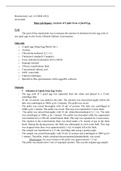
Political Communication Notes
Week 1 - Introduction political communication and journalism
Political communication = ‘the interactions between politics, media and the public’
(Free) media as a fourth state of democracy: refers to the news media and its role in the
political process. It emphasizes the media’s function as a watchdog, holding those in power
accountable and serving as a crucial component of a functioning democracy.
A democracy means that there is an equal division of power. In a democracy the government
consists of the following branches:
- Legislative (makes laws)
- Executive (execute laws)
- Judiciary (checks whether laws are followed)
- Media (provides information and should keep the previous branches in balance)
Functions of media in a democratic society (McNair, 2003):
1. Information: monitoring, inform the citizens
2. Education: explaining what events and facts mean
3. Watchdog function: control over politics, publicity for what politics does (wrong)
4. Platform function: exchange of ideas → public sphere
5. Channel function: political, ideological opinions need to find their way to the people.
,How these functions get meaning, are implemented etc. differ by context and is not the
same in every country. We can compare the Netherlands with the US:
Dutch: many parties. US: two parties in Congress
Dutch: coalition government. US: one party in power
Dutch: strong public broadcaster. US: very weak public broadcaster
Dutch: (traditionally) strong political parallelism US: (traditionally) weak political parallelism
BUT, we can say something about patterns in contexts: Political and media systems
Political systems
Majoritarian democracies Consensus democracies
Plurality voting system Proportion representation
Two-party system Multiparty system
Single party majority cabinets Multiparty coalition cabinets
Power concentrated in executive branch Power sharing between executive and
legislative branches
Individualized pluralism Organized pluralism
Media systems (Hallin & Mancini, 2004)
Development of Mass Press / Inclusiveness of the media market: the reach of news media
among different groups of society. Does the mass media actually reach everyone?
Political Parallelism: the degree to which there are parallels between media and politics
Professionalization / Journalistic Professionalism: operationalized using the following
indicators → internal and external autonomy of journalists, the presence of professional
guidelines and codes of ethics, the degree to which news media enjoy credibility, the degree
of journalists’ orientation toward public service.
State intervention / Role of the State: actions a state takes to support and regulate the
media sector
If we look at these four dimensions, we see patterns which form three models:
, We have to be careful with interpreting these media systems, because:
- critics say that these are not in line with reality (anymore)
- it is too western focused
- it is not empirical
Pluralism & Independence
Closely related to political parallelism is pluralism = that the variety of voices are present in
the media.
- Internal pluralism: pluralism within each media outlet/news paper
- External pluralism: pluralism between different media outlets, so in the media system
as a whole (e.g., variety of left/right wing newspapers, conservative/liberal)
Any functioning democracy should have sufficient levels of pluralism (either internal or
external).
Independence of journalism is an important condition for pluralism. It can be achieved
through:
- Negative freedom: government being ‘passive’ and staying away (e.g., freedom of
speech: government shouldn’t say that they forbid anything)
- Positive freedom: government being ‘actively’ assisting (e.g., education: if the
government would be passive in this case there would probably be no education)
In South-Africa there is a lack of diversity and pluralism in the media (Plessing, 2017). This
can be solved by independence through government support (not control).
Several ways of doing this are through:
- Subsidies (with the aim of sustainability)
- Setting up cooperations with bigger companies
- Supporting regional hubs
- Facilities for journalists
- Training for journalists
With the rise of liberal democracy, propaganda activities have increased. The main aim of
propaganda has been to protect state-corporate power from the threat of public
understanding and participation. Propaganda can be understood as: the forming of texts and
Week 1 - Introduction political communication and journalism
Political communication = ‘the interactions between politics, media and the public’
(Free) media as a fourth state of democracy: refers to the news media and its role in the
political process. It emphasizes the media’s function as a watchdog, holding those in power
accountable and serving as a crucial component of a functioning democracy.
A democracy means that there is an equal division of power. In a democracy the government
consists of the following branches:
- Legislative (makes laws)
- Executive (execute laws)
- Judiciary (checks whether laws are followed)
- Media (provides information and should keep the previous branches in balance)
Functions of media in a democratic society (McNair, 2003):
1. Information: monitoring, inform the citizens
2. Education: explaining what events and facts mean
3. Watchdog function: control over politics, publicity for what politics does (wrong)
4. Platform function: exchange of ideas → public sphere
5. Channel function: political, ideological opinions need to find their way to the people.
,How these functions get meaning, are implemented etc. differ by context and is not the
same in every country. We can compare the Netherlands with the US:
Dutch: many parties. US: two parties in Congress
Dutch: coalition government. US: one party in power
Dutch: strong public broadcaster. US: very weak public broadcaster
Dutch: (traditionally) strong political parallelism US: (traditionally) weak political parallelism
BUT, we can say something about patterns in contexts: Political and media systems
Political systems
Majoritarian democracies Consensus democracies
Plurality voting system Proportion representation
Two-party system Multiparty system
Single party majority cabinets Multiparty coalition cabinets
Power concentrated in executive branch Power sharing between executive and
legislative branches
Individualized pluralism Organized pluralism
Media systems (Hallin & Mancini, 2004)
Development of Mass Press / Inclusiveness of the media market: the reach of news media
among different groups of society. Does the mass media actually reach everyone?
Political Parallelism: the degree to which there are parallels between media and politics
Professionalization / Journalistic Professionalism: operationalized using the following
indicators → internal and external autonomy of journalists, the presence of professional
guidelines and codes of ethics, the degree to which news media enjoy credibility, the degree
of journalists’ orientation toward public service.
State intervention / Role of the State: actions a state takes to support and regulate the
media sector
If we look at these four dimensions, we see patterns which form three models:
, We have to be careful with interpreting these media systems, because:
- critics say that these are not in line with reality (anymore)
- it is too western focused
- it is not empirical
Pluralism & Independence
Closely related to political parallelism is pluralism = that the variety of voices are present in
the media.
- Internal pluralism: pluralism within each media outlet/news paper
- External pluralism: pluralism between different media outlets, so in the media system
as a whole (e.g., variety of left/right wing newspapers, conservative/liberal)
Any functioning democracy should have sufficient levels of pluralism (either internal or
external).
Independence of journalism is an important condition for pluralism. It can be achieved
through:
- Negative freedom: government being ‘passive’ and staying away (e.g., freedom of
speech: government shouldn’t say that they forbid anything)
- Positive freedom: government being ‘actively’ assisting (e.g., education: if the
government would be passive in this case there would probably be no education)
In South-Africa there is a lack of diversity and pluralism in the media (Plessing, 2017). This
can be solved by independence through government support (not control).
Several ways of doing this are through:
- Subsidies (with the aim of sustainability)
- Setting up cooperations with bigger companies
- Supporting regional hubs
- Facilities for journalists
- Training for journalists
With the rise of liberal democracy, propaganda activities have increased. The main aim of
propaganda has been to protect state-corporate power from the threat of public
understanding and participation. Propaganda can be understood as: the forming of texts and