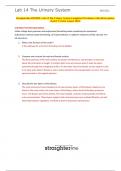
Lab 14 The Urinary System BIO202L
Straighterline BIO202L Lab 14 The Urinary System Completed Worksheet with all lab photos
(Latest Version August 2024)
Lab Report Format Expectations
Utilize college level grammar and professional formatting when completing this worksheet.
Submissions without proper formatting, all required photos or sufficient responses will be rejected. Pre-
lab Questions
1. What is the function of the ureter?
Is the pathway for urine from the kidney to the bladder.
2. Compare and contrast the male and female urethra.
The three portions of the male urethra are penial, membranous, and prostate. It measures
about 20 centimeters in length. It contains both urine and semen when it exits the penis'
extremity through the urinogenital orifice. On the other hand, the female urinary system is only
4 cm long, lacks distinct divisions, and is solely utilized for the transportation of urine. The urine
aperture leads to the vaginal aperture.
3. Describe the two layers of the kidneys.
The renal cortex and renal medulla are the two primary layers of the kidneys. Nephrons are
found in the renal cortex, the outer layer of the kidney, where the first filtration processes
occur. The deeper part of the kidney, the renal medulla, contains renal pyramids and affects
urine concentration. These layers support vital renal processes such as blood filtration, pH and
electrolyte balance regulation, and fluid and pH homeostasis maintenance.
,Lab 14 The Urinary System BIO202L
EXPERIMENT 1: KIDNEY FILTRATION
Introduction Questions
1. What specific part of the kidney does the dialysis tubing represent? What is this part’s function?
Dialysis tubing replicates the actions of Bowman's capsule and the glomerulus in the kidney's
nephron. During dialysis, it functions as a semipermeable membrane that keeps larger
molecules like blood cells and proteins inside while allowing waste products and tiny molecules
to pass through. This procedure mimics the kidney's first stage of urine generation, blood
filtration.
2. What does the yellow food coloring represent at the end of the experiment? What does the
Congo Red represent?
In the dialysis bag, urine is displayed in yellow, while blood traces are shown in red.
, Lab 14 The Urinary System BIO202L
Data and Observations
Record your observations as required by the experimental procedure in the table below.
Table 1: Solutions Present in Each Container Before 60 Minutes Submersion
Solution Dialysis Tubing Beaker
Congo Red yes no
Yellow Food Coloring no yes
Table 2: Solutions Present in Each Container After 60 Minutes Submersion
Solution Dialysis Tubing Beaker
Congo Red yes no
Yellow Food Coloring no yes
Results and Discussion
1. Why is it important that the kidney filters the blood? In your response, discuss what is being
removed and what is being selectively retained.
Our bodies expel wastes, which the kidneys filter out of the blood. Electrolytes, amino acids,
glucose, and other small molecules are excreted and absorbed by the kidneys depending on
which body component hormones regulate. Bound acids and ammonium ions maintain blood
pH, and the kidney regulates blood concentration. Urea, a waste product of nitrogen-containing
amino acid synthesis, is removed from the blood by the kidneys. If the kidneys cannot filter the
blood, nitrogenous byproducts of amino acid synthesis build up in the blood. Waste would thus
continue unabated.
Straighterline BIO202L Lab 14 The Urinary System Completed Worksheet with all lab photos
(Latest Version August 2024)
Lab Report Format Expectations
Utilize college level grammar and professional formatting when completing this worksheet.
Submissions without proper formatting, all required photos or sufficient responses will be rejected. Pre-
lab Questions
1. What is the function of the ureter?
Is the pathway for urine from the kidney to the bladder.
2. Compare and contrast the male and female urethra.
The three portions of the male urethra are penial, membranous, and prostate. It measures
about 20 centimeters in length. It contains both urine and semen when it exits the penis'
extremity through the urinogenital orifice. On the other hand, the female urinary system is only
4 cm long, lacks distinct divisions, and is solely utilized for the transportation of urine. The urine
aperture leads to the vaginal aperture.
3. Describe the two layers of the kidneys.
The renal cortex and renal medulla are the two primary layers of the kidneys. Nephrons are
found in the renal cortex, the outer layer of the kidney, where the first filtration processes
occur. The deeper part of the kidney, the renal medulla, contains renal pyramids and affects
urine concentration. These layers support vital renal processes such as blood filtration, pH and
electrolyte balance regulation, and fluid and pH homeostasis maintenance.
,Lab 14 The Urinary System BIO202L
EXPERIMENT 1: KIDNEY FILTRATION
Introduction Questions
1. What specific part of the kidney does the dialysis tubing represent? What is this part’s function?
Dialysis tubing replicates the actions of Bowman's capsule and the glomerulus in the kidney's
nephron. During dialysis, it functions as a semipermeable membrane that keeps larger
molecules like blood cells and proteins inside while allowing waste products and tiny molecules
to pass through. This procedure mimics the kidney's first stage of urine generation, blood
filtration.
2. What does the yellow food coloring represent at the end of the experiment? What does the
Congo Red represent?
In the dialysis bag, urine is displayed in yellow, while blood traces are shown in red.
, Lab 14 The Urinary System BIO202L
Data and Observations
Record your observations as required by the experimental procedure in the table below.
Table 1: Solutions Present in Each Container Before 60 Minutes Submersion
Solution Dialysis Tubing Beaker
Congo Red yes no
Yellow Food Coloring no yes
Table 2: Solutions Present in Each Container After 60 Minutes Submersion
Solution Dialysis Tubing Beaker
Congo Red yes no
Yellow Food Coloring no yes
Results and Discussion
1. Why is it important that the kidney filters the blood? In your response, discuss what is being
removed and what is being selectively retained.
Our bodies expel wastes, which the kidneys filter out of the blood. Electrolytes, amino acids,
glucose, and other small molecules are excreted and absorbed by the kidneys depending on
which body component hormones regulate. Bound acids and ammonium ions maintain blood
pH, and the kidney regulates blood concentration. Urea, a waste product of nitrogen-containing
amino acid synthesis, is removed from the blood by the kidneys. If the kidneys cannot filter the
blood, nitrogenous byproducts of amino acid synthesis build up in the blood. Waste would thus
continue unabated.