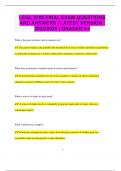
BIOL 1201 EXAM 1 - CHAPTERS 1-5
QUESTIONS AND ANSWERS 100%
CORRECT
1. Order
2. Evolutionary adaptation
3. Regulation
4. Energy processing
5. Growth & development
6. Response to the environment
7. Reproduction - ANSWER-What are the 7 characteristics of life?
** If a system is missing one of these, it is not considered living! **
first shell - 2
second shell - 8
third shell - 8 - ANSWER-How many electrons does it take to fill the first electron shell?
The second? Third?
the sum of its parts - ANSWER-As you move to higher levels of biological organization,
each new level is more than just...?
emergent property - ANSWER-properties that would not have been predictable from
merely observing an object/system
reductionism - ANSWER-reduction of a complex system to simpler components which
are more manageable for studying
ex) studying DNA helps us to understand inheritance
valence shell - ANSWER-an atom's outermost electron shell
hydrogen bond - ANSWER-occurs when a hydrogen atom that is covalently bonded to
one electronegative atom is also attracted to another electronegative atom
donor
acceptor - ANSWER-In a hydrogen bond, the covalently bonded atom is the
___________ and the attracted atom is the _____________.
Van der Waal's interactions - ANSWER-attraction between molecules that are close
together, inducing a "steric fit"
, Asymmetrically distributed electrons result in temporary "hot spots" (dipoles) of positive
and negative charge, causing attractive forces between covalently bonded molecules -
ANSWER-How do Van der Waal's interactions happen?
ecosystems
communities
organism
tissues
organelles - ANSWER-Levels of biological organization, from smallest to largest:
biosphere > __________________ > _____________________ > populations >
_________________ > organs > _______________ > cells > __________________ >
molecules
covalent bonds
valence - ANSWER-____________________ __________ are formed to "compensate"
for non-full ____________ shells
Oxygen
Carbon
Hydrogen
Nitrogen - ANSWER-What are the 4 most common elements in biology?
Calcium
Phosphorus
Potassium
Sulfur
Sodium
Chlorine
Magnesium - ANSWER-What are a few common elements in biology (outside of the
main 4)?
protons - ANSWER-All atoms of an element have the same number of
_______________.
isotopes - ANSWER-atoms of the same element that differ in their number of neutrons
(and thus also their mass)
Carbon-12
Carbon-13
Carbon-14 - ANSWER-What are the 3 common isotopes of carbon?
radioactive isotopes - ANSWER-isotopes that decay spontaneously, giving off particles
and energy
fossils
metabolic
QUESTIONS AND ANSWERS 100%
CORRECT
1. Order
2. Evolutionary adaptation
3. Regulation
4. Energy processing
5. Growth & development
6. Response to the environment
7. Reproduction - ANSWER-What are the 7 characteristics of life?
** If a system is missing one of these, it is not considered living! **
first shell - 2
second shell - 8
third shell - 8 - ANSWER-How many electrons does it take to fill the first electron shell?
The second? Third?
the sum of its parts - ANSWER-As you move to higher levels of biological organization,
each new level is more than just...?
emergent property - ANSWER-properties that would not have been predictable from
merely observing an object/system
reductionism - ANSWER-reduction of a complex system to simpler components which
are more manageable for studying
ex) studying DNA helps us to understand inheritance
valence shell - ANSWER-an atom's outermost electron shell
hydrogen bond - ANSWER-occurs when a hydrogen atom that is covalently bonded to
one electronegative atom is also attracted to another electronegative atom
donor
acceptor - ANSWER-In a hydrogen bond, the covalently bonded atom is the
___________ and the attracted atom is the _____________.
Van der Waal's interactions - ANSWER-attraction between molecules that are close
together, inducing a "steric fit"
, Asymmetrically distributed electrons result in temporary "hot spots" (dipoles) of positive
and negative charge, causing attractive forces between covalently bonded molecules -
ANSWER-How do Van der Waal's interactions happen?
ecosystems
communities
organism
tissues
organelles - ANSWER-Levels of biological organization, from smallest to largest:
biosphere > __________________ > _____________________ > populations >
_________________ > organs > _______________ > cells > __________________ >
molecules
covalent bonds
valence - ANSWER-____________________ __________ are formed to "compensate"
for non-full ____________ shells
Oxygen
Carbon
Hydrogen
Nitrogen - ANSWER-What are the 4 most common elements in biology?
Calcium
Phosphorus
Potassium
Sulfur
Sodium
Chlorine
Magnesium - ANSWER-What are a few common elements in biology (outside of the
main 4)?
protons - ANSWER-All atoms of an element have the same number of
_______________.
isotopes - ANSWER-atoms of the same element that differ in their number of neutrons
(and thus also their mass)
Carbon-12
Carbon-13
Carbon-14 - ANSWER-What are the 3 common isotopes of carbon?
radioactive isotopes - ANSWER-isotopes that decay spontaneously, giving off particles
and energy
fossils
metabolic