SANS GFACT SQL Quiz Questions
& answers 100% correct!!
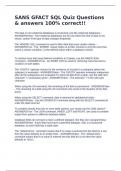
The data in non-relational databases is structured, just like relational databases. -
ANSWERSFalse - Non-relational databases are for use when the kind of data is not
known, and/or if the type of data changes frequently.
The 'WHERE' SQL command is used to filter data that meet certain criteria. -
ANSWERSTrue - The `WHERE` clause helps us to filter records to only the ones that
match a certain condition, i.e.the defined value within a database column
To retrieve rows that meet defined conditions in 2 tables, use the INNER JOIN
command - ANSWERSTrue - An INNER JOIN is used for retrieving rows that meet a
condition in both tables
The `EXISTS` operator checks for the existence of records in a subquery before the
subquery is evaluated - ANSWERSFalse - The 'EXISTS' operator evaluates subqueries
after all the subqueiries are evaluated To select all data from a table, use the wild card
character '!', exclamation point - ANSWERSFalse - The asterisks '*' is the wild card
character
When using the AS command, the renaming of the field is permanent - ANSWERSFalse
- The renaming of a field using the AS command only exists fo the duration of the SQL
query.
When using the SELECT command, data is returned in alphabetical order -
ANSWERSFalse - Use the ORDER BY command along with the SELECT command to
order the data returned
To combine results from two or more table queries, you would use the JOIN clause? -
ANSWERSTrue - The JOIN command, INNER, LEFT and RIGHT, are used to combine
output from queries to different database tables
Database fields do not have to have a defined datatype, like they do in programming -
ANSWERSFalse - Each field must have a specified datatype. SQL is a structured
database, so each field has a static type.
The `default NULL` constraint means that if no value is entered into this field for a row
then the value defaults to an empty field. - ANSWERSFalse - The `default NULL`
constraint means that if no value is entered into this field for a row then the value
defaults to `NULL`.
& answers 100% correct!!
The data in non-relational databases is structured, just like relational databases. -
ANSWERSFalse - Non-relational databases are for use when the kind of data is not
known, and/or if the type of data changes frequently.
The 'WHERE' SQL command is used to filter data that meet certain criteria. -
ANSWERSTrue - The `WHERE` clause helps us to filter records to only the ones that
match a certain condition, i.e.the defined value within a database column
To retrieve rows that meet defined conditions in 2 tables, use the INNER JOIN
command - ANSWERSTrue - An INNER JOIN is used for retrieving rows that meet a
condition in both tables
The `EXISTS` operator checks for the existence of records in a subquery before the
subquery is evaluated - ANSWERSFalse - The 'EXISTS' operator evaluates subqueries
after all the subqueiries are evaluated To select all data from a table, use the wild card
character '!', exclamation point - ANSWERSFalse - The asterisks '*' is the wild card
character
When using the AS command, the renaming of the field is permanent - ANSWERSFalse
- The renaming of a field using the AS command only exists fo the duration of the SQL
query.
When using the SELECT command, data is returned in alphabetical order -
ANSWERSFalse - Use the ORDER BY command along with the SELECT command to
order the data returned
To combine results from two or more table queries, you would use the JOIN clause? -
ANSWERSTrue - The JOIN command, INNER, LEFT and RIGHT, are used to combine
output from queries to different database tables
Database fields do not have to have a defined datatype, like they do in programming -
ANSWERSFalse - Each field must have a specified datatype. SQL is a structured
database, so each field has a static type.
The `default NULL` constraint means that if no value is entered into this field for a row
then the value defaults to an empty field. - ANSWERSFalse - The `default NULL`
constraint means that if no value is entered into this field for a row then the value
defaults to `NULL`.