TEAS ATI SCIENCE SECRET TEST PREP 1
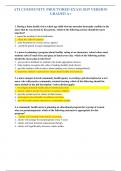
The first four steps of the scientific method are as follows:
1. identify the problem
2. analyze the results
3. develop a hypothesis
4. collect data and experiment on that data
5. - ANSWERS-analyze the results
Quantitative data is more accurate than qualitative data. T or F - ANSWERS-F
Quantitative data is collected through numerical measurements. T or F - ANSWERS-T
Qualitative data is focused on perspectives and behavior. T or F - ANSWERS-T
Qualitative data is collected through observations and interviews. T or F - ANSWERS-T
The _______________ covers the trachea during swallowing, preventing food from entering the
airway. - ANSWERS-Epiglottis
Location and function of cartilage in the body include supportive pads that provide cushion at
joints, such as between the vertebrae of the ___________________. - ANSWERS-spinal cord
Two criteria for classifying epithelial tissues are cell layers and cell ______________ - ANSWERS-
shape
, The parathyroid gland is located on the ___________ lobes of the thyroid gland, on the posterior
aspect. - ANSWERS-lateral
How many organ systems are there in the human body? - ANSWERS-11
The element or structure within the respiratory system responsible dies removing foreign matter
from the lungs - ANSWERS-Cilia
Organized from highest to lowest, what is the hierarchy of the human body's structures is as
follows: organism, organ system, organs, tissues. What comes next? - ANSWERS-Cells, molecules,
atoms
On average, how many neurons does one aim of bromine Br have? - ANSWERS-44.90
On average, how many proteins does one atom of zinc Zn have? - ANSWERS-30
Osmosis is the movement of a solution from an area of low solute concentration to an area of high
some concentration. T or F - ANSWERS-F
Diffusion is the process in the lungs by which oxygen is transported from the air to the blood. T or F
- ANSWERS-T
Gland that is responsible for the regulation of calcium levels - ANSWERS-Parathyroid gland
The large intestine reabsorbs water into the body to form solid waste. T or F - ANSWERS-T
The order of the small intestine is duodenum, _____________, then Ileum. - ANSWERS-Jejunum
The first four steps of the scientific method are as follows:
1. identify the problem
2. analyze the results
3. develop a hypothesis
4. collect data and experiment on that data
5. - ANSWERS-analyze the results
Quantitative data is more accurate than qualitative data. T or F - ANSWERS-F
Quantitative data is collected through numerical measurements. T or F - ANSWERS-T
Qualitative data is focused on perspectives and behavior. T or F - ANSWERS-T
Qualitative data is collected through observations and interviews. T or F - ANSWERS-T
The _______________ covers the trachea during swallowing, preventing food from entering the
airway. - ANSWERS-Epiglottis
Location and function of cartilage in the body include supportive pads that provide cushion at
joints, such as between the vertebrae of the ___________________. - ANSWERS-spinal cord
Two criteria for classifying epithelial tissues are cell layers and cell ______________ - ANSWERS-
shape
, The parathyroid gland is located on the ___________ lobes of the thyroid gland, on the posterior
aspect. - ANSWERS-lateral
How many organ systems are there in the human body? - ANSWERS-11
The element or structure within the respiratory system responsible dies removing foreign matter
from the lungs - ANSWERS-Cilia
Organized from highest to lowest, what is the hierarchy of the human body's structures is as
follows: organism, organ system, organs, tissues. What comes next? - ANSWERS-Cells, molecules,
atoms
On average, how many neurons does one aim of bromine Br have? - ANSWERS-44.90
On average, how many proteins does one atom of zinc Zn have? - ANSWERS-30
Osmosis is the movement of a solution from an area of low solute concentration to an area of high
some concentration. T or F - ANSWERS-F
Diffusion is the process in the lungs by which oxygen is transported from the air to the blood. T or F
- ANSWERS-T
Gland that is responsible for the regulation of calcium levels - ANSWERS-Parathyroid gland
The large intestine reabsorbs water into the body to form solid waste. T or F - ANSWERS-T
The order of the small intestine is duodenum, _____________, then Ileum. - ANSWERS-Jejunum