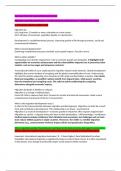
Summary from the required literature by Mel:
Migration and Global Developent. Utrecht University (2024) Niveau 3 / Bachelor gevorderd
1. Introduction Bastia, Skeldon 2020
Migration by:
UN: Long term 12 months or more, relocation to a new county
IOM: All types of movement, regardless legality or voluntariness
Development is a multidimensional process, improving quality of life through economic, social and
environmental initiatives.
What is forced displacement?
Examining resettlement processes and their socio-spatial impacts. Forced to move.
What is labor mobility?
Investigating cross-border employment, role in economic growth and inequality. It highlights both
opportunities for economic advancement and the vulnerabilities migrants face in precarious labor
markets, such as low wages and temporary contracts.
Transnational families & care: exploring how migration impact family dynamics. Global development
highlights the uneven burdens of caregiving and the global commodification of care. Underscoring
the need for policies supporting care networks in both origin and destination countries. Care chains
illustrate inequalities, as wealthier nations benefit from migrant labor, while poorer countries
bear the emotional and caregiving costs. This calls for policies addressing the caregiving
dimensions alongside economic impacts.
Migration by Bastia & Skeldon & critiques.
Migration is a change in habitual place.
Focus UN: fails to capture short-term, focused on circular and internal movements. Need a more
comprehensive framework (all forms of movements)
What is the migration-development nexus?
It refers to the interconnection between migration and development. Migration can both be a result
from and contribute to development. This relationship is not linear / asymmetrical
Migration is a result of development > economic growth in industries often requires migrant labor
Migration as a driver > migrants bring new ideas to their destinations / skill knowledge / remittances.
Positive impacts include remittances that stimulate local economies, but challenges such as brain
drain reduce skilled capacity in origin countries. Moreover, the visible vs. invisible migration
dichotomy (e.g., undocumented workers) shapes policies and perpetuates inequalities.
Why is migration positive? Remmitances contribute to the local economy and support communities.
Why is migration negative? Brain drain leads to loss of human capacity in transmitting regions
Important: International migration dominates ( 8 – 9 times higher). Rural (platteland) to urban
(stedelijk). International migration is significantly larger in scale (3 times more). It is often overlooked
in discussions, even though it profoundly shapes social systems within countries.
, Challenges in measuring development:
Human Development Index (HDI) (it is an average per country, regional inequalities are not taken
into account). Ignore economies, skills and has no environmental impact component
Post-colonial critique:
Development tools are often Eurocentric and ignore historical and geographical contexts.
Historical perspectives:
1950-1970: migration is seen as a means to tackle underdevelopment
1970-2000: skepticism about the impact of migration through inequality and dependency
2000-now: more attention to transnational connections but mixed perspectives
U shaped association between development and emigration:
Migration rates are increasing because people have more resources to migrate (more capabilities
and aspirations). Only at higher income levels does emigration decrease.
Skilled migration, diaspora in policy, remittances are important BUT policies centered on these areas
risk oversimplifying. Bastia & Skeldon wanted a more broader perspective, includes less visible
migration.
Migration often benefits higher-income countires more than lower-income ones. Migrants labor can
boost productively. They advocate for a more nuanced understanding of how migration links places
to origin, transit etc.
2. Critical perspectives (Raghuram, 2009)
Migration and development are framed in oversimplified ways (often emphasizing economic
remittances, while neglecting broader-political dynamics and inequalities.
Migration and development often reinforce state-centric and Eurocentric power structures, framing
the global South as dependent on Northern interventions.
Official narratives highlight economic contributions (remittances, diaspora programs), while
marginalizing forms like undocumented migration.
How does migration contributes to development in both origin and destination countries?
Through financial remittances, skills transfers etc. Migration development nexus often OVERLOOKS
inequalities, marginalizes undocumented migrants and reinforces Eurocentric paradigms.
Visible migration: includes forms like remittances and diaspora led development (align with state-
driven economic goals).
Invisible migration: undocumented workers = often excluded from policy frameworks.
This dichotomy limits holistic policy development, privileging measurable economic outputs over
less tangible social and cultural contributions.
Brain drains refers to the emigration of skilled professionals from low-middle income countries to
wealthier regions, leading to talent loss in origin countries. Reinforces dependency, inequality.
State-centric and Eurocentric frameworks marginalize undocumented migrants and perpetuate
structural dependencies, limiting the scope of holistic migration policies.
Migration and Global Developent. Utrecht University (2024) Niveau 3 / Bachelor gevorderd
1. Introduction Bastia, Skeldon 2020
Migration by:
UN: Long term 12 months or more, relocation to a new county
IOM: All types of movement, regardless legality or voluntariness
Development is a multidimensional process, improving quality of life through economic, social and
environmental initiatives.
What is forced displacement?
Examining resettlement processes and their socio-spatial impacts. Forced to move.
What is labor mobility?
Investigating cross-border employment, role in economic growth and inequality. It highlights both
opportunities for economic advancement and the vulnerabilities migrants face in precarious labor
markets, such as low wages and temporary contracts.
Transnational families & care: exploring how migration impact family dynamics. Global development
highlights the uneven burdens of caregiving and the global commodification of care. Underscoring
the need for policies supporting care networks in both origin and destination countries. Care chains
illustrate inequalities, as wealthier nations benefit from migrant labor, while poorer countries
bear the emotional and caregiving costs. This calls for policies addressing the caregiving
dimensions alongside economic impacts.
Migration by Bastia & Skeldon & critiques.
Migration is a change in habitual place.
Focus UN: fails to capture short-term, focused on circular and internal movements. Need a more
comprehensive framework (all forms of movements)
What is the migration-development nexus?
It refers to the interconnection between migration and development. Migration can both be a result
from and contribute to development. This relationship is not linear / asymmetrical
Migration is a result of development > economic growth in industries often requires migrant labor
Migration as a driver > migrants bring new ideas to their destinations / skill knowledge / remittances.
Positive impacts include remittances that stimulate local economies, but challenges such as brain
drain reduce skilled capacity in origin countries. Moreover, the visible vs. invisible migration
dichotomy (e.g., undocumented workers) shapes policies and perpetuates inequalities.
Why is migration positive? Remmitances contribute to the local economy and support communities.
Why is migration negative? Brain drain leads to loss of human capacity in transmitting regions
Important: International migration dominates ( 8 – 9 times higher). Rural (platteland) to urban
(stedelijk). International migration is significantly larger in scale (3 times more). It is often overlooked
in discussions, even though it profoundly shapes social systems within countries.
, Challenges in measuring development:
Human Development Index (HDI) (it is an average per country, regional inequalities are not taken
into account). Ignore economies, skills and has no environmental impact component
Post-colonial critique:
Development tools are often Eurocentric and ignore historical and geographical contexts.
Historical perspectives:
1950-1970: migration is seen as a means to tackle underdevelopment
1970-2000: skepticism about the impact of migration through inequality and dependency
2000-now: more attention to transnational connections but mixed perspectives
U shaped association between development and emigration:
Migration rates are increasing because people have more resources to migrate (more capabilities
and aspirations). Only at higher income levels does emigration decrease.
Skilled migration, diaspora in policy, remittances are important BUT policies centered on these areas
risk oversimplifying. Bastia & Skeldon wanted a more broader perspective, includes less visible
migration.
Migration often benefits higher-income countires more than lower-income ones. Migrants labor can
boost productively. They advocate for a more nuanced understanding of how migration links places
to origin, transit etc.
2. Critical perspectives (Raghuram, 2009)
Migration and development are framed in oversimplified ways (often emphasizing economic
remittances, while neglecting broader-political dynamics and inequalities.
Migration and development often reinforce state-centric and Eurocentric power structures, framing
the global South as dependent on Northern interventions.
Official narratives highlight economic contributions (remittances, diaspora programs), while
marginalizing forms like undocumented migration.
How does migration contributes to development in both origin and destination countries?
Through financial remittances, skills transfers etc. Migration development nexus often OVERLOOKS
inequalities, marginalizes undocumented migrants and reinforces Eurocentric paradigms.
Visible migration: includes forms like remittances and diaspora led development (align with state-
driven economic goals).
Invisible migration: undocumented workers = often excluded from policy frameworks.
This dichotomy limits holistic policy development, privileging measurable economic outputs over
less tangible social and cultural contributions.
Brain drains refers to the emigration of skilled professionals from low-middle income countries to
wealthier regions, leading to talent loss in origin countries. Reinforces dependency, inequality.
State-centric and Eurocentric frameworks marginalize undocumented migrants and perpetuate
structural dependencies, limiting the scope of holistic migration policies.