Valley Climates
The microclimate of valleys
Microclimate means the climate of a small area.
Temperature differences in valleys
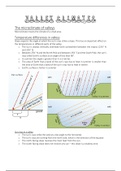
Slope aspectis the angle at which the sun’s rays strike a slope. This has an important effect on
the temperatures in different parts of the valley.
o The sun is always vertically overhead Earth somewhere between the tropics (23½° N
and 23½° S)
o Between 23½° N and the North Pole and between 23½° S and the South Pole, the sun’s
rays strike Earth’s surface at an angle of less than 90°.
o In summer the angle is greater than it is in winter.
o The area of Earth that a band of the sun’s rays has to heat in summer is smaller than
the area of Earth that a band of the sun’s rays has to heat in winter.
o Earth’s surface is hotter in summer
Flat surface
Valley in summer
Valley in winter
Sun rays in a valley
o The sun’s rays strike the land at a low angle to the horizontal.
o The sun’s rays are coming from the north side, which is the direction of the equator.
o The north-facing slope receives the most heat from the sun.
o The south-facing slope does not receive any sun – this slope is a shadow zone.
The microclimate of valleys
Microclimate means the climate of a small area.
Temperature differences in valleys
Slope aspectis the angle at which the sun’s rays strike a slope. This has an important effect on
the temperatures in different parts of the valley.
o The sun is always vertically overhead Earth somewhere between the tropics (23½° N
and 23½° S)
o Between 23½° N and the North Pole and between 23½° S and the South Pole, the sun’s
rays strike Earth’s surface at an angle of less than 90°.
o In summer the angle is greater than it is in winter.
o The area of Earth that a band of the sun’s rays has to heat in summer is smaller than
the area of Earth that a band of the sun’s rays has to heat in winter.
o Earth’s surface is hotter in summer
Flat surface
Valley in summer
Valley in winter
Sun rays in a valley
o The sun’s rays strike the land at a low angle to the horizontal.
o The sun’s rays are coming from the north side, which is the direction of the equator.
o The north-facing slope receives the most heat from the sun.
o The south-facing slope does not receive any sun – this slope is a shadow zone.