Introduction to Research Methodology
Chapter 1 – Psychology is a way of thinking
Empiricism involves using evidence from the senses or from instruments that assist the senses as the
basis for the conclusions, empiricists aim to be systematic and rigorous in their work
Psychologists are empiricists – they base their conclusions on systematic, unbiased observations of the
world and psychological science is based on research conducted by them
Consumers and producers of research those who apply research later on to their work (consumers)
and those who produce it (administer)
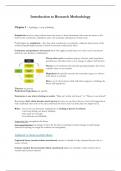
Theory-data cycle researchers propose theories, make hypothesis
(predictions) and collect data to test, change or update their theories
Theory set of statements that describe general principles about how
variables relate to one another
Hypothesis the specific outcome the researcher expects to observe
if the theory is accurate
Data a set of observations which will either support or challenge the
theory and hypotheses
Theories are general
Predictions/hypotheses are specific
Statements to use when referring to results: “Data isn’t in line with theory” or “Theory is not refuted”
Researchers don’t claim theories aren’t proven but they can say that a theory is/isn’t well supported or
well established (thus most of the data confirmed the theory and very little data have disproven it)
Rules: - Never rule out alternative explanations as nothing is proven or refused
. - Can’t keep fixing your theory infinitely
. - One study isn’t enough
. - Good theories are falsifiable
Supporting data strengthens the theory
Non supporting data encourages revision for the theory and improvement/change research design
(instead of rejecting we weigh the evidence for and against)
Cupboard vs Contact-comfort theory
Cupboard theory (mother-infant attachment) mother is valuable to baby mammal because she is a
source of food
Contact-comfort theory (mother-infant attachment) babies are attached to their mothers due to
warmth and fuzziness emitted
, Harlow studied it and found that: the contact-comfort theory was proven
Falsifiability (Prediction)
Features of good scientific theories: • Supported by data
• Are falsifiable (HAS TO BE)
• Have parsimony
• Specific wording
Falsifiability theory must lead to a hypothesis that could actually fail to support the theory (data only
useful if it tells us if the theory is correct or not)
Parsimony if 2 theories explain the data equally well but one is simpler, most scientists will opt for the
simpler more parsimonious theory
Falsifiable if: it’s possible to make observations that ARENT in line with the prediction
Irrefutable/unfalsifiable theories always have excuses as to why it can still exist and be proved correct
and are often questionable as a result (eg. holistic medicine, pseudoscience)
Types of researchers/research
Applied research addresses real-world problems, targets a practical
Basic research goal to enhance the general body of knowledge, without regard for direct application to
practical problems
Translational research uses knowledge derived from basic research to develop and test solutions to real-
world problems
Scientists strive to follow the 4 norms (shared expectations about how they should act) of the
scientific community (Merton's norms):
• Universalism - scientific claims are evaluated according to their merit, independent of the
researcher’s credentials or reputation. The same preestablished criteria apply
to all scientists and all research (anyone can do science)
• Communality - scientific knowledge is created by a community, and its findings belong to
the community (share results)
• Disinterestedness - scientists strive to discover the truth whatever it is; they are not swayed by
conviction, idealism, politics, or profit (no spinning the story)
• Organised scepticism - scientists question everything, including their own theories, widely
accepted ideas, and “ancient wisdom” (always ask questions)
Chapter 1 – Psychology is a way of thinking
Empiricism involves using evidence from the senses or from instruments that assist the senses as the
basis for the conclusions, empiricists aim to be systematic and rigorous in their work
Psychologists are empiricists – they base their conclusions on systematic, unbiased observations of the
world and psychological science is based on research conducted by them
Consumers and producers of research those who apply research later on to their work (consumers)
and those who produce it (administer)
Theory-data cycle researchers propose theories, make hypothesis
(predictions) and collect data to test, change or update their theories
Theory set of statements that describe general principles about how
variables relate to one another
Hypothesis the specific outcome the researcher expects to observe
if the theory is accurate
Data a set of observations which will either support or challenge the
theory and hypotheses
Theories are general
Predictions/hypotheses are specific
Statements to use when referring to results: “Data isn’t in line with theory” or “Theory is not refuted”
Researchers don’t claim theories aren’t proven but they can say that a theory is/isn’t well supported or
well established (thus most of the data confirmed the theory and very little data have disproven it)
Rules: - Never rule out alternative explanations as nothing is proven or refused
. - Can’t keep fixing your theory infinitely
. - One study isn’t enough
. - Good theories are falsifiable
Supporting data strengthens the theory
Non supporting data encourages revision for the theory and improvement/change research design
(instead of rejecting we weigh the evidence for and against)
Cupboard vs Contact-comfort theory
Cupboard theory (mother-infant attachment) mother is valuable to baby mammal because she is a
source of food
Contact-comfort theory (mother-infant attachment) babies are attached to their mothers due to
warmth and fuzziness emitted
, Harlow studied it and found that: the contact-comfort theory was proven
Falsifiability (Prediction)
Features of good scientific theories: • Supported by data
• Are falsifiable (HAS TO BE)
• Have parsimony
• Specific wording
Falsifiability theory must lead to a hypothesis that could actually fail to support the theory (data only
useful if it tells us if the theory is correct or not)
Parsimony if 2 theories explain the data equally well but one is simpler, most scientists will opt for the
simpler more parsimonious theory
Falsifiable if: it’s possible to make observations that ARENT in line with the prediction
Irrefutable/unfalsifiable theories always have excuses as to why it can still exist and be proved correct
and are often questionable as a result (eg. holistic medicine, pseudoscience)
Types of researchers/research
Applied research addresses real-world problems, targets a practical
Basic research goal to enhance the general body of knowledge, without regard for direct application to
practical problems
Translational research uses knowledge derived from basic research to develop and test solutions to real-
world problems
Scientists strive to follow the 4 norms (shared expectations about how they should act) of the
scientific community (Merton's norms):
• Universalism - scientific claims are evaluated according to their merit, independent of the
researcher’s credentials or reputation. The same preestablished criteria apply
to all scientists and all research (anyone can do science)
• Communality - scientific knowledge is created by a community, and its findings belong to
the community (share results)
• Disinterestedness - scientists strive to discover the truth whatever it is; they are not swayed by
conviction, idealism, politics, or profit (no spinning the story)
• Organised scepticism - scientists question everything, including their own theories, widely
accepted ideas, and “ancient wisdom” (always ask questions)