100% tevredenheidsgarantie Direct beschikbaar na je betaling Lees online óf als PDF Geen vaste maandelijkse kosten 4.2 TrustPilot
logo-home
Tentamen (uitwerkingen)

NGN Burns EAQ Case Study Already Graded A+

Beoordeling
-
Verkocht
-
Pagina's
10
Cijfer
A+
Geüpload op
21-11-2024
Geschreven in
2024/2025

NGN Burns EAQ Case Study Already Graded A+ Burns - Patient 1 H&P Denies cardiac history. States excellent health. ️️NURSES' NOTES 1800: Received 59-year-old client via ambulance to the emergency department secondary to lightning strike. Client is alert and oriented to time, place, and person; reports, "I was struck by lightning while fishing and guess I passed out." Family member reports client passed out after the lightning strike but woke up when shaken vigorously. Wounds loosely covered with sterile dressings. 1805: Blood pressure 189/108 mm HG; heart rate of 89 beats per minute, atrial fibrillation per cardiac monitor since initial assessment by emergency medical technicians; respirations of 26 breaths per minute, unlabored; oxygen saturation is 100% on 2 L per minute via nasal cannula; lung fields clear bilaterally, unlabored. Intravenous fluids: Lactated Ringers infusing via 18 g intravascular catheter in left antecubital at 150 mL/h. Bilateral second-degree wounds to client hands; shoes destroyed and third-degree burns to bilateral feet. 1810: Urinary catheter inserted; returned 450 mL clear, straw-colored urine. 1820: Specimen to laboratory. The nurse reviews the clinical data in the electronic health record to help formulate a plan of care for this patient. Complete the diagram by dragging from the choices below to specify which potential condition the client is most likely experiencing, two actions the nurse should take to address that condition, and two parameters the nurse should monitor to assess the client's progress. POTENTIAL CONDITIONS Ineffective tissue perfusion Hypothermia Acute pain Insufficient airway clearance ACTIONS TO TAKE Obtain an electrocardiogram (ECG) Increase oxygen to 100% via nasal cannula Initiate seizure precautions Insert an indwelling urinary catheter Implement the Parkland burn formula PARAMETERS TO MONITOR Pulse oximetry Pain level and level of consciousness (LOC) Cardiac telemetry Arterial blood gases (ABGs) Hourly intake and output ️️POTENTIAL CONDITIONS Ineffective tissue perfusion ACTIONS TO TAKE Obtain an electrocardiogram (ECG) Insert an indwelling urinary catheter PARAMETERS TO MONITOR Cardiac telemetry Hourly intake and output Rationale: Potential Conditions: Ineffective tissue perfusion. The body conducts electrical currents throughout the body, resulting in profound alteration in cardiac arrhythmias, acid-base balance, and rhabdomyolysis. The client's third-degree wounds involve a limited percentage of surface area, which limits hypothermia secondary to tissues weeping fluids. The burns do not involve areas close to the respiratory system. Third-degree burns do not cause pain, but second-degree burns do generate acute pain. Acute pain is not the highest priority now. Take Action: One priority is the need to obtain to obtain a baseline ECG to determine the effects of high voltage to the cardiac muscle and identify the potential source of atrial fibrillation. Another priority action is insertion of an indwelling urinary catheter to monitor fluid resuscitation and to obtain baseline specimen to monitor development of myoglobin in urine. Electrical burns require a modified fluid resuscitation during the first 24 hours and the Parkland formula during the second 24 hours. Clinical evidence does not support an inhalation injury of oxygen as a priority now. The potential for seizures may develop later due to acid-base imbalances but IV fluid contains electrolytes. Parameters to Monitor: Priority monitoring includes cardiac telemetry for life-threatening arrhythmias and hourly intake and output for fluid resuscitation. Pulse oximetry, pain, and ABGs are important but are not the priority related to tissue perfusion. LOC relates to cerebral tissue perfusion; it is monitored but not in relation to pain in this patient. Burns - Patient 2 H&P Paramedic Report 0800: A 35-year-old adult called 911 after receiving thermal burns. Client states canning vegetables and beginning to release the steam when the pot exploded. 0820: Paramedics responded to client's home. Large skin blisters noted on anterior chest, bilateral arms, neck, and face. Glass and food debris noted on burned areas, clothes, and hair. Client oriented x3, crying, shaking from pain. Reports pain 10/10 on a 0 to 10 pain intensity scale. See other side for rest ️️0830: Vital Signs: blood pressure (BP) 190/110 mmHg, heart rate 100 bpm, temperature 98° F (36.6° C), respirations 28 breaths per minute, oxygen saturation 95% and placed on 2 L oxygen via nasal canula, nonproductive coughing noted. 0835: Paramedics initiate intravenous (IV) fluids of lactated Ringers (LR) via 18 g IV catheter at 150 mL/h. Treated client's pain with 4 mg morphine. Removed wet kitchen cloths from client's arms. Replaced with sterile, dry 4 x 4s.

Meer zien Lees minder
Instelling
NGN Burns EAQ Case Study Already Graded A+
Vak
NGN Burns EAQ Case Study Already Graded A+


Oeps! We kunnen je document nu niet laden. Probeer het nog eens of neem contact op met support.

Geschreven voor

Instelling
NGN Burns EAQ Case Study Already Graded A+
Vak
NGN Burns EAQ Case Study Already Graded A+

Documentinformatie

Geüpload op
21 november 2024
Aantal pagina's
10
Geschreven in
2024/2025
Type
Tentamen (uitwerkingen)
Bevat
Vragen en antwoorden

Onderwerpen

Voorbeeld van de inhoud

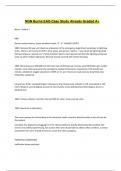
NGN Burns EAQ Case Study Already Graded A+

Burns - Patient 1


H&P

Denies cardiac history. States excellent health. ✔️✔️NURSES' NOTES

1800: Received 59-year-old client via ambulance to the emergency department secondary to lightning
strike. Client is alert and oriented to time, place, and person; reports, "I was struck by lightning while
fishing and guess I passed out." Family member reports client passed out after the lightning strike but
woke up when shaken vigorously. Wounds loosely covered with sterile dressings.


1805: Blood pressure 189/108 mm HG; heart rate of 89 beats per minute, atrial fibrillation per cardiac
monitor since initial assessment by emergency medical technicians; respirations of 26 breaths per
minute, unlabored; oxygen saturation is 100% on 2 L per minute via nasal cannula; lung fields clear
bilaterally, unlabored.


Intravenous fluids: Lactated Ringers infusing via 18 g intravascular catheter in left antecubital at 150
mL/h. Bilateral second-degree wounds to client hands; shoes destroyed and third-degree burns to
bilateral feet.


1810: Urinary catheter inserted; returned 450 mL clear, straw-colored urine.


1820: Specimen to laboratory.


The nurse reviews the clinical data in the electronic health record to help formulate a plan of care for
this patient.

Complete the diagram by dragging from the choices below to specify which potential condition the
client is most likely experiencing, two actions the nurse should take to address that condition, and two
parameters the nurse should monitor to assess the client's progress.


POTENTIAL CONDITIONS

Ineffective tissue perfusion

, Hypothermia

Acute pain

Insufficient airway clearance


ACTIONS TO TAKE

Obtain an electrocardiogram (ECG)

Increase oxygen to 100% via nasal cannula

Initiate seizure precautions

Insert an indwelling urinary catheter

Implement the Parkland burn formula


PARAMETERS TO MONITOR

Pulse oximetry

Pain level and level of consciousness (LOC)

Cardiac telemetry

Arterial blood gases (ABGs)

Hourly intake and output ✔️✔️POTENTIAL CONDITIONS

Ineffective tissue perfusion


ACTIONS TO TAKE

Obtain an electrocardiogram (ECG)


Insert an indwelling urinary catheter


PARAMETERS TO MONITOR

Cardiac telemetry


Hourly intake and output
€8,32
Krijg toegang tot het volledige document:

100% tevredenheidsgarantie
Direct beschikbaar na je betaling
Lees online óf als PDF
Geen vaste maandelijkse kosten


Ook beschikbaar in voordeelbundel

Maak kennis met de verkoper

Seller avatar
De reputatie van een verkoper is gebaseerd op het aantal documenten dat iemand tegen betaling verkocht heeft en de beoordelingen die voor die items ontvangen zijn. Er zijn drie niveau’s te onderscheiden: brons, zilver en goud. Hoe beter de reputatie, hoe meer de kwaliteit van zijn of haar werk te vertrouwen is.
CertifiedGrades Chamberlain College Of Nursing
Volgen Je moet ingelogd zijn om studenten of vakken te kunnen volgen
Verkocht
141
Lid sinds
2 jaar
Aantal volgers
61
Documenten
8748
Laatst verkocht
1 maand geleden
High Scores

Hi there! Welcome to my online tutoring store, your ultimate destination for A+ rated educational resources! My meticulously curated collection of documents is designed to support your learning journey. Each resource has been carefully revised and verified to ensure top-notch quality, empowering you to excel academically. Feel free to reach out to consult with me on any subject matter—I'm here to help you thrive!

3,9

38 beoordelingen

5
21
4
6
3
2
2
3
1
6

Recent door jou bekeken

Waarom studenten kiezen voor Stuvia

Gemaakt door medestudenten, geverifieerd door reviews

Kwaliteit die je kunt vertrouwen: geschreven door studenten die slaagden en beoordeeld door anderen die dit document gebruikten.

Niet tevreden? Kies een ander document

Geen zorgen! Je kunt voor hetzelfde geld direct een ander document kiezen dat beter past bij wat je zoekt.

Betaal zoals je wilt, start meteen met leren

Geen abonnement, geen verplichtingen. Betaal zoals je gewend bent via iDeal of creditcard en download je PDF-document meteen.

Student with book image

“Gekocht, gedownload en geslaagd. Zo makkelijk kan het dus zijn.”

Alisha Student

Veelgestelde vragen