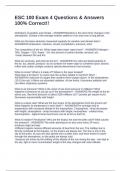
ESC 100 Exam 4 Questions & Answers
100% Correct!!
Definitions of weather and climate - ANSWERSWeather is the short term changes in the
atmosphere. Climate is the average weather patterns of an area over a long period.
What are the basic elements measured regularly for weather and climate data? -
ANSWERSTemperature, moisture, clouds, precipitation, pressure, wind
The composition of dry air. What range does water vapor have? - ANSWERS-Nitrogen -
78%, Oxygen - 21%, Argon - 1%, tiny amount of carbon dioxide, aerosols, etc.
-Varies between 0% and 4%
What are aerosols, and what do the do? - ANSWERSTiny solid and liquid particles in
the air; act, absorb, produce: act as surfaces for water vapor to condense upon; absorb,
reflect and scatter sunlight; produce optical phenomenon (red sunsets)
What is ozone? What is it made of? Where is the layer located?
What does it do there? Is ozone near the surface helpful or harmful? Why? -
ANSWERSA molecule of oxygen that contains three oxygen atoms. In the stratosphere
(10-15 km up). It filters out ultraviolet radiation. At low levels, it becomes pollution and
can affect respiratory systems.
What is air pressure? What is the value of sea level pressure in millibars? What
happens to pressure as you go up in the atmosphere? - ANSWERSThe weight of the air
above you. Sea level pressure is about 1000 millibars (14.7 pounds per square inch).
Decreases exponentially with height.
What is a lapse rate? What are the four layers of the atmosphere from the ground up?
What happens to temperature in each layer? - ANSWERSThe average drop in
temperature with increased altitude in the troposphere. Troposphere - temp decreases
with height; stratosphere - temp increases with height; mesosphere - coldest temp;
thermosphere - highest temp found here, but air to thin to feel hot.
What is rotation? Revolution? Why are the tropics hot and the poles cold? What causes
the seasons? - ANSWERS-The earth spinning on its axis once every 24 hours,
produces night and day.
-Different regions receive different amounts of heat from the sun; The midday Sun is
directly overhead at the Equator, so the tropics are always hot. The Sun is low in the
sky at the poles. Its rays are also spread over a wider area, and have further to travel
through the atmosphere, so the poles are always cold.
-Seasons are driven by the shifting of the altitude of the sun during the day - sun high in
the sky, light is more concentrated; length of the day changes with solar altitude.
, What is the difference between heat and temperature? - ANSWERSHeat: A form of
energy arising from the random motion of the molecules of bodies, which may be
transferred by conduction, convection, or radiation.
Temperature: The degree of hotness or coldness of a body or environment.
What are the three means of heat transfer? Know an example of each. -
ANSWERSRadiation: The transfer of energy through empty space.
Conduction: Heat is transferred by direct contact of particles of matter.
Convection: The movement of fluid, caused by differences in temperature and density
that transfers heat from one part of the fluid to the other.
Know the colors and the various forms of electromagnetic radiation in order from
longest to shortest wavelengths. - ANSWERSThe electromagnetic spectrum includes,
from longest wavelength to shortest: radio waves, microwaves, infrared, optical,
ultraviolet, X-rays, and gamma-rays.
Know the four basic laws governing radiation - ANSWERS1. All objects, at any
temperature, emit radiant energy
2. Hotter objects emit more total energy per unit area than objects too
3. The hottest radiating bodies produce the shortest wavelengths of maximum radiation
4. Objects that are good absorbers of radiation are good emitters as well
How much solar radiation that reaches the top of the atmosphere actually reaches all
the way to the ground? How much is lost back to space? - ANSWERSOf the 100% of
solar radiation arriving at the top of the atmosphere, 30% is reflected back to space; the
earth's surface emits an amount of long wave IR directly to space amounting to 6%; and
air (greenhouse gases in particular) and clouds emit a total of 36% and 28%
(respectively) to space.
What is albedo? Know the value of the planetary albedo. - ANSWERSAlbedo is a
measurement of the amount of light reflected from the surface of a celestial object.
The value: 30%
What is the greenhouse effect? Is that a good name for it? Is it a bad thing? -
ANSWERSIt's necessary for life it keeps our climate warm. Callendar effect. It's bad
when there are to many greenhouse gasses and the cclc climate gets warmer.
How is the atmosphere heated? What controls temperature to vary from place to place?
How does water versus land heat up and cool down? - ANSWERS-Short wavelengths
of light (high energy) passes through the atmosphere without being absorbed by gases.
As a result, the gasses in the atmosphere don't warm up directly from the sun's energy.
The earth, however, does absorb the sun's energy and gets warmer. The ground
releases it's heat and sends it back out into the atmosphere.
-The most important factor is a location's latitude, which is the angular distance,
expressed in degrees and minutes, north or south of the equator.
100% Correct!!
Definitions of weather and climate - ANSWERSWeather is the short term changes in the
atmosphere. Climate is the average weather patterns of an area over a long period.
What are the basic elements measured regularly for weather and climate data? -
ANSWERSTemperature, moisture, clouds, precipitation, pressure, wind
The composition of dry air. What range does water vapor have? - ANSWERS-Nitrogen -
78%, Oxygen - 21%, Argon - 1%, tiny amount of carbon dioxide, aerosols, etc.
-Varies between 0% and 4%
What are aerosols, and what do the do? - ANSWERSTiny solid and liquid particles in
the air; act, absorb, produce: act as surfaces for water vapor to condense upon; absorb,
reflect and scatter sunlight; produce optical phenomenon (red sunsets)
What is ozone? What is it made of? Where is the layer located?
What does it do there? Is ozone near the surface helpful or harmful? Why? -
ANSWERSA molecule of oxygen that contains three oxygen atoms. In the stratosphere
(10-15 km up). It filters out ultraviolet radiation. At low levels, it becomes pollution and
can affect respiratory systems.
What is air pressure? What is the value of sea level pressure in millibars? What
happens to pressure as you go up in the atmosphere? - ANSWERSThe weight of the air
above you. Sea level pressure is about 1000 millibars (14.7 pounds per square inch).
Decreases exponentially with height.
What is a lapse rate? What are the four layers of the atmosphere from the ground up?
What happens to temperature in each layer? - ANSWERSThe average drop in
temperature with increased altitude in the troposphere. Troposphere - temp decreases
with height; stratosphere - temp increases with height; mesosphere - coldest temp;
thermosphere - highest temp found here, but air to thin to feel hot.
What is rotation? Revolution? Why are the tropics hot and the poles cold? What causes
the seasons? - ANSWERS-The earth spinning on its axis once every 24 hours,
produces night and day.
-Different regions receive different amounts of heat from the sun; The midday Sun is
directly overhead at the Equator, so the tropics are always hot. The Sun is low in the
sky at the poles. Its rays are also spread over a wider area, and have further to travel
through the atmosphere, so the poles are always cold.
-Seasons are driven by the shifting of the altitude of the sun during the day - sun high in
the sky, light is more concentrated; length of the day changes with solar altitude.
, What is the difference between heat and temperature? - ANSWERSHeat: A form of
energy arising from the random motion of the molecules of bodies, which may be
transferred by conduction, convection, or radiation.
Temperature: The degree of hotness or coldness of a body or environment.
What are the three means of heat transfer? Know an example of each. -
ANSWERSRadiation: The transfer of energy through empty space.
Conduction: Heat is transferred by direct contact of particles of matter.
Convection: The movement of fluid, caused by differences in temperature and density
that transfers heat from one part of the fluid to the other.
Know the colors and the various forms of electromagnetic radiation in order from
longest to shortest wavelengths. - ANSWERSThe electromagnetic spectrum includes,
from longest wavelength to shortest: radio waves, microwaves, infrared, optical,
ultraviolet, X-rays, and gamma-rays.
Know the four basic laws governing radiation - ANSWERS1. All objects, at any
temperature, emit radiant energy
2. Hotter objects emit more total energy per unit area than objects too
3. The hottest radiating bodies produce the shortest wavelengths of maximum radiation
4. Objects that are good absorbers of radiation are good emitters as well
How much solar radiation that reaches the top of the atmosphere actually reaches all
the way to the ground? How much is lost back to space? - ANSWERSOf the 100% of
solar radiation arriving at the top of the atmosphere, 30% is reflected back to space; the
earth's surface emits an amount of long wave IR directly to space amounting to 6%; and
air (greenhouse gases in particular) and clouds emit a total of 36% and 28%
(respectively) to space.
What is albedo? Know the value of the planetary albedo. - ANSWERSAlbedo is a
measurement of the amount of light reflected from the surface of a celestial object.
The value: 30%
What is the greenhouse effect? Is that a good name for it? Is it a bad thing? -
ANSWERSIt's necessary for life it keeps our climate warm. Callendar effect. It's bad
when there are to many greenhouse gasses and the cclc climate gets warmer.
How is the atmosphere heated? What controls temperature to vary from place to place?
How does water versus land heat up and cool down? - ANSWERS-Short wavelengths
of light (high energy) passes through the atmosphere without being absorbed by gases.
As a result, the gasses in the atmosphere don't warm up directly from the sun's energy.
The earth, however, does absorb the sun's energy and gets warmer. The ground
releases it's heat and sends it back out into the atmosphere.
-The most important factor is a location's latitude, which is the angular distance,
expressed in degrees and minutes, north or south of the equator.