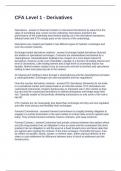
CFA Level 1 - Derivatives
Derivatives - answer A financial contract or instrument that derives its value from the
value of something else, known as the underlying. Derivatives transform the
performance of the underlying asset before paying out in the derivatives transaction.
(Mutual funds and ETFs simply pass on the returns of the underlying).
Derivatives are created and traded in two different types of markets: exchanges and
over-the-counter markets.
Exchange-traded derivatives markets - answer Exchange-traded derivatives (futures)
are traded on specialized exchanges. Contracts are standardized and backed by a
clearinghouse. Standardization facilitates the creation of a more liquid market for
derivatives, however at the cost of flexibility. Liquidity is a function of trading interest and
level of uncertainty. Little trading interest and a high level of uncertainty lead to low
liquidity. Market-makers (ready to buy at once price and sell at another) and speculators
(willing to take risks) play big role in this market.
All clearing and settling is done through a clearinghouse and the clearinghouse provides
a credit guarantee. Exchanges are also transparent and has regulations.
Over-the-counter derivatives markets - answerOTC derivatives (forwards) do not trade
in a centralized market and instead trade in an informal market. OTC derivatives are
customized instruments. Dealers (banks) play an important role in this market as they
buy and sell the customized derivatives to market participants and hedge away their
risk. Typically unable to find perfectly offsetting transactions so only some of the risk is
laid off.
OTC markets are not necessarily less liquid than exchanges but they are less regulated
and offer more privacy and flexibility than exchanges.
Forward Commitment - answerA forward commitment is a legally binding obligation to
engage in a certain transaction in the spot market at a future date at terms agreed upon
today. They include forward contracts, futures contracts, and swap contracts.
Forward Contract - answerCustomized and private contracts between two parties where
one (the long position) has an obligation to buy an asset and the counterpart (the short
position) has an obligation to sell the asset at a fixed forward price and future date that
are agreed upon signing the contract. If the price increases, it benefits the buyer. Can
be written on equities, bonds, assets, or interest rates. Either physical delivery of the
share or cash settlement for difference between price of stock at settlement and the
forward price.
,There is a default risk associated with forward contracts.
Forward Contract valuing - answer-Forward price (F) is determined at contract initiation
and does not change over the term of the contract. F(0,T).
-Value (V) of the forward contract changes over the term of the contract as the price of
the underlying changes V(0,T).
-Spot price (S) of the underlying asset also changes over the term of the contract S₀.
Vt(0,T) = S(t) - F(0,T)
Payoff - Long position
S(T) > F(0,T) => S(t) - F(0,T) => positive payoff
S(T) < F(0,T) => S(t) - F(0,T) => negative payoff
Payoff - Short position
S(T) > F(0,T) => -[S(t) - F(0,T)] => negative payoff
S(T) < F(0,T) => -[S(t) - F(0,T)] => positive payoff
Cash and carry arbitrage => borrow at risk free rate and sell the forward, purchase the
underlying
Reverse cash and carry arbitrage => short the underlying and invest proceeds at risk
free, buy the forward
-The forward price at initiation is the unique price that yields zero value to the long and
short position - no-arbitrage forward price:
V(0,T) = S₀ - [F(0,T)/(1+r)^T] = 0
S₀ = [F(0,T)/(1+r)^T]
If there are costs θ and benefits γ incurred:
F[0,T] = (S₀ - γ - θ)(1+r)^t = S₀(1+r)^t - (γ - θ)(1+r)^t
1. Because neither the long nor the short pays anything to the other at initiation of a
forward contract, the value is 0 at initiation.
2. The forward price is the spot price compounded at the risk-free rate over the life of
the contract.
3. The forward price of an asset with benefits (costs) is the spot price compounded at
the risk-free rate over the life of the contract minus (plus) the future value of those
benefits (costs).
Value - Long position
initiation = 0
during the life of the contract = S(t) - F(0,T)/(1+r)^(T-t)
at expiration = S(t) - F(0,T)
Value - short position
initiation = 0
during the life of the contract = F(0,T)/(1+r)^(T-t) - S(t)
at expiration = F(0,T) - S(t)
, Forward Rate Agreement (FRA) - answerIs a forward contract where the underlying is
an interest rate (usually a LIBOR). If LIBOR at expiration is greater than the FRA rate,
the long benefits by access to a loan at lower-than-market rates, while the short has to
give out a loan at lower rates. If LIBOR at expiration is lower than the FRA rate, the
short benefits by investing funds at a higher-than-market interest rate.
The FRA is just a forward rate derived from the term structure of interest rates (spot
rates), even though the underlying is not an asset.
Futures Contract - answerStandardized derivative contracts where one party, the buyer,
will purchase an underlying asset from the other party, the seller, at a later date at a
price agreed upon at contract initiation. For futures contracts, there is a daily settlement
of gains and losses and the futures exchange (through its clearinghouse) provides a
credit guarantee. Clearinghouses guarantee that participants on the exchange will meet
their obligations.
Swaps - answerA swap is an OTC derivative contract in which two parties agree to
exchange a series of cash flows whereby one party pays a variable series that will be
determined by an underlying asset or rate, and the counterpart pays either 1) a variable
series determined by a different underlying asset or rate or 2) a fixed series. A swap
contract is the equivalent to a series of forward contracts.
For example, a company wants to borrow some money from a bank but the bank only
offers floating-rate loans. The company can add a swap to effectively convert its
floating-rate loan to a fixed-rate loan. The company makes fixed payments based on
principal of the swap and receives floating payments from the swap counterparty and
pass on those receipts to the bank to fulfill its obligations on the loan.
Contingent Claims - answerA contingent claim is a derivative in which the outcome or
payoff is determined by the outcome or payoff of an underlying asset, conditional on
some event occurring. Contingent claims include options, credit derivatives, and asset-
backed securities.
Options Contract - answerAre contingent claims because their payoff depends on the
underlying's value in the future. Options are derivatives that give their holders the choice
(not the obligation) to buy or sell the underlying from or to the seller (writer) of the
option. Call = buy, Put = sell. The exercise of the call or put is contingent upon the
future price of the underlying. Options can be customized OTC contracts or
standardized exchange-traded contracts.
Credit Derivative - answerIs a contract that transfers credit risk from one party (the
protection buyer) to another party (the credit protection seller), where the latter protects
the former against a specific credit loss. Most credit derivatives are credit default swaps,
which is a bilateral contract between two parties that transfers the credit risk embedded
in a reference obligation from one party to another. Essentially an insurance contract.
Derivatives - answer A financial contract or instrument that derives its value from the
value of something else, known as the underlying. Derivatives transform the
performance of the underlying asset before paying out in the derivatives transaction.
(Mutual funds and ETFs simply pass on the returns of the underlying).
Derivatives are created and traded in two different types of markets: exchanges and
over-the-counter markets.
Exchange-traded derivatives markets - answer Exchange-traded derivatives (futures)
are traded on specialized exchanges. Contracts are standardized and backed by a
clearinghouse. Standardization facilitates the creation of a more liquid market for
derivatives, however at the cost of flexibility. Liquidity is a function of trading interest and
level of uncertainty. Little trading interest and a high level of uncertainty lead to low
liquidity. Market-makers (ready to buy at once price and sell at another) and speculators
(willing to take risks) play big role in this market.
All clearing and settling is done through a clearinghouse and the clearinghouse provides
a credit guarantee. Exchanges are also transparent and has regulations.
Over-the-counter derivatives markets - answerOTC derivatives (forwards) do not trade
in a centralized market and instead trade in an informal market. OTC derivatives are
customized instruments. Dealers (banks) play an important role in this market as they
buy and sell the customized derivatives to market participants and hedge away their
risk. Typically unable to find perfectly offsetting transactions so only some of the risk is
laid off.
OTC markets are not necessarily less liquid than exchanges but they are less regulated
and offer more privacy and flexibility than exchanges.
Forward Commitment - answerA forward commitment is a legally binding obligation to
engage in a certain transaction in the spot market at a future date at terms agreed upon
today. They include forward contracts, futures contracts, and swap contracts.
Forward Contract - answerCustomized and private contracts between two parties where
one (the long position) has an obligation to buy an asset and the counterpart (the short
position) has an obligation to sell the asset at a fixed forward price and future date that
are agreed upon signing the contract. If the price increases, it benefits the buyer. Can
be written on equities, bonds, assets, or interest rates. Either physical delivery of the
share or cash settlement for difference between price of stock at settlement and the
forward price.
,There is a default risk associated with forward contracts.
Forward Contract valuing - answer-Forward price (F) is determined at contract initiation
and does not change over the term of the contract. F(0,T).
-Value (V) of the forward contract changes over the term of the contract as the price of
the underlying changes V(0,T).
-Spot price (S) of the underlying asset also changes over the term of the contract S₀.
Vt(0,T) = S(t) - F(0,T)
Payoff - Long position
S(T) > F(0,T) => S(t) - F(0,T) => positive payoff
S(T) < F(0,T) => S(t) - F(0,T) => negative payoff
Payoff - Short position
S(T) > F(0,T) => -[S(t) - F(0,T)] => negative payoff
S(T) < F(0,T) => -[S(t) - F(0,T)] => positive payoff
Cash and carry arbitrage => borrow at risk free rate and sell the forward, purchase the
underlying
Reverse cash and carry arbitrage => short the underlying and invest proceeds at risk
free, buy the forward
-The forward price at initiation is the unique price that yields zero value to the long and
short position - no-arbitrage forward price:
V(0,T) = S₀ - [F(0,T)/(1+r)^T] = 0
S₀ = [F(0,T)/(1+r)^T]
If there are costs θ and benefits γ incurred:
F[0,T] = (S₀ - γ - θ)(1+r)^t = S₀(1+r)^t - (γ - θ)(1+r)^t
1. Because neither the long nor the short pays anything to the other at initiation of a
forward contract, the value is 0 at initiation.
2. The forward price is the spot price compounded at the risk-free rate over the life of
the contract.
3. The forward price of an asset with benefits (costs) is the spot price compounded at
the risk-free rate over the life of the contract minus (plus) the future value of those
benefits (costs).
Value - Long position
initiation = 0
during the life of the contract = S(t) - F(0,T)/(1+r)^(T-t)
at expiration = S(t) - F(0,T)
Value - short position
initiation = 0
during the life of the contract = F(0,T)/(1+r)^(T-t) - S(t)
at expiration = F(0,T) - S(t)
, Forward Rate Agreement (FRA) - answerIs a forward contract where the underlying is
an interest rate (usually a LIBOR). If LIBOR at expiration is greater than the FRA rate,
the long benefits by access to a loan at lower-than-market rates, while the short has to
give out a loan at lower rates. If LIBOR at expiration is lower than the FRA rate, the
short benefits by investing funds at a higher-than-market interest rate.
The FRA is just a forward rate derived from the term structure of interest rates (spot
rates), even though the underlying is not an asset.
Futures Contract - answerStandardized derivative contracts where one party, the buyer,
will purchase an underlying asset from the other party, the seller, at a later date at a
price agreed upon at contract initiation. For futures contracts, there is a daily settlement
of gains and losses and the futures exchange (through its clearinghouse) provides a
credit guarantee. Clearinghouses guarantee that participants on the exchange will meet
their obligations.
Swaps - answerA swap is an OTC derivative contract in which two parties agree to
exchange a series of cash flows whereby one party pays a variable series that will be
determined by an underlying asset or rate, and the counterpart pays either 1) a variable
series determined by a different underlying asset or rate or 2) a fixed series. A swap
contract is the equivalent to a series of forward contracts.
For example, a company wants to borrow some money from a bank but the bank only
offers floating-rate loans. The company can add a swap to effectively convert its
floating-rate loan to a fixed-rate loan. The company makes fixed payments based on
principal of the swap and receives floating payments from the swap counterparty and
pass on those receipts to the bank to fulfill its obligations on the loan.
Contingent Claims - answerA contingent claim is a derivative in which the outcome or
payoff is determined by the outcome or payoff of an underlying asset, conditional on
some event occurring. Contingent claims include options, credit derivatives, and asset-
backed securities.
Options Contract - answerAre contingent claims because their payoff depends on the
underlying's value in the future. Options are derivatives that give their holders the choice
(not the obligation) to buy or sell the underlying from or to the seller (writer) of the
option. Call = buy, Put = sell. The exercise of the call or put is contingent upon the
future price of the underlying. Options can be customized OTC contracts or
standardized exchange-traded contracts.
Credit Derivative - answerIs a contract that transfers credit risk from one party (the
protection buyer) to another party (the credit protection seller), where the latter protects
the former against a specific credit loss. Most credit derivatives are credit default swaps,
which is a bilateral contract between two parties that transfers the credit risk embedded
in a reference obligation from one party to another. Essentially an insurance contract.