
CASE 1- THE DEVELOPING NERVOUS SYSTEM
Brain Development
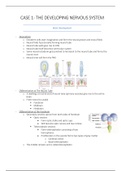
- Neurulation
o Ectoderm cells start invagination and form the neural groove and neural folds
o Neural folds fuse dorsally forming neural tube
o Neural tube walls give rise to CNS
o Neural tube itself becomes ventricular system
o Some neural ectoderm gets pinched to lie lateral to the neural tube and forms the
neural crest
o Neural crest will form the PNS
- Differentiation of The Neural Tube
o 3 swellings at rostral end of neural tube (primary vesicles) give rise to the entire
brain
o From rostral to caudal
§ Forebrain
§ Midbrain
§ Hindbrain
- Differentiation of the Forebrain
o Secondary vesicles sprout from both sides of forebrain
§ Optic vesicles
• Form optic stalks and optic cups
• Will become optic nerves and two retinas
§ Telencephalic vesicles
• Form telencephalon consisting of two
hemispheres
• Proliferation in this vesicle forms two types of gray matter
o Cerebral cortex
o Basal telencephalon
o The middle remains and is called diencephalon
, § Differentiates into thalamus and hypothalamus
o Fluid filled spaces within hemispheres make up lateral ventricles and space at the
center of diencephalon is the third ventricle
o Neurons extent axons to communicate with other parts of NS
§ These axons form three major white matter systems
• Cortical white matter
o All axons that run to and from neurons in cerebral cortex
• Corpus callosum
o Continuous with cortical white matter
o Forms axonal bridge linking cortical neurons of the two
hemispheres
• Internal capsule
o Links cortex with brain stem (thalamus)
- Differentiation of the midbrain
o Dorsal surface becomes the tectum
o Floor of midbrain becomes the tegmentum
o CSF filled space in between becomes cerebral aqueduct
§ It connects rostrally with the third ventricle of
diencephalon
- Differentiation of hindbrain
o Differentiates into
§ Begins with tissue at dorsal-lateral wall, growing dorsally and medially until it
fuses with its twin on the other side differentiating into the Cerebellum
§ Ventral wall of tube swells and differentiates into Pons
§ Medulla Oblongata is formed by ventral and lateral walls of caudal half of
hindbrain swelling
o Cerebellum and Pons develop from rostral half
o Medulla Oblongata develops from caudal
half
o CSF filled tube becomes fourth ventricle
,- Differentiation of the Spinal Cord
o Comes from the caudal neural tube
o Tissue walls expand, cavity of the tube constricts, this
forms CSF-filled spinal canal
o Gray matter
§ Dorsal horn
§ Ventral horn
§ Intermediate zone
o White matter
§ Axons
Neurogenesis
- Cell proliferation
o Walls of vesicles consist of two layers
§ Ventricular zone lines the inside
§ Marginal zone faces overlying pia
o Within these layers, neurons undergo cellular balled to form new neurons
§ 1st position
• Cell in ventricular zone extends a process reaching upwards towards
the pia
§ 2nd position
• Nucleus of cell migrates upward from
ventricular surface towards pial surface
• Followed by replication of cell’s DNA
§ 3rd position
• Nucleus containing 2 copies of genetic
material retracts back to ventricular
surface
th
§ 4 position
• Cell retracts its arm from pial surface
th
§ 5
• Cell divides in two
- Radial Glial cells
o Earliest distinguishable cells in primitive neural epithelium
o Cell bodies in ventricular zone, process extends to pial surface
o Extended processes allow for the migration of neurons from ventricular zone
o Also act as progenitor cells for neuros and astrocytes
o Dependent on Notch signaling that regulates a cascade of transcription factors
, o Fate of newly formed cell depends on plane of cleavage
§ Vertically cleavage
• Remain in ventricular zone to divide again
o Predominates in early stages of development
• Notch-1 and numb proteins are partitioned
symmetrically
§ Horizontal cleavage
• Daughter cell lying farthest away from ventricular
surface migrates away to cortex and never divides
again
o Notch-1 goes with daughter cell that
migrates away
• Other daughter cells (bottom)
o Remain in ventricular zone to divide further
o Numb remains with cell that divides again
o Mature cortical cells can be classified as glial or neurons
§ Neurons can be classified according to
• The layer they reside
• Dendritic morphology
• Neurotransmitter they use
§ All these cells arise from neural stem cells
- Cell migration
o Neurons migrate along glial cells
o Three pathways
§ Radial
• Move along the long and unbranched glial
cells
• After neuron leaves the cell cycle, its
leading process wraps around the shaft of
glial cell and its nucleus translocates into
the leading process
• Microtubules envelop the nucleus in a
cage-like structure
• Adhesive receptors (e.g. integrins) promote neural extension
• Immature neurons (neuroblasts) follow this path from ventricular
zone toward brain surface
• When this is complete, radial glial cells withdraw their radial process
§ Tangential
• Neurons use axonal tracts as their guides
• Follow precise routes of navigation and settling
§ Free migration
• PNS without radial glial cells or axonal tracts
, • BMP triggers changes in neural crest cells, inducing expression of
transcription factors that regulate cytoskeleton properties and
enzymes that degrade extracellular matrix proteins
o This and alteration in adhesive proteins allows neural crest
cells to migrate into periphery
- Layer Organization of Cerebral Cortex
o Settling position of a neuron correlates with the “birthday” of the cell
o Cells that leave cell cycle at early stages give rise to neurons that settle in deepest
part of cortex
o Cells that leave cell division at later stages settle in more superficial layers of cortex
o Inside-first, outside-last rule
- Cell differentiation
o Specific spatiotemporal pattern of gene expression
o Neuroblast differentiation begins as soon as precursor cells divide
§ Uneven distribution of TFs
o Further differentiation happens when neuroblast arrives in cortical plate
o Neuronal differentiation occurs first
o Astrocyte differentiation follows
o Oligodendrocyte differentiation is the last
o Neuronal differentiation begins with dendrites sprouting from cell body
§ These look the same at first, later one becomes the axon and the others
remain dendrites
Brain Development
- Neurulation
o Ectoderm cells start invagination and form the neural groove and neural folds
o Neural folds fuse dorsally forming neural tube
o Neural tube walls give rise to CNS
o Neural tube itself becomes ventricular system
o Some neural ectoderm gets pinched to lie lateral to the neural tube and forms the
neural crest
o Neural crest will form the PNS
- Differentiation of The Neural Tube
o 3 swellings at rostral end of neural tube (primary vesicles) give rise to the entire
brain
o From rostral to caudal
§ Forebrain
§ Midbrain
§ Hindbrain
- Differentiation of the Forebrain
o Secondary vesicles sprout from both sides of forebrain
§ Optic vesicles
• Form optic stalks and optic cups
• Will become optic nerves and two retinas
§ Telencephalic vesicles
• Form telencephalon consisting of two
hemispheres
• Proliferation in this vesicle forms two types of gray matter
o Cerebral cortex
o Basal telencephalon
o The middle remains and is called diencephalon
, § Differentiates into thalamus and hypothalamus
o Fluid filled spaces within hemispheres make up lateral ventricles and space at the
center of diencephalon is the third ventricle
o Neurons extent axons to communicate with other parts of NS
§ These axons form three major white matter systems
• Cortical white matter
o All axons that run to and from neurons in cerebral cortex
• Corpus callosum
o Continuous with cortical white matter
o Forms axonal bridge linking cortical neurons of the two
hemispheres
• Internal capsule
o Links cortex with brain stem (thalamus)
- Differentiation of the midbrain
o Dorsal surface becomes the tectum
o Floor of midbrain becomes the tegmentum
o CSF filled space in between becomes cerebral aqueduct
§ It connects rostrally with the third ventricle of
diencephalon
- Differentiation of hindbrain
o Differentiates into
§ Begins with tissue at dorsal-lateral wall, growing dorsally and medially until it
fuses with its twin on the other side differentiating into the Cerebellum
§ Ventral wall of tube swells and differentiates into Pons
§ Medulla Oblongata is formed by ventral and lateral walls of caudal half of
hindbrain swelling
o Cerebellum and Pons develop from rostral half
o Medulla Oblongata develops from caudal
half
o CSF filled tube becomes fourth ventricle
,- Differentiation of the Spinal Cord
o Comes from the caudal neural tube
o Tissue walls expand, cavity of the tube constricts, this
forms CSF-filled spinal canal
o Gray matter
§ Dorsal horn
§ Ventral horn
§ Intermediate zone
o White matter
§ Axons
Neurogenesis
- Cell proliferation
o Walls of vesicles consist of two layers
§ Ventricular zone lines the inside
§ Marginal zone faces overlying pia
o Within these layers, neurons undergo cellular balled to form new neurons
§ 1st position
• Cell in ventricular zone extends a process reaching upwards towards
the pia
§ 2nd position
• Nucleus of cell migrates upward from
ventricular surface towards pial surface
• Followed by replication of cell’s DNA
§ 3rd position
• Nucleus containing 2 copies of genetic
material retracts back to ventricular
surface
th
§ 4 position
• Cell retracts its arm from pial surface
th
§ 5
• Cell divides in two
- Radial Glial cells
o Earliest distinguishable cells in primitive neural epithelium
o Cell bodies in ventricular zone, process extends to pial surface
o Extended processes allow for the migration of neurons from ventricular zone
o Also act as progenitor cells for neuros and astrocytes
o Dependent on Notch signaling that regulates a cascade of transcription factors
, o Fate of newly formed cell depends on plane of cleavage
§ Vertically cleavage
• Remain in ventricular zone to divide again
o Predominates in early stages of development
• Notch-1 and numb proteins are partitioned
symmetrically
§ Horizontal cleavage
• Daughter cell lying farthest away from ventricular
surface migrates away to cortex and never divides
again
o Notch-1 goes with daughter cell that
migrates away
• Other daughter cells (bottom)
o Remain in ventricular zone to divide further
o Numb remains with cell that divides again
o Mature cortical cells can be classified as glial or neurons
§ Neurons can be classified according to
• The layer they reside
• Dendritic morphology
• Neurotransmitter they use
§ All these cells arise from neural stem cells
- Cell migration
o Neurons migrate along glial cells
o Three pathways
§ Radial
• Move along the long and unbranched glial
cells
• After neuron leaves the cell cycle, its
leading process wraps around the shaft of
glial cell and its nucleus translocates into
the leading process
• Microtubules envelop the nucleus in a
cage-like structure
• Adhesive receptors (e.g. integrins) promote neural extension
• Immature neurons (neuroblasts) follow this path from ventricular
zone toward brain surface
• When this is complete, radial glial cells withdraw their radial process
§ Tangential
• Neurons use axonal tracts as their guides
• Follow precise routes of navigation and settling
§ Free migration
• PNS without radial glial cells or axonal tracts
, • BMP triggers changes in neural crest cells, inducing expression of
transcription factors that regulate cytoskeleton properties and
enzymes that degrade extracellular matrix proteins
o This and alteration in adhesive proteins allows neural crest
cells to migrate into periphery
- Layer Organization of Cerebral Cortex
o Settling position of a neuron correlates with the “birthday” of the cell
o Cells that leave cell cycle at early stages give rise to neurons that settle in deepest
part of cortex
o Cells that leave cell division at later stages settle in more superficial layers of cortex
o Inside-first, outside-last rule
- Cell differentiation
o Specific spatiotemporal pattern of gene expression
o Neuroblast differentiation begins as soon as precursor cells divide
§ Uneven distribution of TFs
o Further differentiation happens when neuroblast arrives in cortical plate
o Neuronal differentiation occurs first
o Astrocyte differentiation follows
o Oligodendrocyte differentiation is the last
o Neuronal differentiation begins with dendrites sprouting from cell body
§ These look the same at first, later one becomes the axon and the others
remain dendrites



