M.V.D.
LEARNING OBJECTIVES MOD1
THEME 1
1. Immune System Defense Mechanisms:
Understand and describe the anatomical, chemical, and physical barriers
that serve as the first line of defense against pathogens.
o Anatomical
Skin: mechanical shield against m.o.'s, with slightly acidic
surface
Mucous membranes: respiratory, digestive, urogenital and
other tracts
Cilia in respiratory tract
Tears & saliva: wash away + lysozyme
o Chemical
Enzymes: lysozyme
Acidic environments: stomach & vagina
Antimicrobial peptides: kill pathogens
Sebum & sweat: sebum contains fatty acids with antimicrobial
properties
o Physical
Coughing & sneezing: expel pathogens trapped in mucus
Urine flow: flushed out bacteria from urinary tract
Explain normal hematopoiesis and its role in generating various types of
immune cells.
o Multipotential Hematopoietic Stem Cell
Common Myeloid Progenitor
Megakaryocyte
Thrombocytes
Erythrocyte
Mast cell
Myeloblast
Basophil
Neutrophil
Eosinophil
Monocyte
- Macrophage
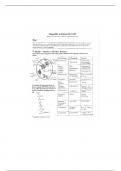
Figure 1: Hematopoiesi
Common Lymphoid Progenitor
Natural killer cell
Small lymphocyte
T lymphocyte
B lymphocyte
- Plasma cell
Identify key lymphoid organs and tissue sites where different steps of the
immune response occur.
o Primary Lymphoid Organs
Bone Marrow
Production of B cells, T cells, NK cells, dendritic cells,
etc.
B cell maturation
Thymus
1
, M.V.D.
T cell maturation
Positive selection
Negative selection
o Secondary Lymphoid Organs & Tissues
Lymph nodes
Structure
Small, bean-shaped nodes
Function
Filter for lymph
APC’s (dendritic cells & macrophages) capture
antigens and bring them to the lymph nodes to
present them to T cells etc.
Immune response
T and B cells encounter antigens presented by
APC’s triggers activation activated T cells
proliferate into cytotoxic T cells or T helper cells;
B cells into plasma cells
Spleen
Structure
Red pulp
White pulp
Function
Red: filters old or damaged RBC’s
White: rich in lymphocytes, functions as lymph
node, filters blood-borne pathogens
Immune response
Activates B and T cells, similar to lymph nodes
Focuses more on blood infections
Mucosa-Associated Lymphoid Tissue (MALT)
Structure
Immune tissues found in mucosal surfaces
Function
Initiates local immune response
Comprehend the molecular basis of immune recognition.
o Key Components
Pattern Recognition Receptors (PRRs)
Toll-like receptors: detect PAMPs (Pathogen-Associated
Molecular Patterns)
LPS
Viral RNA
Flagellin
Function
Provide non-specific defense by recognizing
common microbials signatures
Antigens & Antigen receptors
B Cell Receptors (BCRs)
Recognize antigens through membrane-bound
antigens (BCRs)
BCRs can bind directly to intact antigens
- Activates B cells
- Differentiate into plasma cells secreting
antibodies
T Cell Receptors (TCRs)
2
, M.V.D.
Recognize antigens presented on MHC
CD4+ T helper cells
- MHC Class-II, found on APCs
CD8+ Cytotoxic T cells
- MHC Class-I, found on all nucleated cells
- Directly kill infected or abnormal cells
Major Histocompatibility Complex (MHC, HLA in
humans)
Class I
Found on all nucleated cells
Present endogenous antigens (from inside the
cell, such as viral of tumor proteins)
CD8+ cytotoxic T cells
Class II
Found on professional APCs
Present exogenous antigens (outside the cell,
such as bacterial proteins:
CD4+ helper T cells
MHC diversity ensures a wide variety of pathogens can
be recognized
Antigen Presentation
APCs
Dendritic cells
Macrophages
B cells
After recognition, an APC captures a pathogen and
degrades into smaller fragments. These are loaded on
the MHC molecules and can then be recognized by T
cells
Essential for activating T cells and the adaptive
immune system
o Key Molecular Interactions
Antigen-antibody interaction
Antibodies (immunoglobulins), produced by B cells,
bind specific antigens with high affinity and specificity.
Antibodies recognize epitopes on antigens.
Binding of antibodies can neutralize them, opsonize
them for phagocytosis, or active the complement
system (classical pathway)
TCR-MHC-Peptide Interaction
TCR recognize antigens presented on MHC molecules
CD4+ (Th): MHC Class-II
CD8+ (Tc): MHC Class-I
After recognition, a cascade of signaling pathways
activates the t cell, which then proliferates into effector
or memory T cells
Co-stimulatory Signals
T cells require co-stimulatory signals, provided by the
interaction between APCs (e.g. CD80 or CD86) and
receptors on T cells (CD28)
APCs secrete cytokines to influence the T cells to
differentiate into specific subtypes
Th1: help macrophages suppress intracellular
infections
3
, M.V.D.
- IFN-ɣ; TNF-α; IL-2; LT; GM-CSF
Th2: help basophils, mast cells, eosinophils, and
B-cells respond to parasite infections
- IL-4; IL-5; IL-10; IL-13; TGF-β
Th17: enhance the neutrophil response to fungal
and extracellular bacterial infections
- IL-17; IL-21; IL-22; IL-26
Thf: help B-cells become activated, switch
isotype, and increase antibody affinity
- IL-21; IL-4; IFN-ɣ
THαβ: provide immunity against viruses
- IFN-α; IFN-β; IL-10
Cytokines & Chemokines
Cytokines (e.g. interleukins & interferons) and
chemokines are signaling molecules that module
immune cell behavior
APCs secrete cytokines
Chemokines direct migration of immune cells to
infection sites
2. Mechanisms of Immune Response:
Explain the mechanisms of action mediated by the innate immune system
and the acquired (or adaptive) immune system, including the key
cytokines involved.
o Innate Immune System
Physical & Chemical barriers (MOA)
Skin
Mucous membranes
Chemical secretions
Phagocytosis (MOA)
Macrophages and neutrophils engulf pathogens
These cells ingest pathogens after recognizing PAMPs
Pattern Recognition Receptors (PRRs) (MOA)
Innate immune cells express PRRs like Toll-like
receptors that detect PAMPs
Binding of PAMPs to PRRs triggers signaling pathway
that activate immune responses
Inflammation (MOA)
Inflammation triggered by innate immune system when
a pathogen invades
Mast cells and/or macrophages release inflammatory
mediators increase blood flow and permeability
redness, heat and swelling
Histamines
Cytokines
Natural Killer (NK) cells (MOA)
Recognize infected cells by a change in MHC Class-I
expression, like the absence of an MHC Class-I
molecule
Can also be activated antibodies
Release cytotoxic molecules
4
LEARNING OBJECTIVES MOD1
THEME 1
1. Immune System Defense Mechanisms:
Understand and describe the anatomical, chemical, and physical barriers
that serve as the first line of defense against pathogens.
o Anatomical
Skin: mechanical shield against m.o.'s, with slightly acidic
surface
Mucous membranes: respiratory, digestive, urogenital and
other tracts
Cilia in respiratory tract
Tears & saliva: wash away + lysozyme
o Chemical
Enzymes: lysozyme
Acidic environments: stomach & vagina
Antimicrobial peptides: kill pathogens
Sebum & sweat: sebum contains fatty acids with antimicrobial
properties
o Physical
Coughing & sneezing: expel pathogens trapped in mucus
Urine flow: flushed out bacteria from urinary tract
Explain normal hematopoiesis and its role in generating various types of
immune cells.
o Multipotential Hematopoietic Stem Cell
Common Myeloid Progenitor
Megakaryocyte
Thrombocytes
Erythrocyte
Mast cell
Myeloblast
Basophil
Neutrophil
Eosinophil
Monocyte
- Macrophage
Figure 1: Hematopoiesi
Common Lymphoid Progenitor
Natural killer cell
Small lymphocyte
T lymphocyte
B lymphocyte
- Plasma cell
Identify key lymphoid organs and tissue sites where different steps of the
immune response occur.
o Primary Lymphoid Organs
Bone Marrow
Production of B cells, T cells, NK cells, dendritic cells,
etc.
B cell maturation
Thymus
1
, M.V.D.
T cell maturation
Positive selection
Negative selection
o Secondary Lymphoid Organs & Tissues
Lymph nodes
Structure
Small, bean-shaped nodes
Function
Filter for lymph
APC’s (dendritic cells & macrophages) capture
antigens and bring them to the lymph nodes to
present them to T cells etc.
Immune response
T and B cells encounter antigens presented by
APC’s triggers activation activated T cells
proliferate into cytotoxic T cells or T helper cells;
B cells into plasma cells
Spleen
Structure
Red pulp
White pulp
Function
Red: filters old or damaged RBC’s
White: rich in lymphocytes, functions as lymph
node, filters blood-borne pathogens
Immune response
Activates B and T cells, similar to lymph nodes
Focuses more on blood infections
Mucosa-Associated Lymphoid Tissue (MALT)
Structure
Immune tissues found in mucosal surfaces
Function
Initiates local immune response
Comprehend the molecular basis of immune recognition.
o Key Components
Pattern Recognition Receptors (PRRs)
Toll-like receptors: detect PAMPs (Pathogen-Associated
Molecular Patterns)
LPS
Viral RNA
Flagellin
Function
Provide non-specific defense by recognizing
common microbials signatures
Antigens & Antigen receptors
B Cell Receptors (BCRs)
Recognize antigens through membrane-bound
antigens (BCRs)
BCRs can bind directly to intact antigens
- Activates B cells
- Differentiate into plasma cells secreting
antibodies
T Cell Receptors (TCRs)
2
, M.V.D.
Recognize antigens presented on MHC
CD4+ T helper cells
- MHC Class-II, found on APCs
CD8+ Cytotoxic T cells
- MHC Class-I, found on all nucleated cells
- Directly kill infected or abnormal cells
Major Histocompatibility Complex (MHC, HLA in
humans)
Class I
Found on all nucleated cells
Present endogenous antigens (from inside the
cell, such as viral of tumor proteins)
CD8+ cytotoxic T cells
Class II
Found on professional APCs
Present exogenous antigens (outside the cell,
such as bacterial proteins:
CD4+ helper T cells
MHC diversity ensures a wide variety of pathogens can
be recognized
Antigen Presentation
APCs
Dendritic cells
Macrophages
B cells
After recognition, an APC captures a pathogen and
degrades into smaller fragments. These are loaded on
the MHC molecules and can then be recognized by T
cells
Essential for activating T cells and the adaptive
immune system
o Key Molecular Interactions
Antigen-antibody interaction
Antibodies (immunoglobulins), produced by B cells,
bind specific antigens with high affinity and specificity.
Antibodies recognize epitopes on antigens.
Binding of antibodies can neutralize them, opsonize
them for phagocytosis, or active the complement
system (classical pathway)
TCR-MHC-Peptide Interaction
TCR recognize antigens presented on MHC molecules
CD4+ (Th): MHC Class-II
CD8+ (Tc): MHC Class-I
After recognition, a cascade of signaling pathways
activates the t cell, which then proliferates into effector
or memory T cells
Co-stimulatory Signals
T cells require co-stimulatory signals, provided by the
interaction between APCs (e.g. CD80 or CD86) and
receptors on T cells (CD28)
APCs secrete cytokines to influence the T cells to
differentiate into specific subtypes
Th1: help macrophages suppress intracellular
infections
3
, M.V.D.
- IFN-ɣ; TNF-α; IL-2; LT; GM-CSF
Th2: help basophils, mast cells, eosinophils, and
B-cells respond to parasite infections
- IL-4; IL-5; IL-10; IL-13; TGF-β
Th17: enhance the neutrophil response to fungal
and extracellular bacterial infections
- IL-17; IL-21; IL-22; IL-26
Thf: help B-cells become activated, switch
isotype, and increase antibody affinity
- IL-21; IL-4; IFN-ɣ
THαβ: provide immunity against viruses
- IFN-α; IFN-β; IL-10
Cytokines & Chemokines
Cytokines (e.g. interleukins & interferons) and
chemokines are signaling molecules that module
immune cell behavior
APCs secrete cytokines
Chemokines direct migration of immune cells to
infection sites
2. Mechanisms of Immune Response:
Explain the mechanisms of action mediated by the innate immune system
and the acquired (or adaptive) immune system, including the key
cytokines involved.
o Innate Immune System
Physical & Chemical barriers (MOA)
Skin
Mucous membranes
Chemical secretions
Phagocytosis (MOA)
Macrophages and neutrophils engulf pathogens
These cells ingest pathogens after recognizing PAMPs
Pattern Recognition Receptors (PRRs) (MOA)
Innate immune cells express PRRs like Toll-like
receptors that detect PAMPs
Binding of PAMPs to PRRs triggers signaling pathway
that activate immune responses
Inflammation (MOA)
Inflammation triggered by innate immune system when
a pathogen invades
Mast cells and/or macrophages release inflammatory
mediators increase blood flow and permeability
redness, heat and swelling
Histamines
Cytokines
Natural Killer (NK) cells (MOA)
Recognize infected cells by a change in MHC Class-I
expression, like the absence of an MHC Class-I
molecule
Can also be activated antibodies
Release cytotoxic molecules
4