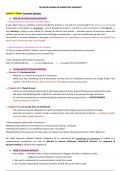
Decision making in marketing
Lecture 1
Heuristics & Biases
The illusion of decision making: are we in full control?
The default effect:
People in marketing use the default effect to help us, in some sort, to decide.
If a decision is harder (donor), you are more prone to run in a bias (everyone is donor when
born).
The default option is the option the chooser will obtain if he or she does nothing.
bounded rationality: we are constraint in our decision making
o decisions are often complex and difficult
o individuals/ consumers are bounded rational, they have to make decisions under
several constraints: limited knowledge/information, limited resources (time,
attention, memory), limited motivation
Heuristics: cognitive shortcuts to make decisions quickly and efficiently (simplify decisions)
Problem: can lead to systematic errors and biases (e.g. deviations from the true or objective
value, violation of probability laws)
Decoy effect: putting things in context
(newspaper subscription example)
Most famous for doing that: Apple, Iphone (16GB, 32GB etc)
o Choices are made in a context
- relative to other alternatives rather than based on absolute preferences
o Decoy effect: The choice of one option over the other changes when a third –
asymmetrically dominated – option is introduced
asymmetrically dominated = irrelevant alternative
Managerial relevance:
Adding an irrelevant alternative ‘helps’ consumers to decide upselling
Examples: pricing of consumer electronic products (e.g. Apple), restaurant choices
Anchoring: put a number in people’s head, they decide accordingly (example of the redwood
tree)
Anchoring and adjustment = making an estimation based on a process of anchoring on a
salient number and adjusting up or down
Problem: adjustments are typically insufficient, estimation is biased towards the anchor
,Managerial relevance
General: negotiations, price expectations
Specifically: sales techniques (price, product portfolio): furniture, cars, home appliances etc.
Starbucks sets a different anchor (selling experiences instead of selling coffee)
Mental accounting (ice cream example): different pockets matter
Loosing money from different ‘mental accounts’ influences purchase decisions
people keep track of their expenses in different mental accounts (i.e. categories);
these mental accounts influence the decision making process
Managerial & policy relevance:
o Individuals / consumers spend money differently depending on the ‘account’ they
pay from
o Examples: tax refunds, birthday money, investments, bonuses at work, lottery
winnings
Availability heuristics: events are judged more likely to the extent that they are vivid or
easily recalled
Managerial & Policy relevance:
Overestimation of the likelihood that something good or bad will happen
Examples: seeing news, lottery winners, sweepstakes
Representativeness Heuristics: judgement that the probability that object A belongs to class
B depends on the degree to which A resembles B. That is, people rely on characteristics that
are representative for a category when judging likelihoods.
But: if something is more representative, that does not make it more likely
Managerial relevance:
o Misjudgments of likelihood of outcomes based on representative characteristics
o Example: coin toss HTTHHTHT judged more likely than HHHHHHHH
Preferences about framed problems
Winning > Losing
Winning risk averse
Losing risk taking
Framing effect: the frame of a message influences the decision; i.e., people react differently
depending on how a message is presented
Two effects:
1. People prefer positive outcomes over negative outcomes
2. People are risk averse over gains, but risk seeking over loses
Managerial & policy relevance:
Firing vs. saving employees: out of 600, would you father fire 400 or save 200?
Health treatments: would you rather have a 90% chance to live or a 10% chance to die?
,Prospect theory (Tversky & Kahneman, 1979)
Losing causes us much more pain than gaining causes us happiness.
Expected Utility Theory vs. Prospect Theory
Expected Utility Theory
o Utility as a function of absolute wealth
o Marginal utility decreases as wealth increases
Prospect theory
o Reference dependence = value is measured in gains and losses relative to a reference
point
o Diminishing sensitivity = marginal value of gains and losses decreases with their size
o Loss aversion = ‘losses loom larger than gains’
Managerial & Policy relevance
o Loss aversion: potential losses motivate more than potential gains (e.g. purchase,
policy implementation)
o But: Losses make people risk seeking (e.g. financial decision making)
Key takeaways:
1. Decisions are often complex and difficult. To make decisions quickly and efficiently
consumers use several heuristics
2. Heuristics can lead to systematic errors and biases; mistakes people repeat over and
over again (i.e. not always rational but predictably irrational)
3. In decision making, we need to go beyond the standard economical model of
expected utility; prospect theory provides a relevant framework
, 4. Understanding both rational and irrational behavior is important for consumers,
managers and policy makers in financial decision making, HR management, product
pricing, marketing strategy, health policies etc.
Lecture 2
Social influence: we influence others and are influenced by others
Weapons of influence: Techniques to persuade people / consumers
Reciprocity & Door-in-the-Face
Commitment & Foot-in-the-Door
Social proof
Scarcity
Reciprocity: give to receive
Reciprocity:
- based on the social norm to repay what another person has given to us
- across cultures people are taught to live up to this social norm, resulting in distaste for
people how to violate the norm
- Problem: exploitation of the rule as it enforces uninvited debt and can trigger unequal
exchange
Managerial relevance
- Sales techniques: ‘not-so-free samples’ in supermarkets, gifts from sales persons, car tests
over the weekend etc.
- Further examples: dinner invitations, birthday presents, sponsorship
Indirect reciprocity: slamming the door in the face
Rejection-then-retreat
Door-in-the-face technique (DITF)
- getting compliance to a request by starting with a large (or unreasonable) request. If the
large request is rejected, a concession will be offered (i.e. a smaller / reasonable request)
Example:
Group 1: Take a group of young criminals to the zoo for 2 hours
Group 2: (i) Work of 2 years as nonpaid counselor for young criminals or
(ii) take a group of young criminals to the zoo for 2 hours
Managerial & Policy relevance:
- Examples: labor negotiations, sales price, getting friends to move furniture
- Spillover to further request; but do not push it too far
Commitment and Consistency: Stuck with a choice
- After making a commitment, people are more likely to agree with requests in-line
with this commitment
Lecture 1
Heuristics & Biases
The illusion of decision making: are we in full control?
The default effect:
People in marketing use the default effect to help us, in some sort, to decide.
If a decision is harder (donor), you are more prone to run in a bias (everyone is donor when
born).
The default option is the option the chooser will obtain if he or she does nothing.
bounded rationality: we are constraint in our decision making
o decisions are often complex and difficult
o individuals/ consumers are bounded rational, they have to make decisions under
several constraints: limited knowledge/information, limited resources (time,
attention, memory), limited motivation
Heuristics: cognitive shortcuts to make decisions quickly and efficiently (simplify decisions)
Problem: can lead to systematic errors and biases (e.g. deviations from the true or objective
value, violation of probability laws)
Decoy effect: putting things in context
(newspaper subscription example)
Most famous for doing that: Apple, Iphone (16GB, 32GB etc)
o Choices are made in a context
- relative to other alternatives rather than based on absolute preferences
o Decoy effect: The choice of one option over the other changes when a third –
asymmetrically dominated – option is introduced
asymmetrically dominated = irrelevant alternative
Managerial relevance:
Adding an irrelevant alternative ‘helps’ consumers to decide upselling
Examples: pricing of consumer electronic products (e.g. Apple), restaurant choices
Anchoring: put a number in people’s head, they decide accordingly (example of the redwood
tree)
Anchoring and adjustment = making an estimation based on a process of anchoring on a
salient number and adjusting up or down
Problem: adjustments are typically insufficient, estimation is biased towards the anchor
,Managerial relevance
General: negotiations, price expectations
Specifically: sales techniques (price, product portfolio): furniture, cars, home appliances etc.
Starbucks sets a different anchor (selling experiences instead of selling coffee)
Mental accounting (ice cream example): different pockets matter
Loosing money from different ‘mental accounts’ influences purchase decisions
people keep track of their expenses in different mental accounts (i.e. categories);
these mental accounts influence the decision making process
Managerial & policy relevance:
o Individuals / consumers spend money differently depending on the ‘account’ they
pay from
o Examples: tax refunds, birthday money, investments, bonuses at work, lottery
winnings
Availability heuristics: events are judged more likely to the extent that they are vivid or
easily recalled
Managerial & Policy relevance:
Overestimation of the likelihood that something good or bad will happen
Examples: seeing news, lottery winners, sweepstakes
Representativeness Heuristics: judgement that the probability that object A belongs to class
B depends on the degree to which A resembles B. That is, people rely on characteristics that
are representative for a category when judging likelihoods.
But: if something is more representative, that does not make it more likely
Managerial relevance:
o Misjudgments of likelihood of outcomes based on representative characteristics
o Example: coin toss HTTHHTHT judged more likely than HHHHHHHH
Preferences about framed problems
Winning > Losing
Winning risk averse
Losing risk taking
Framing effect: the frame of a message influences the decision; i.e., people react differently
depending on how a message is presented
Two effects:
1. People prefer positive outcomes over negative outcomes
2. People are risk averse over gains, but risk seeking over loses
Managerial & policy relevance:
Firing vs. saving employees: out of 600, would you father fire 400 or save 200?
Health treatments: would you rather have a 90% chance to live or a 10% chance to die?
,Prospect theory (Tversky & Kahneman, 1979)
Losing causes us much more pain than gaining causes us happiness.
Expected Utility Theory vs. Prospect Theory
Expected Utility Theory
o Utility as a function of absolute wealth
o Marginal utility decreases as wealth increases
Prospect theory
o Reference dependence = value is measured in gains and losses relative to a reference
point
o Diminishing sensitivity = marginal value of gains and losses decreases with their size
o Loss aversion = ‘losses loom larger than gains’
Managerial & Policy relevance
o Loss aversion: potential losses motivate more than potential gains (e.g. purchase,
policy implementation)
o But: Losses make people risk seeking (e.g. financial decision making)
Key takeaways:
1. Decisions are often complex and difficult. To make decisions quickly and efficiently
consumers use several heuristics
2. Heuristics can lead to systematic errors and biases; mistakes people repeat over and
over again (i.e. not always rational but predictably irrational)
3. In decision making, we need to go beyond the standard economical model of
expected utility; prospect theory provides a relevant framework
, 4. Understanding both rational and irrational behavior is important for consumers,
managers and policy makers in financial decision making, HR management, product
pricing, marketing strategy, health policies etc.
Lecture 2
Social influence: we influence others and are influenced by others
Weapons of influence: Techniques to persuade people / consumers
Reciprocity & Door-in-the-Face
Commitment & Foot-in-the-Door
Social proof
Scarcity
Reciprocity: give to receive
Reciprocity:
- based on the social norm to repay what another person has given to us
- across cultures people are taught to live up to this social norm, resulting in distaste for
people how to violate the norm
- Problem: exploitation of the rule as it enforces uninvited debt and can trigger unequal
exchange
Managerial relevance
- Sales techniques: ‘not-so-free samples’ in supermarkets, gifts from sales persons, car tests
over the weekend etc.
- Further examples: dinner invitations, birthday presents, sponsorship
Indirect reciprocity: slamming the door in the face
Rejection-then-retreat
Door-in-the-face technique (DITF)
- getting compliance to a request by starting with a large (or unreasonable) request. If the
large request is rejected, a concession will be offered (i.e. a smaller / reasonable request)
Example:
Group 1: Take a group of young criminals to the zoo for 2 hours
Group 2: (i) Work of 2 years as nonpaid counselor for young criminals or
(ii) take a group of young criminals to the zoo for 2 hours
Managerial & Policy relevance:
- Examples: labor negotiations, sales price, getting friends to move furniture
- Spillover to further request; but do not push it too far
Commitment and Consistency: Stuck with a choice
- After making a commitment, people are more likely to agree with requests in-line
with this commitment