Week 4 – International Marketing
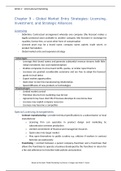
Chapter 9 – Global Market Entry Strategies: Licensing,
Investment, and Strategic Alliances
Licensing
- Definition: Contractual arrangement whereby one company (the licensor) makes a
legally protected asset available to another company (the licensee) in exchange for
royalties, license fees, or some other form of compensation
- Licensed asset may be a brand name, company name, patent, trade secret, or
product formulation
- Global market entry and expansion strategy
Advantages
- Leverage their brand names and generate substantial revenue streams (with little
initial investment; low cost implementation)
- Enables companies to circumvent tariffs, quotas, or similar report barriers
- Licensees are granted considerable autonomy and are free to adapt the licensed
goods to local tastes
- Export market opportunities
- Open door to low-risk manufacturing relationships
- Speed diffusion of new products or technologies
Disadvantages
- Limited market control
- Potential returns from marketing may be lost
- Agreement may have short life if licensee develops its own know-how
- Licensee may exploit company resources
- Licensee may become a competitor
Special Licensing Arrangements
- Contract manufacturing = provide technical specifications to a subcontractor or local
manufacturer
o Licensing firm can specialize in product design and marketing bc
subcontractor oversees production
o Limited commitment of financial and managerial resources
o Quick entry into target market
o May open themselves to public scrutiny e.g. criticism if workers in contract
factories are paid poorly
- Franchising = contract between a parent company-franchiser and a franchisee that
allows the franchisee to operate a business developed by the franchiser in return for
a fee and adherence to franchise-wide policies and practices
Based on the book ‘Global Marketing’ by Warren J. Keegan and Mark C. Green
Chapter 9 – Global Market Entry Strategies: Licensing,
Investment, and Strategic Alliances
Licensing
- Definition: Contractual arrangement whereby one company (the licensor) makes a
legally protected asset available to another company (the licensee) in exchange for
royalties, license fees, or some other form of compensation
- Licensed asset may be a brand name, company name, patent, trade secret, or
product formulation
- Global market entry and expansion strategy
Advantages
- Leverage their brand names and generate substantial revenue streams (with little
initial investment; low cost implementation)
- Enables companies to circumvent tariffs, quotas, or similar report barriers
- Licensees are granted considerable autonomy and are free to adapt the licensed
goods to local tastes
- Export market opportunities
- Open door to low-risk manufacturing relationships
- Speed diffusion of new products or technologies
Disadvantages
- Limited market control
- Potential returns from marketing may be lost
- Agreement may have short life if licensee develops its own know-how
- Licensee may exploit company resources
- Licensee may become a competitor
Special Licensing Arrangements
- Contract manufacturing = provide technical specifications to a subcontractor or local
manufacturer
o Licensing firm can specialize in product design and marketing bc
subcontractor oversees production
o Limited commitment of financial and managerial resources
o Quick entry into target market
o May open themselves to public scrutiny e.g. criticism if workers in contract
factories are paid poorly
- Franchising = contract between a parent company-franchiser and a franchisee that
allows the franchisee to operate a business developed by the franchiser in return for
a fee and adherence to franchise-wide policies and practices
Based on the book ‘Global Marketing’ by Warren J. Keegan and Mark C. Green