Week 11 – International Marketing
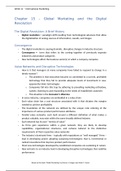
Chapter 15 – Global Marketing and the Digital
Revolution
The Digital Revolution: A Brief History
- Digital revolution = paradigm shift resulting from technological advances that allow
the digitalization of analog sources of information, sounds, and images
Convergence
- The digital revolution is causing dramatic, disruptive changes in industry structure
- Convergence = term that refers to the coming together of previously separate
industries and product categories
- New technologies affect the business sector(s) in which a company competes
Value Networks and Disruptive Technologies
- How is it that managers at many companies have failed to respond to change in a
timely manner?
o The problem is that executives become so committed to a current, profitable
technology that they fail to provide adequate levels of investment in new,
apparently riskier technologies
o Companies fall into this trap by adhering to prevailing marketing orthodoxy,
namely, listening to and responding to the needs of established customers
o This situation is the innovator’s dilemma
- In every industry, companies are embedded in a value chain
- Each value chain has a cost structure associated with it that dictates the margins
needed to achieve profitability
- The boundaries of the network are defined by the unique rank ordering of the
importance of various product performance attributes
- Parallel value networks, each built around a different definition of what makes a
product valuable, may exist within the same broadly defined industry
- Each network has its own ‘’metrics of value’’
- As firms gain experience within a given network, they are likely to develop
capabilities, organizational structures, and cultures tailored to the distinctive
requirements of their respective value networks
- The industry’s dominant firms – typically with reputations as ‘’well managed’’ firms –
lead in developing and/or adopting sustaining technologies; that is, incremental or
radical innovations that improve product performance
- Most new technologies developed by established companies are sustaining in nature
- New entrants to an industry lead in developing disruptive technologies that redefine
performance
Based on the book ‘Global Marketing’ by Warren J. Keegan and Mark C. Green
Chapter 15 – Global Marketing and the Digital
Revolution
The Digital Revolution: A Brief History
- Digital revolution = paradigm shift resulting from technological advances that allow
the digitalization of analog sources of information, sounds, and images
Convergence
- The digital revolution is causing dramatic, disruptive changes in industry structure
- Convergence = term that refers to the coming together of previously separate
industries and product categories
- New technologies affect the business sector(s) in which a company competes
Value Networks and Disruptive Technologies
- How is it that managers at many companies have failed to respond to change in a
timely manner?
o The problem is that executives become so committed to a current, profitable
technology that they fail to provide adequate levels of investment in new,
apparently riskier technologies
o Companies fall into this trap by adhering to prevailing marketing orthodoxy,
namely, listening to and responding to the needs of established customers
o This situation is the innovator’s dilemma
- In every industry, companies are embedded in a value chain
- Each value chain has a cost structure associated with it that dictates the margins
needed to achieve profitability
- The boundaries of the network are defined by the unique rank ordering of the
importance of various product performance attributes
- Parallel value networks, each built around a different definition of what makes a
product valuable, may exist within the same broadly defined industry
- Each network has its own ‘’metrics of value’’
- As firms gain experience within a given network, they are likely to develop
capabilities, organizational structures, and cultures tailored to the distinctive
requirements of their respective value networks
- The industry’s dominant firms – typically with reputations as ‘’well managed’’ firms –
lead in developing and/or adopting sustaining technologies; that is, incremental or
radical innovations that improve product performance
- Most new technologies developed by established companies are sustaining in nature
- New entrants to an industry lead in developing disruptive technologies that redefine
performance
Based on the book ‘Global Marketing’ by Warren J. Keegan and Mark C. Green