2019-2020 – UAntwerpen – Anna Gagiano – Applied Linguistics – English: Grammar & Proficiency –
BA2 – Semester 1
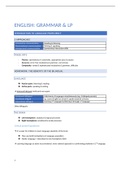
Proficiency
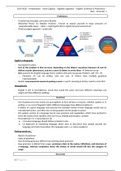
- Transferring messages correctly & fluently
- Influential theory by Stephen Krashen: “Crucial to expose yourself to large amounts of
‘comprehensible input’ – listen + read English that is slightly beyond current level”
- Three-pronged approach + trade-offs:
English orthography
- Inconsistent system
- Part of the problem is that we have, depending on the dialect, anywhere between 35 and 45
distinct sounds (phonemes), and yet a mere 26 letters to write them Defective script
- One sound in the English language that is written with only one group of letters: soft <th> /ð/
o Phoneme /ð/ can be written only one way Others have multiple graphical
representations
- Sound: most important aspect of spelling a word, a word’s meaning & history need to come first
Homophones
- English is rich in homophones, words that sound the same, but have different meanings and
origins and thus different spellings
Grammar
- Set of patterns for how words are put together to form phrases or clauses, whether spoken or in
writing, or as a set of linguistic habits (different languages have different patterns)
- A dialect of a given language may become the standard variety of that language mostly due to
coincidental factors, and often due to being spoken by the people in power
- The spoken version of a language has its own grammar and regularities, which have evolved to
serve the needs of the speakers who use it (e.g. implied punctuation, context)
- Prescriptivism (1) descriptivism (2)
o (1) A given language should follow consistent rules
o (2) Approach to examining language which aims to document how people actually use
language and track innovations (for language users, i.e. native speakers)
Parting words on…
- Nature of grammar
- Value of grammar
- How knowing grammar differs from knowing about grammar
- How grammar is distinct from usage: grammar refers to the syntax, inflections, and structure of
a language, whereas complaints about the misuse of words would fall into the category of
usage
Key terms
1|Pagina
, 2019-2020 – UAntwerpen – Anna Gagiano – Applied Linguistics – English: Grammar & Proficiency –
BA2 – Semester 1
1) Parts of speech/word classes
- Closed word classes: new words are never, or only very rarely, added
- Open word classes: new words can (easily) be added
- Lexical words: provide content
- Functional words: explain grammatical or structural relationships within the sentence/utterance
Nouns
Word used for thing/person SG/PL Uncountable: no PL form
Verbs
Action/state Tense: present, past, future
Auxiliary Modal verb
Form of to be/have to create some verb tenses Goes with another verb to express various
ideas or shades of meaning
Forming negative verbs & questions May, might, can, could, should, ought to,
would, will, shall
Participle: form of verb used in various verb tenses Infinitive
Present participle: ends with -ing To + verb
Regular past participle: ends with -ed or -d Gerund
Irregular past participle: given, thought, run Form of verb ending with -ing
Adjectives
Goes together with a noun Describes appearance/nature of sth
Possessive adjective indicates that sth belongs to or is connected with sb or sth
Adverbs
‘Describes’ a verb/action: how sth happens/is done Goes together with a verb
Can also go with an adjective Can also go with another adverb
Prepositions
Word/phrase such as at, (out) of, in, on, for, off, by Used in many ways, e.g. in connection with
time, place, movement, and in many phrases
Used after verbs, nouns & adjectives to form phrases with particular meanings
Pronouns
Used instead of a noun/name Refer to people and things
Personal pronouns
Subject pron.: I, you, she, he, it, we, they Object pron.: me, you, her, him, it, us, them
Possessive pron.: mine, yours, hers, his, its, ours, Other words as pron.: this, that, these, those
theirs
Articles
A/an or the Used before nouns
Linking words and phrases
Join parts of sentences together Conjunctions
Connectives Linkers
2) Parts of a sentence
- A sentence: a group of words/grammatical unit with one or more “clauses”
o Main clause: contains subject + verb and makes sense on its own
Main clauses linked by conjunction: coordinated clauses compound sentence
o Dependent clause: does not make sense on its own (participle/relative clause)
Does not have to have a verb or a subject
o Sentence containing two or more clauses = complex sentence
o Clauses normally separated by commas
o Begins with a capital letter
2|Pagina
, 2019-2020 – UAntwerpen – Anna Gagiano – Applied Linguistics – English: Grammar & Proficiency –
BA2 – Semester 1
o Ends with a full stop, question mark or exclamation mark
o Can be short or long
o SV(O): subject + verb that is connected with subject (+ object of verb)
- Predicate = the verb + the adjunct (but not the subject)
- Parsing: breaking down a sentence into its component parts
o Use of sentence diagrams (helps reader to interpret sentence’s meaning)
o To make sense of a sentence, first find the main verb ad then find the subject of that verb
Key grammar
Academic writing uses passive structures, more sophisticated time words and phrases, and indirect
questions more frequently than more everyday forms of writing. Using these structures often affects
word order, grammar in other parts of the sentence, and punctuation.
3) Singular or plural subjects and verbs
- Make sure your verbs are correctly SG or PL by identifying their subject in order to ensure
grammaticality
o Designating a sentence as ‘ungrammatical’ means that native speakers tend to avoid the
sentence, cringe when they hear it, and judge it as sounding odd
- In a complex sentence a verb can be a long way from its subject and it is easy to get confused
about whether it should be SG or PL
- Subject-verb agreement/concord: a SG subject must have a SG verb, a PL subject a PL verb
o A past simple affirmative verb does not show a difference for SG or PL
o Future simple: ‘will’ never changes its form, regardless of the type of noun. It is important to
remember that the subject noun affects the verb, but other things - such as the tense -
affect the verb too!
Group nouns
Group nouns may not end with ‘(e)s’, but they still have PL meaning as they refer to a large
number of people/things: police, government, class, crowd, team, public, audience, press, family,
community, population, staff
If the word is used to refer to the group as a single unit: Singular verb
If the word is used to refer to the various members in the group: Plural verb
Police is always used with a: Plural verb
Everybody, everyone, nobody, no one are grammatically SG words: Singular verb
Some PL nouns do not end with ‘s’ but they are PL (e.g. people, children, men, women): Plural verb
Academic subjects that end with ‘s’ (e.g. politics, economics) are SG, but when the Plural verb
same word is used with a different meaning not referring to academic study:
Mathematics & gymnastics despite having an ‘s’, are uncountable nouns (it): Singular verb
Collective nouns
Who for the group, which for the unit
Numbers
The number of: Singular verb
A (small/large) number of: Plural verb
Fractions, percentages & proportions: Verb agrees with the noun nearest to it
The average: Singular verb
4) Correct tense formation
- Verb tense: form of verb relating to the time when sth happens
- Choice of tense must match the time that is being referred to in the sentence
- Tenses for present actions
3|Pagina
BA2 – Semester 1
Proficiency
- Transferring messages correctly & fluently
- Influential theory by Stephen Krashen: “Crucial to expose yourself to large amounts of
‘comprehensible input’ – listen + read English that is slightly beyond current level”
- Three-pronged approach + trade-offs:
English orthography
- Inconsistent system
- Part of the problem is that we have, depending on the dialect, anywhere between 35 and 45
distinct sounds (phonemes), and yet a mere 26 letters to write them Defective script
- One sound in the English language that is written with only one group of letters: soft <th> /ð/
o Phoneme /ð/ can be written only one way Others have multiple graphical
representations
- Sound: most important aspect of spelling a word, a word’s meaning & history need to come first
Homophones
- English is rich in homophones, words that sound the same, but have different meanings and
origins and thus different spellings
Grammar
- Set of patterns for how words are put together to form phrases or clauses, whether spoken or in
writing, or as a set of linguistic habits (different languages have different patterns)
- A dialect of a given language may become the standard variety of that language mostly due to
coincidental factors, and often due to being spoken by the people in power
- The spoken version of a language has its own grammar and regularities, which have evolved to
serve the needs of the speakers who use it (e.g. implied punctuation, context)
- Prescriptivism (1) descriptivism (2)
o (1) A given language should follow consistent rules
o (2) Approach to examining language which aims to document how people actually use
language and track innovations (for language users, i.e. native speakers)
Parting words on…
- Nature of grammar
- Value of grammar
- How knowing grammar differs from knowing about grammar
- How grammar is distinct from usage: grammar refers to the syntax, inflections, and structure of
a language, whereas complaints about the misuse of words would fall into the category of
usage
Key terms
1|Pagina
, 2019-2020 – UAntwerpen – Anna Gagiano – Applied Linguistics – English: Grammar & Proficiency –
BA2 – Semester 1
1) Parts of speech/word classes
- Closed word classes: new words are never, or only very rarely, added
- Open word classes: new words can (easily) be added
- Lexical words: provide content
- Functional words: explain grammatical or structural relationships within the sentence/utterance
Nouns
Word used for thing/person SG/PL Uncountable: no PL form
Verbs
Action/state Tense: present, past, future
Auxiliary Modal verb
Form of to be/have to create some verb tenses Goes with another verb to express various
ideas or shades of meaning
Forming negative verbs & questions May, might, can, could, should, ought to,
would, will, shall
Participle: form of verb used in various verb tenses Infinitive
Present participle: ends with -ing To + verb
Regular past participle: ends with -ed or -d Gerund
Irregular past participle: given, thought, run Form of verb ending with -ing
Adjectives
Goes together with a noun Describes appearance/nature of sth
Possessive adjective indicates that sth belongs to or is connected with sb or sth
Adverbs
‘Describes’ a verb/action: how sth happens/is done Goes together with a verb
Can also go with an adjective Can also go with another adverb
Prepositions
Word/phrase such as at, (out) of, in, on, for, off, by Used in many ways, e.g. in connection with
time, place, movement, and in many phrases
Used after verbs, nouns & adjectives to form phrases with particular meanings
Pronouns
Used instead of a noun/name Refer to people and things
Personal pronouns
Subject pron.: I, you, she, he, it, we, they Object pron.: me, you, her, him, it, us, them
Possessive pron.: mine, yours, hers, his, its, ours, Other words as pron.: this, that, these, those
theirs
Articles
A/an or the Used before nouns
Linking words and phrases
Join parts of sentences together Conjunctions
Connectives Linkers
2) Parts of a sentence
- A sentence: a group of words/grammatical unit with one or more “clauses”
o Main clause: contains subject + verb and makes sense on its own
Main clauses linked by conjunction: coordinated clauses compound sentence
o Dependent clause: does not make sense on its own (participle/relative clause)
Does not have to have a verb or a subject
o Sentence containing two or more clauses = complex sentence
o Clauses normally separated by commas
o Begins with a capital letter
2|Pagina
, 2019-2020 – UAntwerpen – Anna Gagiano – Applied Linguistics – English: Grammar & Proficiency –
BA2 – Semester 1
o Ends with a full stop, question mark or exclamation mark
o Can be short or long
o SV(O): subject + verb that is connected with subject (+ object of verb)
- Predicate = the verb + the adjunct (but not the subject)
- Parsing: breaking down a sentence into its component parts
o Use of sentence diagrams (helps reader to interpret sentence’s meaning)
o To make sense of a sentence, first find the main verb ad then find the subject of that verb
Key grammar
Academic writing uses passive structures, more sophisticated time words and phrases, and indirect
questions more frequently than more everyday forms of writing. Using these structures often affects
word order, grammar in other parts of the sentence, and punctuation.
3) Singular or plural subjects and verbs
- Make sure your verbs are correctly SG or PL by identifying their subject in order to ensure
grammaticality
o Designating a sentence as ‘ungrammatical’ means that native speakers tend to avoid the
sentence, cringe when they hear it, and judge it as sounding odd
- In a complex sentence a verb can be a long way from its subject and it is easy to get confused
about whether it should be SG or PL
- Subject-verb agreement/concord: a SG subject must have a SG verb, a PL subject a PL verb
o A past simple affirmative verb does not show a difference for SG or PL
o Future simple: ‘will’ never changes its form, regardless of the type of noun. It is important to
remember that the subject noun affects the verb, but other things - such as the tense -
affect the verb too!
Group nouns
Group nouns may not end with ‘(e)s’, but they still have PL meaning as they refer to a large
number of people/things: police, government, class, crowd, team, public, audience, press, family,
community, population, staff
If the word is used to refer to the group as a single unit: Singular verb
If the word is used to refer to the various members in the group: Plural verb
Police is always used with a: Plural verb
Everybody, everyone, nobody, no one are grammatically SG words: Singular verb
Some PL nouns do not end with ‘s’ but they are PL (e.g. people, children, men, women): Plural verb
Academic subjects that end with ‘s’ (e.g. politics, economics) are SG, but when the Plural verb
same word is used with a different meaning not referring to academic study:
Mathematics & gymnastics despite having an ‘s’, are uncountable nouns (it): Singular verb
Collective nouns
Who for the group, which for the unit
Numbers
The number of: Singular verb
A (small/large) number of: Plural verb
Fractions, percentages & proportions: Verb agrees with the noun nearest to it
The average: Singular verb
4) Correct tense formation
- Verb tense: form of verb relating to the time when sth happens
- Choice of tense must match the time that is being referred to in the sentence
- Tenses for present actions
3|Pagina