
Leerdoelen Samenvatting
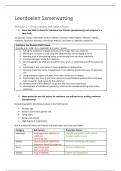
Module 1 – Drug craving and neural basis
1. Name the DSM-5 criteria for Substance Use Disorder [paraphrasing] and recognize in a
case study
10 separate classes in the DSM: alcohol, caffeine, cannabis, hallucinogens, inhalants, opioids,
sedatives, hypnotics, axiolytics, stimulants, tobacco, and other or unknown substances
Substance Use Disorder DSM Criteria:
Severity: 2-3 = mild 4-5 = moderate 6 or more = severe
1. Taking the substance in larger amounts or for longer than you meant to
2. Wanting to cut down or stop using the substance but not managing to do so
3. Spending a lot of time getting, using, or recovering from use of the substance
4. Cravings and urges to use the substance
5. Not managing to do what you should at home, work, or school because of the substance
use
6. Continuing to use, even when it causes problems in relationships
7. Giving up important social, occupational, or recreational activities because of substance
use
8. Using substances again and again, even when it puts you in danger
9. Continuing to use, even if you have a physical or psychological problem that could have
been caused or made worse by the substance
10. Needing more of the substance to get the effect you want (tolerance)
11. Development of withdrawal symptoms, which can be relieved by taking more of the
substance
2. Name protective and risk factors for substance use and barriers to seeking treatment
[paraphrasing]
Sociodemographics of substance abuse in the Netherlands:
• Younger age
• Gender; men have a greater risk
• Living alone
• Being unemployed
• High degree of urbanization
Risk & protective factors can interact with each other and cause each other.
Category Risk factors Protective factors
Individual Early aggressive behavior in Self-efficacy (belief in self-control)
childhood Academic performance
Early drug use
Family Lack of parental supervision Parental monitoring and support
Substance abuse by caregivers
Peers Low refusal skills Positive relationships
Poor social skills
School Drug availability School anti-drug policies
, Community Community poverty Neighbourhood resources
Addictive Administration through smoking
potential drugs or injecting
No single factor can predict whether an individual will develop substance abuse.
The interaction between factors influences risk for addiction: negative consequences can
maintain/worsen the abuse
-> This causes a vicious cycle
Barriers to seeking treatment
• Attitudinal: 'I thought it would get better', 'I thought I could handle it myself'
• Readiness for change: 'I thought the problem wasn't serious enough'
o Can be targeted by motivational interviewing
• Stigma: 'I was too embarrassed to discuss it'
• Financial/Cost: 'Health insurance didn't cover treatment'
• Structural: 'I didn't know where to go/how to get there'
3. Explain the role of withdrawal symptoms in substance abuse [analyzing]
Traditional view: drugs are taken to avoid the unpleasant withdrawal symptoms & thus compulsive
drug taking in maintained to avoid unpleasant symptoms
Incentive-salience theory: pleasure and withdrawal are unlikely to be a complete explanation of
addiction:
• Drug withdrawal may be less powerful at motivating than people think: it is ineffective to
directly motivate drug taking
• There is no explanation for why addicts so often relapse even after they have long been free
from withdrawal symptoms
4. Describe the history of the concept of addiction (i.e., the different models) [paraphrasing]
Models of addiction:
• Moral model (1800): addiction is a sign of moral weakness -> people with an addiction were
locked up
• Pharmacological model (mid-19th century): the highly addictive characteristics of the
substance causes the addiction -> countermeasure is preventing people from getting
involved with these dangerous substances
• Symptomatic model (1930-1950): addiction is a symptom of an underlying character-
neurosis or personality disorder -> psycho-therapeutic treatment
• Disease model (1940-1960): fundamental biological and psychological differences exist
between addicts and non-addicts, due to which addicts can't use drugs in moderation. Main
features are uncontrollability and physical dependence -> AA
• Learning theory model (1960-1970) -> addiction is a form of maladaptive behavior that
could be un-learned again with the help of behavioral therapeutic interventions.
, • Bio-psycho-social model (1970 – 1990) -> social circumstances, in addition to biological and
psychological causes, play an important role in the development of addictive behavior. The
onset and termination of the addiction are seen as the result of a continuous interaction
between innate vulnerability (bio), personal development (psycho) and circumstances
(social).
• Brain disease model (1990-...) -> an innate vulnerability forms the indispensable basis for
repeated use of psychoactive substances, while the repeated use of these substances in turn
leads to important, difficult to reverse, changes in the brain. -> pharmalogical and behavioral
therapeutic interventions
5. Give 3 arguments in favour of a neurobiological (brain disease) perspective on substance
abuse, and 3 against [evaluating] (*this will partly be covered during the first ACD tutorial)
Brain disease model: addiction might be better considered and treated as a disease of the brain
-> It's similar to other chronic diseases
-> Central brain dysfunctions: hyperactive reward system (incentive sensitization) & cognitive
dysfunction
Arguments in favour of the brain disease Arguments against the brain disease model
model
Addiction is a disorder of fronto-striatal circuits: Some brain functions do show recovery
• all substances of abuse have in
common that they affect dopamine
pathways involved in craving and habits
• Alcohol and substance abuse are
associated with altered function and
gray matter losses in the prefrontal
cortex, insula and cingulate cortex,
regions involved in top-down cognitive
control over behavior
• In line with the notion of a chronic
disease, these changes in brain function
and structure are long-lasting and
persist after the individual stops taking
the drug
Neuroimaging as the ultimate diagnostic tool is Brain lesions/dysfunctions are not sufficiently
not a realistic demand. Other neuropsychiatric specific to support diagnosis
disorders can also not be diagnosed on the
basis of brain scans.
Neuroimaging helps to reveal underlying
mechanisms, and these insights can identify
targets for behavioral and pharmacological
treatment and personalized medicine
strategies.
True, that's why convergence with findings Neuroimaging studies just offer correlational
from experimental animal models is so (not causal) evidence
important
, That's not an argument against the brain Availability, costs, social influences, policies and
disease model, as these factors ultimately exert socioeconomic factors also play an important
their influences on behaviour by impacting role in addiction
neural processes.
That's correct, but that's because genetic risk is A genetic predisposition is not a recipe for
probabilistic, not deterministic compulsion
• Meta-analysis of twin and adoption
studies has estimated heritability at
50% in alcohol addiction, indicating
that DNA sequence variation accounts
for 50% of the risk for this condition
• Polygenic risk factors are shared across
different substances
Total abstinence for the rest of one's life is a Spontaneous remission: large proportions of
relatively rare treatment outcome individuals achieve natural recovery in the
• Test-retest reliability is likely to be low absence of any formal treatment
in people with only mild SUD. People at
the severe end of the spectrum do tend
to show a chronic relapsing course
The view of the chronic illness helps people to The brain disease model doesn't allievate
get the treatment that they deserve stigma, sometimes even worsens it
6. Indicate the difference between Pavlovian and instrumental conditioning [paraphrasing]
and be able to apply this to a concrete example of behaviour [analyzing]
Pavlovian conditioning = a biologically potent stimulus is paired with a neutral stimulus which
eventually causes a conditioned response to be paired with the specific, neutral stimulus
It is defined as: a change in behavior due to experience with a relationship between a (neutral)
conditioned stimulus (CS) and a (motivationally relevant) unconditioned stimulus (US)
When drug users are exposed to associated stimuli, these is increased activity in the NAcc.
There is also an increase in dopamine activity: Thus motivationally significant events are reflected in
phasic dopamine firing.
Module 1 – Drug craving and neural basis
1. Name the DSM-5 criteria for Substance Use Disorder [paraphrasing] and recognize in a
case study
10 separate classes in the DSM: alcohol, caffeine, cannabis, hallucinogens, inhalants, opioids,
sedatives, hypnotics, axiolytics, stimulants, tobacco, and other or unknown substances
Substance Use Disorder DSM Criteria:
Severity: 2-3 = mild 4-5 = moderate 6 or more = severe
1. Taking the substance in larger amounts or for longer than you meant to
2. Wanting to cut down or stop using the substance but not managing to do so
3. Spending a lot of time getting, using, or recovering from use of the substance
4. Cravings and urges to use the substance
5. Not managing to do what you should at home, work, or school because of the substance
use
6. Continuing to use, even when it causes problems in relationships
7. Giving up important social, occupational, or recreational activities because of substance
use
8. Using substances again and again, even when it puts you in danger
9. Continuing to use, even if you have a physical or psychological problem that could have
been caused or made worse by the substance
10. Needing more of the substance to get the effect you want (tolerance)
11. Development of withdrawal symptoms, which can be relieved by taking more of the
substance
2. Name protective and risk factors for substance use and barriers to seeking treatment
[paraphrasing]
Sociodemographics of substance abuse in the Netherlands:
• Younger age
• Gender; men have a greater risk
• Living alone
• Being unemployed
• High degree of urbanization
Risk & protective factors can interact with each other and cause each other.
Category Risk factors Protective factors
Individual Early aggressive behavior in Self-efficacy (belief in self-control)
childhood Academic performance
Early drug use
Family Lack of parental supervision Parental monitoring and support
Substance abuse by caregivers
Peers Low refusal skills Positive relationships
Poor social skills
School Drug availability School anti-drug policies
, Community Community poverty Neighbourhood resources
Addictive Administration through smoking
potential drugs or injecting
No single factor can predict whether an individual will develop substance abuse.
The interaction between factors influences risk for addiction: negative consequences can
maintain/worsen the abuse
-> This causes a vicious cycle
Barriers to seeking treatment
• Attitudinal: 'I thought it would get better', 'I thought I could handle it myself'
• Readiness for change: 'I thought the problem wasn't serious enough'
o Can be targeted by motivational interviewing
• Stigma: 'I was too embarrassed to discuss it'
• Financial/Cost: 'Health insurance didn't cover treatment'
• Structural: 'I didn't know where to go/how to get there'
3. Explain the role of withdrawal symptoms in substance abuse [analyzing]
Traditional view: drugs are taken to avoid the unpleasant withdrawal symptoms & thus compulsive
drug taking in maintained to avoid unpleasant symptoms
Incentive-salience theory: pleasure and withdrawal are unlikely to be a complete explanation of
addiction:
• Drug withdrawal may be less powerful at motivating than people think: it is ineffective to
directly motivate drug taking
• There is no explanation for why addicts so often relapse even after they have long been free
from withdrawal symptoms
4. Describe the history of the concept of addiction (i.e., the different models) [paraphrasing]
Models of addiction:
• Moral model (1800): addiction is a sign of moral weakness -> people with an addiction were
locked up
• Pharmacological model (mid-19th century): the highly addictive characteristics of the
substance causes the addiction -> countermeasure is preventing people from getting
involved with these dangerous substances
• Symptomatic model (1930-1950): addiction is a symptom of an underlying character-
neurosis or personality disorder -> psycho-therapeutic treatment
• Disease model (1940-1960): fundamental biological and psychological differences exist
between addicts and non-addicts, due to which addicts can't use drugs in moderation. Main
features are uncontrollability and physical dependence -> AA
• Learning theory model (1960-1970) -> addiction is a form of maladaptive behavior that
could be un-learned again with the help of behavioral therapeutic interventions.
, • Bio-psycho-social model (1970 – 1990) -> social circumstances, in addition to biological and
psychological causes, play an important role in the development of addictive behavior. The
onset and termination of the addiction are seen as the result of a continuous interaction
between innate vulnerability (bio), personal development (psycho) and circumstances
(social).
• Brain disease model (1990-...) -> an innate vulnerability forms the indispensable basis for
repeated use of psychoactive substances, while the repeated use of these substances in turn
leads to important, difficult to reverse, changes in the brain. -> pharmalogical and behavioral
therapeutic interventions
5. Give 3 arguments in favour of a neurobiological (brain disease) perspective on substance
abuse, and 3 against [evaluating] (*this will partly be covered during the first ACD tutorial)
Brain disease model: addiction might be better considered and treated as a disease of the brain
-> It's similar to other chronic diseases
-> Central brain dysfunctions: hyperactive reward system (incentive sensitization) & cognitive
dysfunction
Arguments in favour of the brain disease Arguments against the brain disease model
model
Addiction is a disorder of fronto-striatal circuits: Some brain functions do show recovery
• all substances of abuse have in
common that they affect dopamine
pathways involved in craving and habits
• Alcohol and substance abuse are
associated with altered function and
gray matter losses in the prefrontal
cortex, insula and cingulate cortex,
regions involved in top-down cognitive
control over behavior
• In line with the notion of a chronic
disease, these changes in brain function
and structure are long-lasting and
persist after the individual stops taking
the drug
Neuroimaging as the ultimate diagnostic tool is Brain lesions/dysfunctions are not sufficiently
not a realistic demand. Other neuropsychiatric specific to support diagnosis
disorders can also not be diagnosed on the
basis of brain scans.
Neuroimaging helps to reveal underlying
mechanisms, and these insights can identify
targets for behavioral and pharmacological
treatment and personalized medicine
strategies.
True, that's why convergence with findings Neuroimaging studies just offer correlational
from experimental animal models is so (not causal) evidence
important
, That's not an argument against the brain Availability, costs, social influences, policies and
disease model, as these factors ultimately exert socioeconomic factors also play an important
their influences on behaviour by impacting role in addiction
neural processes.
That's correct, but that's because genetic risk is A genetic predisposition is not a recipe for
probabilistic, not deterministic compulsion
• Meta-analysis of twin and adoption
studies has estimated heritability at
50% in alcohol addiction, indicating
that DNA sequence variation accounts
for 50% of the risk for this condition
• Polygenic risk factors are shared across
different substances
Total abstinence for the rest of one's life is a Spontaneous remission: large proportions of
relatively rare treatment outcome individuals achieve natural recovery in the
• Test-retest reliability is likely to be low absence of any formal treatment
in people with only mild SUD. People at
the severe end of the spectrum do tend
to show a chronic relapsing course
The view of the chronic illness helps people to The brain disease model doesn't allievate
get the treatment that they deserve stigma, sometimes even worsens it
6. Indicate the difference between Pavlovian and instrumental conditioning [paraphrasing]
and be able to apply this to a concrete example of behaviour [analyzing]
Pavlovian conditioning = a biologically potent stimulus is paired with a neutral stimulus which
eventually causes a conditioned response to be paired with the specific, neutral stimulus
It is defined as: a change in behavior due to experience with a relationship between a (neutral)
conditioned stimulus (CS) and a (motivationally relevant) unconditioned stimulus (US)
When drug users are exposed to associated stimuli, these is increased activity in the NAcc.
There is also an increase in dopamine activity: Thus motivationally significant events are reflected in
phasic dopamine firing.



