Week 1
Lecture 1: Case formulation approach & functional analyses
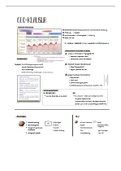
Basic principles of CBT
● Cognitive behavioral therapy→ systematic, action-oriented
psychological treatment to improve mental health
● Focus on challenging and changing unhelpful cognitions, behaviors and emotions
● Umbrella term⇒ several types of treatments
○ More cognitive focused variant by Beck
○ Exposure therapy
○ Behavioral activation
○ Related to EMDR, mindfulness, ACT, EFT,...
● Treats depression, anxiety, PTSD, ODC, ticks, SUD, psychotic disorders
● Cognitions, behaviors and emotions are interconnected
CASE CONCEPTUALIZATION
Core ideas:
❖ The problem described by the patient is
not 1-1 with treatment plan ⇒ no direct
link
❖ Focus on understanding WHY
➢ Understanding where the behavior is
happening and why⇒ treatment looks
entirely different based on these
answers (even if the behavior is
the same for two people)
■ Two people can have the same
problem, but the analysis could direct to totally different treatments
❖ Develop hypotheses
, ➢ Based on individual analyses
➢ Information gathering
➢ Link to theoretical models
❖ During treatment and evaluation phase: Test your hypotheses
➢ Is it an effective intervention?
➢ Are the symptoms reducing?
➢ Should different therapeutic methods be used
❖ After evaluation go back to reflect whether you missed something (info
gathering and individual analyses)⇒ Constant reflection
With complex problems→ individual analyses result in better treatment
effects
Different types of case formulation:
- Behavioral, cognitive or cognitive behavioral case formulation
Summary of client formulation:
- Guides treatment
- Guides the selection, focus and sequence of interventions
- Identifies client strengths and suggests ways to build client resilience
- Helps understand non-response in therapy and suggests alternatives for change
INDIVIDUAL ANALYSES: FUNCTIONAL ANALYSIS
Conditioning models helps understanding behavior (adaptive and maladaptive)
➢ Classical conditioning
○ Unconditional stimulus gets paired with another stimulus and results in a
conditioned response
➢ Operant conditioning
○ Reinforcement→ increases behavior
■ Positive= addition of stimulus
■ Negative removal of stimulus
○ Punishment→ decreases behavior
■ Positive= addition of stimulus
■ Negative = removal of stimulus
Functional analyses
3 elements in FA (ABC):
Lecture 1: Case formulation approach & functional analyses
Basic principles of CBT
● Cognitive behavioral therapy→ systematic, action-oriented
psychological treatment to improve mental health
● Focus on challenging and changing unhelpful cognitions, behaviors and emotions
● Umbrella term⇒ several types of treatments
○ More cognitive focused variant by Beck
○ Exposure therapy
○ Behavioral activation
○ Related to EMDR, mindfulness, ACT, EFT,...
● Treats depression, anxiety, PTSD, ODC, ticks, SUD, psychotic disorders
● Cognitions, behaviors and emotions are interconnected
CASE CONCEPTUALIZATION
Core ideas:
❖ The problem described by the patient is
not 1-1 with treatment plan ⇒ no direct
link
❖ Focus on understanding WHY
➢ Understanding where the behavior is
happening and why⇒ treatment looks
entirely different based on these
answers (even if the behavior is
the same for two people)
■ Two people can have the same
problem, but the analysis could direct to totally different treatments
❖ Develop hypotheses
, ➢ Based on individual analyses
➢ Information gathering
➢ Link to theoretical models
❖ During treatment and evaluation phase: Test your hypotheses
➢ Is it an effective intervention?
➢ Are the symptoms reducing?
➢ Should different therapeutic methods be used
❖ After evaluation go back to reflect whether you missed something (info
gathering and individual analyses)⇒ Constant reflection
With complex problems→ individual analyses result in better treatment
effects
Different types of case formulation:
- Behavioral, cognitive or cognitive behavioral case formulation
Summary of client formulation:
- Guides treatment
- Guides the selection, focus and sequence of interventions
- Identifies client strengths and suggests ways to build client resilience
- Helps understand non-response in therapy and suggests alternatives for change
INDIVIDUAL ANALYSES: FUNCTIONAL ANALYSIS
Conditioning models helps understanding behavior (adaptive and maladaptive)
➢ Classical conditioning
○ Unconditional stimulus gets paired with another stimulus and results in a
conditioned response
➢ Operant conditioning
○ Reinforcement→ increases behavior
■ Positive= addition of stimulus
■ Negative removal of stimulus
○ Punishment→ decreases behavior
■ Positive= addition of stimulus
■ Negative = removal of stimulus
Functional analyses
3 elements in FA (ABC):