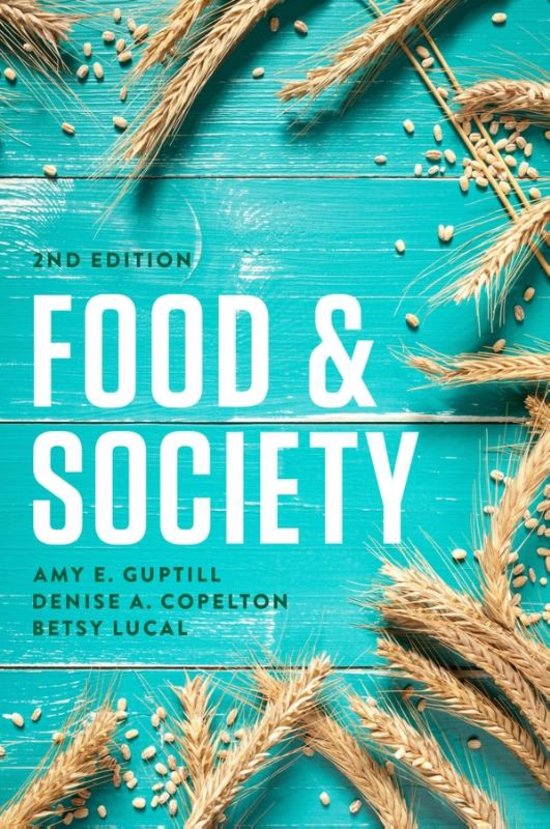
Amy E. Guptill, Denise A. Copelton and Betsy Lucal;
Food & Society. Principles and Paradoxes.
Chapter 1 Principles and paradoxes in the study of food
Racial eating contests: staged by whites for white audience. Similarity with today’s competitive
eating in form. Social and cultural contexts make them distinct.
Foodways = patterns that establish ‘’what we eat, how and why and under what circumstances we
eat’’.
Focus on food preparation, consumption, cultural dimensions of food and eating
Key element of foodways = what we eat.
Food system = the set of vast, interlinked institutions and processes that transform sunlight, water
and soil into meaning-laden foods. It highlights the production, processing and distribution of food
and turns our attention to the materiality of the food we eat.
Major purpose of a food system = providing nutrition to keep us alive.
Historically, food systems small and localized. As technologies advanced and populations grew, food
systems became more complex. Workings of food systems are invisible do not understand how
complex the system is.
Food production (too much or too little rain can interfere) processing (strike by workers can shut
down processing) distributed (hurricane can interrupt, trucking company going bankrupt)
consumer
Waste: all the parts that we do not eat (including packaging, wastewater, chemicals).
Three principles (underlying the interdisciplinary study of food and society help frame our
understanding):
1. Food is both richly symbolic and undeniably material
a. Both social and physiological dimensions of food help explain food choices (comfort
food)
2. People’s experiences with food are individual and social
a. The practices we participate in reveal much about our social location and multiple
identities
3. Social inequality persistent patterns in which some people enjoy more material and
cultural privileges than others.
These principles provide a conceptual framework organizes our exploration of this field.
Paradoxes: the individual and society
Social constructionist perspective out of frustration with structuralism’s tendency to make existing
structures seem inevitable and immutable and to frame individuals as passive.
Social constructionism = emphasizes individuals’ agency, when people make choices and behave in
certain ways, they help to shape the social world in which they live. Persistence of patterns
because of continually reproduction by human action.
,Agency does not mean freedom from social influence; it means navigating and shaping social and
cultural landscapes both individually and collectively.
Personal food value systems = set of processes people use to make choices about foods they eat
taste, health, cost, time and social relationships were the 5 main values around which these systems
revolved.
Chapter 2 Food and Identity: fitting in and standing out
Identity work = activity through which we define for ourselves and other who we are socially and
culturally.
Symbol = something that stands for something else
Status symbols = objects that signify one’s position (or social status) in society
Relationship between food and identity is complex interplay of individual and society.
Food functions also as status symbol, shaping how we see ourselves and how others view us. Food is
consumed through the social act of eating plays significant role in social construction of identity.
Rituals = social activities performed primarily for their symbolic significance, rather than for practical
end
Religious rituals can contribute to social solidarity (the feelings of ‘’we-ness’’ within groups). It gives
participants feelings of connection to other past and present members. Rituals are key to maintaining
group identity and values, and powerful agents of social transformation
Food and national and regional identity
Cuisines = distinct sets of ingredients, flavor principles, and cooking techniques foster unique
national and regional identities.
National/regional cuisines stems from distinctive local agricultures, ethnic, religious and other social
differences associated with people of the giving area, representing structural and cultural
dimensions.
Structural differences have more to do with how economic and political systems, geography and
climate, shape foodways. Link between food and identity is not simply a matter of individual
preference or choice shaped by social structural features beyond the control of anybody.
National rituals of solidarity are important for generating feelings of social cohesion and symbolically
incorporating new members.
Invented traditions (like thanksgiving) serve 3 important purposes:
1. They symbolize social cohesion and create strong collective identity
2. They establish new social institutions and legitimize existing ones
3. They socialize individuals into the shared norms and values of the group practicing them
All countries, particularly multicultural ones, need rituals to create a sense of national community.
Benedict Anderson calls nations imagined communities since ‘’members of the smallest nation will
never know most of their fellow-members, meet them, or even hear of them, yet in the minds of
, each lives the image of their communion.’’ this concept helps to explain why for example
Thanksgiving is an important ritual.
Rituals can also reflect persistent inequalities.
Food and racial-ethnic identity
Ethnic revival = when Americans sought to reclaim their ethnic heritage as a response to the
hegemonic process (=the way dominant cultural forms incorporate and thereby erase cultural
distinctions)
Reclaiming a lost ethnic heritage creates a neo-ethnicity. In seeking neo-ethnicity, members of the
grassroots ethnic revival embraced traditional cultural forms (like ethnic foodways).
Culinary tourists = those who view ethnic food as an enjoyable respite from normal and mundane
foodways.
Because ethnic food was linked to high-quality ingredients and supposedly authentic and time-
consuming cooking techniques, manufacturers could present packaged ethnic food as a specialty
product with higher prices.
Mainstream corporations acquired businesses to expand their profits by moving from mass
marketing to micro-marketing = promoting specific products to narrowly defined consumer groups
based on age, gender, ethnicity and other social statuses.
- Advantage: through this marketing, corporations could market ethnic goods to middle-and
upper-class families who could afford their higher costs, and other generations immigrants
who lacked the time and knowledge to cook ethnic food.
Food and social class identity
Lower-class groups tend to have poorer diets than higher-status groups healthier foods cost more
cost produces a social class gradient in diet and nutrition
Bourdieu noted 3 differences between upper-class and working-class foodways:
1. Upper-class foodways require one to defer gratification, while working-class ones embrace
immediate satisfaction
2. Upper-class foodways valorize difficult and time-consuming dishes, while working-class ones
celebrate simple and quick ones
3. Upper-class culture prioritizes form, while working-class culture emphasizes substance and
function
Many people in affluent countries participate in both classes foodways at times; Bourdieu notes that
social class influences which ones a person finds accessible and enjoyable.
Food and gender identity
There are multiple ways in which food is gendered:
- Within a culture, particular foods or dishes are constructed as masculine or feminine.
- Men and women have different relationships with food (women concern with food and
weight)
- Men have increased their share of household labor, women still perform the bulk of
housework, including feeding work (= planning and provisioning meals and preparing)
Food & Society. Principles and Paradoxes.
Chapter 1 Principles and paradoxes in the study of food
Racial eating contests: staged by whites for white audience. Similarity with today’s competitive
eating in form. Social and cultural contexts make them distinct.
Foodways = patterns that establish ‘’what we eat, how and why and under what circumstances we
eat’’.
Focus on food preparation, consumption, cultural dimensions of food and eating
Key element of foodways = what we eat.
Food system = the set of vast, interlinked institutions and processes that transform sunlight, water
and soil into meaning-laden foods. It highlights the production, processing and distribution of food
and turns our attention to the materiality of the food we eat.
Major purpose of a food system = providing nutrition to keep us alive.
Historically, food systems small and localized. As technologies advanced and populations grew, food
systems became more complex. Workings of food systems are invisible do not understand how
complex the system is.
Food production (too much or too little rain can interfere) processing (strike by workers can shut
down processing) distributed (hurricane can interrupt, trucking company going bankrupt)
consumer
Waste: all the parts that we do not eat (including packaging, wastewater, chemicals).
Three principles (underlying the interdisciplinary study of food and society help frame our
understanding):
1. Food is both richly symbolic and undeniably material
a. Both social and physiological dimensions of food help explain food choices (comfort
food)
2. People’s experiences with food are individual and social
a. The practices we participate in reveal much about our social location and multiple
identities
3. Social inequality persistent patterns in which some people enjoy more material and
cultural privileges than others.
These principles provide a conceptual framework organizes our exploration of this field.
Paradoxes: the individual and society
Social constructionist perspective out of frustration with structuralism’s tendency to make existing
structures seem inevitable and immutable and to frame individuals as passive.
Social constructionism = emphasizes individuals’ agency, when people make choices and behave in
certain ways, they help to shape the social world in which they live. Persistence of patterns
because of continually reproduction by human action.
,Agency does not mean freedom from social influence; it means navigating and shaping social and
cultural landscapes both individually and collectively.
Personal food value systems = set of processes people use to make choices about foods they eat
taste, health, cost, time and social relationships were the 5 main values around which these systems
revolved.
Chapter 2 Food and Identity: fitting in and standing out
Identity work = activity through which we define for ourselves and other who we are socially and
culturally.
Symbol = something that stands for something else
Status symbols = objects that signify one’s position (or social status) in society
Relationship between food and identity is complex interplay of individual and society.
Food functions also as status symbol, shaping how we see ourselves and how others view us. Food is
consumed through the social act of eating plays significant role in social construction of identity.
Rituals = social activities performed primarily for their symbolic significance, rather than for practical
end
Religious rituals can contribute to social solidarity (the feelings of ‘’we-ness’’ within groups). It gives
participants feelings of connection to other past and present members. Rituals are key to maintaining
group identity and values, and powerful agents of social transformation
Food and national and regional identity
Cuisines = distinct sets of ingredients, flavor principles, and cooking techniques foster unique
national and regional identities.
National/regional cuisines stems from distinctive local agricultures, ethnic, religious and other social
differences associated with people of the giving area, representing structural and cultural
dimensions.
Structural differences have more to do with how economic and political systems, geography and
climate, shape foodways. Link between food and identity is not simply a matter of individual
preference or choice shaped by social structural features beyond the control of anybody.
National rituals of solidarity are important for generating feelings of social cohesion and symbolically
incorporating new members.
Invented traditions (like thanksgiving) serve 3 important purposes:
1. They symbolize social cohesion and create strong collective identity
2. They establish new social institutions and legitimize existing ones
3. They socialize individuals into the shared norms and values of the group practicing them
All countries, particularly multicultural ones, need rituals to create a sense of national community.
Benedict Anderson calls nations imagined communities since ‘’members of the smallest nation will
never know most of their fellow-members, meet them, or even hear of them, yet in the minds of
, each lives the image of their communion.’’ this concept helps to explain why for example
Thanksgiving is an important ritual.
Rituals can also reflect persistent inequalities.
Food and racial-ethnic identity
Ethnic revival = when Americans sought to reclaim their ethnic heritage as a response to the
hegemonic process (=the way dominant cultural forms incorporate and thereby erase cultural
distinctions)
Reclaiming a lost ethnic heritage creates a neo-ethnicity. In seeking neo-ethnicity, members of the
grassroots ethnic revival embraced traditional cultural forms (like ethnic foodways).
Culinary tourists = those who view ethnic food as an enjoyable respite from normal and mundane
foodways.
Because ethnic food was linked to high-quality ingredients and supposedly authentic and time-
consuming cooking techniques, manufacturers could present packaged ethnic food as a specialty
product with higher prices.
Mainstream corporations acquired businesses to expand their profits by moving from mass
marketing to micro-marketing = promoting specific products to narrowly defined consumer groups
based on age, gender, ethnicity and other social statuses.
- Advantage: through this marketing, corporations could market ethnic goods to middle-and
upper-class families who could afford their higher costs, and other generations immigrants
who lacked the time and knowledge to cook ethnic food.
Food and social class identity
Lower-class groups tend to have poorer diets than higher-status groups healthier foods cost more
cost produces a social class gradient in diet and nutrition
Bourdieu noted 3 differences between upper-class and working-class foodways:
1. Upper-class foodways require one to defer gratification, while working-class ones embrace
immediate satisfaction
2. Upper-class foodways valorize difficult and time-consuming dishes, while working-class ones
celebrate simple and quick ones
3. Upper-class culture prioritizes form, while working-class culture emphasizes substance and
function
Many people in affluent countries participate in both classes foodways at times; Bourdieu notes that
social class influences which ones a person finds accessible and enjoyable.
Food and gender identity
There are multiple ways in which food is gendered:
- Within a culture, particular foods or dishes are constructed as masculine or feminine.
- Men and women have different relationships with food (women concern with food and
weight)
- Men have increased their share of household labor, women still perform the bulk of
housework, including feeding work (= planning and provisioning meals and preparing)