1 SCHMIDT – INTRODUCTION TO MOTOR LEARNING AND PERFORMANCE
Theories and hypothesis
An experiment that supports a hypothesis is not the strongest type of evidence. What is usually far
stronger is if the results are contrary (= tegengesteld) to the prediction: the theory must be incorrect.
Definition of skill
‘’The ability to get some desired end result with maximum certainty and minimum time and energy.’’
There are four important components of the definition ‘skill’:
1. Movement with environmental goal
2. Maximization of the certainty (= zekerheid) to achieve the goal, so it isn’t based on luck
3. Minimization of the energy: physical and mental
4. Minimization of the time used
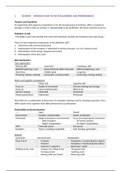
Skill classification
Task organization
Discrete skill Serial skill Continuous skill
Definite beginning + end Several discrete skills connected Without beginning + end
Short time Middle rated Long time
Throwing, kicking, catching Gymnastics, brushing teeth Swimming, running, skating
Motor and cognitive components
---- Motor skill Cognitive skill
Focus on Quality of movement Decision making and strategy
Focus on Correct performance What to do
Decision making Minimized Maximized
Motor performance Maximized Minimized
Most skills are a combination of those two. For example: drawing a trail or climbing mountains. New
skills require more cognition than skills performed by a professional.
Predictability of the environment
---- Open Closed
Environment Variable, unpredictable Stable, predictable
Movement Adapt movement on environment Focus on producing the movement
- Body transport - No body transport
- Object manipulation - No object manipulation
Skills Externally paced Self-paced
Examples Tennis, wrestling, basketball Golf, bowling, gymnastics
Didactic
Locomotor Non-locomotor Manipulative
From A to B - Transfers - Propulsive (= accelerating the object)
- Postures - Receptive (= decelerating the object)
- Gestures (= gebaren) - Bouncing (= both)
Walking to the chair - Going to sit, rolling in bed - Throwing a ball
- Turning around - Catching a ball
- Waving with your hands - Bouncing a ball
, Theory stages of performance and learning
---- Early learning Later stage
Gentile Getting the idea of the movement Fixed or variety
Newell Understanding basic patterns Controlled
Fitts and Posner Cognitive, associative stage Autonomous
Adams Verbal stage (talk) Motor stage (movement)
Other examples of classifications are:
- Simple motor task | Plural motor tasks
- Fine motor movement | Gross motor movement
2 SCHMIDT – PROCESSING INFORMATION AND MAKING DECISIONS
Information processing
Information processing Explanation Example
Input - -
1. Stimulus identification Sensory sources (vision / smell) Seeing traffic lights
What is the stimulus?
2. Response selection Decision making Yes, I have to slow speed
What response to make?
3. Movement programming Organizing the motor system to Planning to slow speed
make the movement
Output - -
There is no overlapping between the stages.
Reaction time (RT)
RT is the period of time between the start of the
stimulus and beginning the movement response.
It is the duration of the 3 stages of processing
information. RT is important to measure the
speed and effectiveness of decision making.
Number of Stimulus-Response alternatives
- A factor that influences RT
- The more numbers of S-R alternatives there are the longer the RT
- The fastest situation is simple RT, because there is only one stimulus and one response
- Hick’s Law Choice RT = a + b log2 (N)
Theories and hypothesis
An experiment that supports a hypothesis is not the strongest type of evidence. What is usually far
stronger is if the results are contrary (= tegengesteld) to the prediction: the theory must be incorrect.
Definition of skill
‘’The ability to get some desired end result with maximum certainty and minimum time and energy.’’
There are four important components of the definition ‘skill’:
1. Movement with environmental goal
2. Maximization of the certainty (= zekerheid) to achieve the goal, so it isn’t based on luck
3. Minimization of the energy: physical and mental
4. Minimization of the time used
Skill classification
Task organization
Discrete skill Serial skill Continuous skill
Definite beginning + end Several discrete skills connected Without beginning + end
Short time Middle rated Long time
Throwing, kicking, catching Gymnastics, brushing teeth Swimming, running, skating
Motor and cognitive components
---- Motor skill Cognitive skill
Focus on Quality of movement Decision making and strategy
Focus on Correct performance What to do
Decision making Minimized Maximized
Motor performance Maximized Minimized
Most skills are a combination of those two. For example: drawing a trail or climbing mountains. New
skills require more cognition than skills performed by a professional.
Predictability of the environment
---- Open Closed
Environment Variable, unpredictable Stable, predictable
Movement Adapt movement on environment Focus on producing the movement
- Body transport - No body transport
- Object manipulation - No object manipulation
Skills Externally paced Self-paced
Examples Tennis, wrestling, basketball Golf, bowling, gymnastics
Didactic
Locomotor Non-locomotor Manipulative
From A to B - Transfers - Propulsive (= accelerating the object)
- Postures - Receptive (= decelerating the object)
- Gestures (= gebaren) - Bouncing (= both)
Walking to the chair - Going to sit, rolling in bed - Throwing a ball
- Turning around - Catching a ball
- Waving with your hands - Bouncing a ball
, Theory stages of performance and learning
---- Early learning Later stage
Gentile Getting the idea of the movement Fixed or variety
Newell Understanding basic patterns Controlled
Fitts and Posner Cognitive, associative stage Autonomous
Adams Verbal stage (talk) Motor stage (movement)
Other examples of classifications are:
- Simple motor task | Plural motor tasks
- Fine motor movement | Gross motor movement
2 SCHMIDT – PROCESSING INFORMATION AND MAKING DECISIONS
Information processing
Information processing Explanation Example
Input - -
1. Stimulus identification Sensory sources (vision / smell) Seeing traffic lights
What is the stimulus?
2. Response selection Decision making Yes, I have to slow speed
What response to make?
3. Movement programming Organizing the motor system to Planning to slow speed
make the movement
Output - -
There is no overlapping between the stages.
Reaction time (RT)
RT is the period of time between the start of the
stimulus and beginning the movement response.
It is the duration of the 3 stages of processing
information. RT is important to measure the
speed and effectiveness of decision making.
Number of Stimulus-Response alternatives
- A factor that influences RT
- The more numbers of S-R alternatives there are the longer the RT
- The fastest situation is simple RT, because there is only one stimulus and one response
- Hick’s Law Choice RT = a + b log2 (N)