

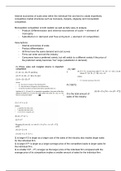
Internal economies of scale arise within the individual firm and tend to create imperfectly
competitive market structures such as monopoly, duopoly, oligopoly and monopolistic
competition.
Monopolistic competition is both realistic as well as fairly easy to analyse.
- Product differentiation and internal economies of scale → element of
monopoly.
- Substitution in demand and free entry/exit → element of competition.
Assumptions:
- Internal economies of scale
- Product differentiation
- All firms have the same demand and cost curves
- Firms can enter and exit the industry
- Consumers have a preferred variety, but will switch to a different variety if the price of
the preferred variety becomes “too” large (substitution in demand).
(5) MR
=
P-(1/B)*Q
S is the total amount of
sales of the industry
Q is larger if S is larger as a larger size of the sales of the industry also implies larger sales
for the individual firm.
Q is larger if P* is larger as a larger average price of the competitors leads to larger sales for
the individual firm.
Q is smaller if (P – P*) is larger as the larger price of the individual firm compared with the
average price of its competitors implies a smaller amount of sales for the individual firm.
competitive market structures such as monopoly, duopoly, oligopoly and monopolistic
competition.
Monopolistic competition is both realistic as well as fairly easy to analyse.
- Product differentiation and internal economies of scale → element of
monopoly.
- Substitution in demand and free entry/exit → element of competition.
Assumptions:
- Internal economies of scale
- Product differentiation
- All firms have the same demand and cost curves
- Firms can enter and exit the industry
- Consumers have a preferred variety, but will switch to a different variety if the price of
the preferred variety becomes “too” large (substitution in demand).
(5) MR
=
P-(1/B)*Q
S is the total amount of
sales of the industry
Q is larger if S is larger as a larger size of the sales of the industry also implies larger sales
for the individual firm.
Q is larger if P* is larger as a larger average price of the competitors leads to larger sales for
the individual firm.
Q is smaller if (P – P*) is larger as the larger price of the individual firm compared with the
average price of its competitors implies a smaller amount of sales for the individual firm.



