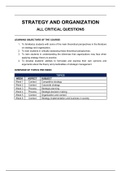
STRATEGY AND ORGANIZATION
ALL CRITICAL QUESTIONS
LEARNING OBJECTIVES OF THE COURSE:
1. To familiarize students with some of the main theoretical perspectives in the literature
on strategy and organization.
2. To train students in critically assessing these theoretical perspectives.
3. To train students in understanding the dilemmas that organizations may face when
applying strategy theory to practice.
4. To develop students’ abilities to formulate and express their own opinions and
arguments about the theory and practicalities of strategic management
OVERVIEW OF TOPICS PER WEEK
TOPICS
WEEK ASPECT SUBJECT
Week 1 Content Competitive strategy
Week 2 Content Corporate strategy
Week 3 Process Strategic planning
Week 4 Process Strategic-decision making
Week 5 Context Organization and context
Week 6 Context Strategy implementation and business in society
,1. WEEK 1 – COMPETITIVE STRATEGY
Question Answers
Strategy is the process of applying practical tactics in order to
What is strategy?
achieve pre-set company goals or to create competitive advantage.
The standard model of strategy is typically a three-step process in
What is the standard model
which strategic analysis is followed by strategic choice and strategy
of strategy?
implementation.
Although this standard model is easy to interpret and can easily be
applied by organizational leaders and business unit managers,
there is some critique on the model.
What is the disadvantage
and advantage of the 1. The model assumes there is one right approach to strategy
standard model of strategy? 2. The model leads to a boxed and procedural way of thinking. For
example, it assumes that one good brain can develop the strategy
and it oversimplifies the development of strategy
3. The model lacks theoretical grounding.
Competitive strategy is the long term plan of a particular company
or business unit in order to gain a competitive advantage over its
What is a competitive
competitors in its industry. The central question is why some firms
strategy?
outcompete other firms and what the sources are of their
competitive advantage.
The positioning view: The positioning school is one of the well-
known schools when it comes to strategy. The focus of this school
was on the structure of the industry and that profit potential for an
organization relies on the structure of the industry. The school
assumes that every industry has an underlying competitive
structure and that the essence of strategy formulation is to cope
What are two perspectives with the competition. Therefore, this school is very industry
on competitive strategy and oriented.
describe the main thought of
these views The resource-based perspective view: The resource-based view
looks at profit potential from a different perspective. The resource-
based view according to Barney is much more internally focusses
and that firm-specific resource creates competitive advantage.
Why do some firms perform better than others? Because they
implement a unique value-creating strategy based upon their
resources.
According to the SCP framework (structure – conduct –
performance framework), the market environment has a direct,
What is the SCP
short-term impact on the market structure. The market structure
Framework?
then has a direct influence on the firm's economic conduct, which in
turn affects its market performance.
The model was oriented at industrial-organizational economics and
How did Porter view the SCP was used by policymakers to maximize welfare. According to
framework differently? Porter, the main insight is that there must be more to the
environment than price, which was until then the focus.
Explain the SCP framework Structure: The five competitive forces: the threat of new entrants,
according to Porter threat of substitute products, bargaining power of suppliers,
bargaining power of buyers and rivalry among existing firms. After
the five forces, you can determine what steps a firm can take to
realize the profit potential of the industry.
Conduct: Actions were taken to realize the industry-specific profit
potential Refers to the action a firms takes to realize the profit
potential.
- Cost leadership
- Differentiation
- Focus
, Performance: Industry structure determines much of the
performance, but individual firms can do better or worse (depends
on competitive advantage).
First, if competitive advantage can be achieved by using tools to
choose attractive industries, how can some firms be better at
What are critiques on the picking the right strategy compared to others?
view of Porter?
Secondly, the positioning view is considered to be limited when it
comes to firm competitive advantage and where this comes from.
The resource-based view according to Barney is much more
internally focusses and that firm-specific resource creates
What is the resource-based
competitive advantage. Why do some firms perform better than
view?
others? Because they implement a unique value-creating strategy
based upon their resources.
- Firms differ from each other. Different form Porter, as he believes
What are the assumptions of that all firms are relatively the same
the RBV? - These are relatively stable
- These differences lead to differences in performance.
Resources: all assets, capabilities, organizational processes, firm
attributes, information, knowledge, etc. controlled by a firm that
enables the firm to conceive of and implement strategies that
improve its efficiency and effectiveness.
What are resources?
Examples of resources:
- Physical capital such as equipment or raw materials
- Human capital such as individual experience and judgement
- Organizational capital such as performance management and
reporting systems
- Valuable: to convince of or implement strategies that improve its
efficiency and effectiveness.
What are resources as a - Rare: when the number of firms that want the resource is more
source of competitive than the number of firms that have the resource.
advantage? - Inimitable: another company cannot copy the resource
- Non-substitutable: another company cannot get the same with
another resource
What is the difference The difference between competitive advantage and sustained
between competitive competitive advantage, which are organizational assets, attributes,
advantage and sustainable or abilities that are difficult to duplicate or exceed and provide a
competitive advantage? superior or favourable long term position over competitors.
First, it was argued that possessing the resources is something
What is the critique on the different from actually using them well.
resource-based view of
Barney? Secondly, there is very little evidence that resources lead to
superior performances.
Positioning view:
- Focus on the external environment.
- Industry structure determines much of the performance of firms
within an industry, but individual firms can do better or worse by
choosing successful strategies. Strategy determines the firms fit in
Explain the main differences
the environment.
of the positioning view
compared to the resource-
Resource-based view:
based view
- Focus on the internal environment.
- The competitive advantage arises from firm-specific resources.
Strategy cannot be duplicated and resources are heterogeneously
distributed and imperfectly mobile.
- Competitive advantages reside within the firm.
What is the view of Grand According to Grand and Baden-Fuller, knowledge accessing
and Baden-Fuller? (borrowed, not acquired) is the primary motive for alliance formation
and may be preferred by firms to their usefulness for accessing and
, exploiting specialized knowledge fast.
This might be useful when for example the knowledge cannot be
fully utilized in own product domains, if other firms obtain the
When could knowledge
knowledge already or if there is uncertainty if the knowledge is
sharing be useful, according
needed for the future. A good example is a partnership of Gillette
to Grand and Baden-Fuller?
with Warner Bros both companies could benefit from each other’s
clientele.
Granados and Gupta refer to the phenomenon of sharing or
keeping information from stakeholders. This because consumers
increasingly expect to be well informed and this puts pressure on
the transparency about products services. Therefore, they argue
What is the view of Granados
that organizations should strategically think about if and which
and Gupta?
information is disclosed and firms who are better to adapt to the
effects of technological breakthroughs, will be better able to
compete. A good example of Gillette is their knowledge sharing how
their clients behave and what they do.
-According to Grand and Baden-Fuller, sharing resources can be
accomplished by borrowing or sharing resources with other firms.
However, according to Granados and Gupta sharing resources is
What are the main about sharing or disclosing information from stakeholders.
differences between the
articles of Grand and Baden- -According to Grand and Baden-Fuller, the advantage of knowledge
Fuller and Granados and sharing stems from accessing knowledge at a low cost as it does
Gupta? not require heavy acquisition costs. However, according to
Granados and Gupta, the advantage comes from careful
management of knowledge and selectively disclosing information to
stakeholders.
According to Porter, a competitive strategy is about selecting
favourable positions in attractive industries and choose between
What is the main message of generic strategies to maximize profit potential. Barney, however,
week 1? believes that an organization should own or develop superior
resources to create competitive advantage. Also, two views exist on
either sharing resources or disclosing information.
ALL CRITICAL QUESTIONS
LEARNING OBJECTIVES OF THE COURSE:
1. To familiarize students with some of the main theoretical perspectives in the literature
on strategy and organization.
2. To train students in critically assessing these theoretical perspectives.
3. To train students in understanding the dilemmas that organizations may face when
applying strategy theory to practice.
4. To develop students’ abilities to formulate and express their own opinions and
arguments about the theory and practicalities of strategic management
OVERVIEW OF TOPICS PER WEEK
TOPICS
WEEK ASPECT SUBJECT
Week 1 Content Competitive strategy
Week 2 Content Corporate strategy
Week 3 Process Strategic planning
Week 4 Process Strategic-decision making
Week 5 Context Organization and context
Week 6 Context Strategy implementation and business in society
,1. WEEK 1 – COMPETITIVE STRATEGY
Question Answers
Strategy is the process of applying practical tactics in order to
What is strategy?
achieve pre-set company goals or to create competitive advantage.
The standard model of strategy is typically a three-step process in
What is the standard model
which strategic analysis is followed by strategic choice and strategy
of strategy?
implementation.
Although this standard model is easy to interpret and can easily be
applied by organizational leaders and business unit managers,
there is some critique on the model.
What is the disadvantage
and advantage of the 1. The model assumes there is one right approach to strategy
standard model of strategy? 2. The model leads to a boxed and procedural way of thinking. For
example, it assumes that one good brain can develop the strategy
and it oversimplifies the development of strategy
3. The model lacks theoretical grounding.
Competitive strategy is the long term plan of a particular company
or business unit in order to gain a competitive advantage over its
What is a competitive
competitors in its industry. The central question is why some firms
strategy?
outcompete other firms and what the sources are of their
competitive advantage.
The positioning view: The positioning school is one of the well-
known schools when it comes to strategy. The focus of this school
was on the structure of the industry and that profit potential for an
organization relies on the structure of the industry. The school
assumes that every industry has an underlying competitive
structure and that the essence of strategy formulation is to cope
What are two perspectives with the competition. Therefore, this school is very industry
on competitive strategy and oriented.
describe the main thought of
these views The resource-based perspective view: The resource-based view
looks at profit potential from a different perspective. The resource-
based view according to Barney is much more internally focusses
and that firm-specific resource creates competitive advantage.
Why do some firms perform better than others? Because they
implement a unique value-creating strategy based upon their
resources.
According to the SCP framework (structure – conduct –
performance framework), the market environment has a direct,
What is the SCP
short-term impact on the market structure. The market structure
Framework?
then has a direct influence on the firm's economic conduct, which in
turn affects its market performance.
The model was oriented at industrial-organizational economics and
How did Porter view the SCP was used by policymakers to maximize welfare. According to
framework differently? Porter, the main insight is that there must be more to the
environment than price, which was until then the focus.
Explain the SCP framework Structure: The five competitive forces: the threat of new entrants,
according to Porter threat of substitute products, bargaining power of suppliers,
bargaining power of buyers and rivalry among existing firms. After
the five forces, you can determine what steps a firm can take to
realize the profit potential of the industry.
Conduct: Actions were taken to realize the industry-specific profit
potential Refers to the action a firms takes to realize the profit
potential.
- Cost leadership
- Differentiation
- Focus
, Performance: Industry structure determines much of the
performance, but individual firms can do better or worse (depends
on competitive advantage).
First, if competitive advantage can be achieved by using tools to
choose attractive industries, how can some firms be better at
What are critiques on the picking the right strategy compared to others?
view of Porter?
Secondly, the positioning view is considered to be limited when it
comes to firm competitive advantage and where this comes from.
The resource-based view according to Barney is much more
internally focusses and that firm-specific resource creates
What is the resource-based
competitive advantage. Why do some firms perform better than
view?
others? Because they implement a unique value-creating strategy
based upon their resources.
- Firms differ from each other. Different form Porter, as he believes
What are the assumptions of that all firms are relatively the same
the RBV? - These are relatively stable
- These differences lead to differences in performance.
Resources: all assets, capabilities, organizational processes, firm
attributes, information, knowledge, etc. controlled by a firm that
enables the firm to conceive of and implement strategies that
improve its efficiency and effectiveness.
What are resources?
Examples of resources:
- Physical capital such as equipment or raw materials
- Human capital such as individual experience and judgement
- Organizational capital such as performance management and
reporting systems
- Valuable: to convince of or implement strategies that improve its
efficiency and effectiveness.
What are resources as a - Rare: when the number of firms that want the resource is more
source of competitive than the number of firms that have the resource.
advantage? - Inimitable: another company cannot copy the resource
- Non-substitutable: another company cannot get the same with
another resource
What is the difference The difference between competitive advantage and sustained
between competitive competitive advantage, which are organizational assets, attributes,
advantage and sustainable or abilities that are difficult to duplicate or exceed and provide a
competitive advantage? superior or favourable long term position over competitors.
First, it was argued that possessing the resources is something
What is the critique on the different from actually using them well.
resource-based view of
Barney? Secondly, there is very little evidence that resources lead to
superior performances.
Positioning view:
- Focus on the external environment.
- Industry structure determines much of the performance of firms
within an industry, but individual firms can do better or worse by
choosing successful strategies. Strategy determines the firms fit in
Explain the main differences
the environment.
of the positioning view
compared to the resource-
Resource-based view:
based view
- Focus on the internal environment.
- The competitive advantage arises from firm-specific resources.
Strategy cannot be duplicated and resources are heterogeneously
distributed and imperfectly mobile.
- Competitive advantages reside within the firm.
What is the view of Grand According to Grand and Baden-Fuller, knowledge accessing
and Baden-Fuller? (borrowed, not acquired) is the primary motive for alliance formation
and may be preferred by firms to their usefulness for accessing and
, exploiting specialized knowledge fast.
This might be useful when for example the knowledge cannot be
fully utilized in own product domains, if other firms obtain the
When could knowledge
knowledge already or if there is uncertainty if the knowledge is
sharing be useful, according
needed for the future. A good example is a partnership of Gillette
to Grand and Baden-Fuller?
with Warner Bros both companies could benefit from each other’s
clientele.
Granados and Gupta refer to the phenomenon of sharing or
keeping information from stakeholders. This because consumers
increasingly expect to be well informed and this puts pressure on
the transparency about products services. Therefore, they argue
What is the view of Granados
that organizations should strategically think about if and which
and Gupta?
information is disclosed and firms who are better to adapt to the
effects of technological breakthroughs, will be better able to
compete. A good example of Gillette is their knowledge sharing how
their clients behave and what they do.
-According to Grand and Baden-Fuller, sharing resources can be
accomplished by borrowing or sharing resources with other firms.
However, according to Granados and Gupta sharing resources is
What are the main about sharing or disclosing information from stakeholders.
differences between the
articles of Grand and Baden- -According to Grand and Baden-Fuller, the advantage of knowledge
Fuller and Granados and sharing stems from accessing knowledge at a low cost as it does
Gupta? not require heavy acquisition costs. However, according to
Granados and Gupta, the advantage comes from careful
management of knowledge and selectively disclosing information to
stakeholders.
According to Porter, a competitive strategy is about selecting
favourable positions in attractive industries and choose between
What is the main message of generic strategies to maximize profit potential. Barney, however,
week 1? believes that an organization should own or develop superior
resources to create competitive advantage. Also, two views exist on
either sharing resources or disclosing information.