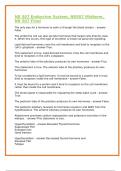
NR 507 Endocrine System, NR507 Midterm,
NR 507 Final
The only way for a hormone to work is through the blood stream. - answer-
False.
The endocrine cell can also secrete hormones that target cells directly close
it. When this occurs, this type of secretion is known as paracrine signaling.
Lipid-derived hormones cross the cell membrane and bind to receptors in the
cell's cytoplasm - answer-True.
This statement is true. Lipid-derived hormones cross the cell membrane and
bind to receptors in the cell's cytoplasm.
The anterior lobe of the pituitary produces its own hormones - answer-True.
This statement is true. The anterior lobe of the pituitary produces its own
hormones
To be considered a lipid hormone, it must be bound to a protein and it must
bind to receptors inside the cell membrane - answer-False.
It must be bound to a protein and it bind to receptors on the cell membrane
rather than inside the cell membrane.
The pineal gland is responsible for regulating the sleep-wake cycle - answer-
True.
The posterior lobe of the pituitary produces its own hormones - answer-False.
The posterior pituitary receives its hormones (oxytocin and ADH) from the
hypothalamus. The anterior pituitary produces its own hormones.
Aldosterone promotes sodium reabsorption and potassium excretion in the
kidneys. - answer-This statement is true.
Hyperthyroidism - answer-Elevated Thyroid Hormone
Suppressed TSH
Enlarged liver
Hand tremors
Hypothyroidism - answer-Decreased thyroid hormone and
Elevated TSH
Fatigue
,Diminished deep tendon reflexes
Type 1 DM - answer-Onset 1<10-20 years
Associated with diabetic ketoacidosis
Symptoms: polyuria, polyphagia, polydipsia
Autoimmune:Genetic and environmental factors, resulting in gradual process
of autoimmune destruction in genetically susceptible individuals
Nonautoimmune:Unknown
Strong association with HLA-DQA and HLA-DQB genes
acute complications: Diabetic ketoacidosis
Type 2 DM - answer-Usually > 40 years of age
Associated with hyperosmolar nonketotic coma
Symptoms: weakness, weight loss, infections
Results from genetic susceptibility (polygenic) combined with environmental
determinants and other risk factors
Inherited defects in beta-cell mass and function combined with peripheral
tissue insulin resistance
Associated with long-duration obesity
strong genetic association
Acute complications: Hyperosmolar nonketotic coma
alpha cells - answer-responsible for secreting glucagon
beta cells - answer-responsible for secreting insulin and amylin
inhibits glucagon secretion
delta cells - answer-responsible for secreting gastrin and somatostatin
F (PP) Cells - answer-secrete pancreatic polypeptide that stimulates gastric
secretions and antagonizes cholecystokinin.
Criteria to diagnose Diabetes Type 1 and 2 - answer-FPG ≥126 mg/dL (7.0
mmol/L). Fasting is defined as no caloric intake for at least 8 h*
OR
2-h PG ≥200 mg/dL (11.1 mmol/L) during OGTT. The test should be
performed as described by the WHO, using a glucose load containing the
equivalent of 75 g anhydrous glucose dissolved in water*
OR
A1C ≥6.5% (48 mmol/mol). The test should be performed in a laboratory
using a method that is NGSP certified and standardized to the DCCT assay*
,OR
In a patient with classic symptoms of hyperglycemia or hyperglycemic crisis,
a random plasma glucose ≥200 mg/dL (11.1 mmol/L)
*In the absence of unequivocal hyperglycemia, diagnosis requires two
abnormal test results from the same sample or in two separate test samples
pre-screening for DM - answer-HbA1c (as measured in a DCCT-referenced
assay) ≥6.5%
OR
FPG ≥126 mg/dL (7.0 mmol/L); fasting is defined as no caloric intake for at
least 8 hr.
OR
2-hr plasma glucose ≥200 mg/dL (11.1 mmol/L) during an OGTT
OR
In a patient with classic symptoms of hyperglycemia or hyperglycemic crisis,
a random plasma glucose ≥200 mg/dL (11.1 mmol/L)
Categories of Increased Risk for Diabetes (Prediabetes) - answer-1. FPG 100
to 125 mg/dL
2. 2-hr PG in the range of 140 to 199 mg/dL during an OGTT
3. HbA1c 5.7% to 6.4%
Symptoms of hypoglycemia can result from activation of the sympathetic
nervous system to cause neurogenic reactions that occur when the blood
glucose drops rapidly: - answer-Tachycardia
Palpitations
Diaphoresis
Tremors
Pallor
Arousal anxiety
Other symptoms include:
Headache
Dizziness
Blurred vision
Irritability
Fatigue
Poor judgement
Confusion
Hunger
Seizures
Coma
Treatment of hypoglycemia - answer-Immediate glucose replacement is
required by either oral or intravenous replacement. For patients who are at
high risk for developing hypoglycemia, glucagon is prescribed for home use.
, The practitioner should discuss medications and diet management and
proper monitoring of blood glucose levels in the patient education plan.
DKA pathophysiology - answer-Insulin deficiency and an increase in counter-
regulatory hormones (catecholamines, cortisol, glucagon and growth
hormone) are the most significant factors for developing DKA.
Under normal circumstances, the counter-regulatory hormones antagonize
insulin by increasing glucose production and decreasing use of glucose by
the tissues. Extreme insulin deficiency results in decreased uptake of
glucose, increased fat mobilization and release of fatty acids and
gluconeogenesis, glycogenesis and ketogenesis.
Without insulin, the free fatty acids increase the production of ketone bodies
in the liver at a high rate that exceeds peripheral use. This causes ketone
bodies to accumulate and results in decreased pH and metabolic acidosis.
The buffer system is activated in response to metabolic acidosis. Remember
that insulin also has an antilipolytic effect. When insulin is deficient, there is
increased circulating ketones that contributes to DKA. Also, ketones are
normally used by the tissues as an energy source to produce bicarbonate.
In DKA, the number of ketones and bicarbonate cannot be balanced.
Circulating ketones increase because of impaired use by the peripheral
tissues, thus increasing strong acids to freely circulate. Bicarbonate buffering
does not occur which leads to metabolic acidosis.
Clinical manifestations of DKA - answer-Kussmaul respirations: the individual
hyperventilates to compensate for the metabolic acidosis
Postural dizziness
Central nervous system depression
Ketonuria
Anorexia, nausea, vomiting
Abdominal pain
Acetone breath
Dehydration
Thirst
Polyuria
Hyperglycemia causes an osmotic diuresis that leads to polyuria along with
dehydration. Large amounts of glucose are lost in the urine because the
blood glucose is higher than the renal threshold.
Electrolyte abnormalities also occur:
Hyponatremia
Hypophosphatemia
Hypomagnesemia
NR 507 Final
The only way for a hormone to work is through the blood stream. - answer-
False.
The endocrine cell can also secrete hormones that target cells directly close
it. When this occurs, this type of secretion is known as paracrine signaling.
Lipid-derived hormones cross the cell membrane and bind to receptors in the
cell's cytoplasm - answer-True.
This statement is true. Lipid-derived hormones cross the cell membrane and
bind to receptors in the cell's cytoplasm.
The anterior lobe of the pituitary produces its own hormones - answer-True.
This statement is true. The anterior lobe of the pituitary produces its own
hormones
To be considered a lipid hormone, it must be bound to a protein and it must
bind to receptors inside the cell membrane - answer-False.
It must be bound to a protein and it bind to receptors on the cell membrane
rather than inside the cell membrane.
The pineal gland is responsible for regulating the sleep-wake cycle - answer-
True.
The posterior lobe of the pituitary produces its own hormones - answer-False.
The posterior pituitary receives its hormones (oxytocin and ADH) from the
hypothalamus. The anterior pituitary produces its own hormones.
Aldosterone promotes sodium reabsorption and potassium excretion in the
kidneys. - answer-This statement is true.
Hyperthyroidism - answer-Elevated Thyroid Hormone
Suppressed TSH
Enlarged liver
Hand tremors
Hypothyroidism - answer-Decreased thyroid hormone and
Elevated TSH
Fatigue
,Diminished deep tendon reflexes
Type 1 DM - answer-Onset 1<10-20 years
Associated with diabetic ketoacidosis
Symptoms: polyuria, polyphagia, polydipsia
Autoimmune:Genetic and environmental factors, resulting in gradual process
of autoimmune destruction in genetically susceptible individuals
Nonautoimmune:Unknown
Strong association with HLA-DQA and HLA-DQB genes
acute complications: Diabetic ketoacidosis
Type 2 DM - answer-Usually > 40 years of age
Associated with hyperosmolar nonketotic coma
Symptoms: weakness, weight loss, infections
Results from genetic susceptibility (polygenic) combined with environmental
determinants and other risk factors
Inherited defects in beta-cell mass and function combined with peripheral
tissue insulin resistance
Associated with long-duration obesity
strong genetic association
Acute complications: Hyperosmolar nonketotic coma
alpha cells - answer-responsible for secreting glucagon
beta cells - answer-responsible for secreting insulin and amylin
inhibits glucagon secretion
delta cells - answer-responsible for secreting gastrin and somatostatin
F (PP) Cells - answer-secrete pancreatic polypeptide that stimulates gastric
secretions and antagonizes cholecystokinin.
Criteria to diagnose Diabetes Type 1 and 2 - answer-FPG ≥126 mg/dL (7.0
mmol/L). Fasting is defined as no caloric intake for at least 8 h*
OR
2-h PG ≥200 mg/dL (11.1 mmol/L) during OGTT. The test should be
performed as described by the WHO, using a glucose load containing the
equivalent of 75 g anhydrous glucose dissolved in water*
OR
A1C ≥6.5% (48 mmol/mol). The test should be performed in a laboratory
using a method that is NGSP certified and standardized to the DCCT assay*
,OR
In a patient with classic symptoms of hyperglycemia or hyperglycemic crisis,
a random plasma glucose ≥200 mg/dL (11.1 mmol/L)
*In the absence of unequivocal hyperglycemia, diagnosis requires two
abnormal test results from the same sample or in two separate test samples
pre-screening for DM - answer-HbA1c (as measured in a DCCT-referenced
assay) ≥6.5%
OR
FPG ≥126 mg/dL (7.0 mmol/L); fasting is defined as no caloric intake for at
least 8 hr.
OR
2-hr plasma glucose ≥200 mg/dL (11.1 mmol/L) during an OGTT
OR
In a patient with classic symptoms of hyperglycemia or hyperglycemic crisis,
a random plasma glucose ≥200 mg/dL (11.1 mmol/L)
Categories of Increased Risk for Diabetes (Prediabetes) - answer-1. FPG 100
to 125 mg/dL
2. 2-hr PG in the range of 140 to 199 mg/dL during an OGTT
3. HbA1c 5.7% to 6.4%
Symptoms of hypoglycemia can result from activation of the sympathetic
nervous system to cause neurogenic reactions that occur when the blood
glucose drops rapidly: - answer-Tachycardia
Palpitations
Diaphoresis
Tremors
Pallor
Arousal anxiety
Other symptoms include:
Headache
Dizziness
Blurred vision
Irritability
Fatigue
Poor judgement
Confusion
Hunger
Seizures
Coma
Treatment of hypoglycemia - answer-Immediate glucose replacement is
required by either oral or intravenous replacement. For patients who are at
high risk for developing hypoglycemia, glucagon is prescribed for home use.
, The practitioner should discuss medications and diet management and
proper monitoring of blood glucose levels in the patient education plan.
DKA pathophysiology - answer-Insulin deficiency and an increase in counter-
regulatory hormones (catecholamines, cortisol, glucagon and growth
hormone) are the most significant factors for developing DKA.
Under normal circumstances, the counter-regulatory hormones antagonize
insulin by increasing glucose production and decreasing use of glucose by
the tissues. Extreme insulin deficiency results in decreased uptake of
glucose, increased fat mobilization and release of fatty acids and
gluconeogenesis, glycogenesis and ketogenesis.
Without insulin, the free fatty acids increase the production of ketone bodies
in the liver at a high rate that exceeds peripheral use. This causes ketone
bodies to accumulate and results in decreased pH and metabolic acidosis.
The buffer system is activated in response to metabolic acidosis. Remember
that insulin also has an antilipolytic effect. When insulin is deficient, there is
increased circulating ketones that contributes to DKA. Also, ketones are
normally used by the tissues as an energy source to produce bicarbonate.
In DKA, the number of ketones and bicarbonate cannot be balanced.
Circulating ketones increase because of impaired use by the peripheral
tissues, thus increasing strong acids to freely circulate. Bicarbonate buffering
does not occur which leads to metabolic acidosis.
Clinical manifestations of DKA - answer-Kussmaul respirations: the individual
hyperventilates to compensate for the metabolic acidosis
Postural dizziness
Central nervous system depression
Ketonuria
Anorexia, nausea, vomiting
Abdominal pain
Acetone breath
Dehydration
Thirst
Polyuria
Hyperglycemia causes an osmotic diuresis that leads to polyuria along with
dehydration. Large amounts of glucose are lost in the urine because the
blood glucose is higher than the renal threshold.
Electrolyte abnormalities also occur:
Hyponatremia
Hypophosphatemia
Hypomagnesemia