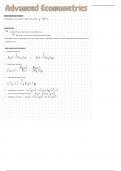
Advanced Ecomometrics
Herhaling linear models
Remember the standard regression model y
=
XB + E
Conditioning
7
Conditioning is important in econometrics
2
VB what is variance today, given yesterday
Remember that an assumption of the classic linear regression model is that should be fixed therefore we
condition on
Some important formulas
·
Marginal density
f(y) =
JA(x y)dx
,
or f(x) =
(f(x y)dy ,
·
Conditional density
b(y x)f(y x)
, ,
f(yx) =
f(x) Sh(y x) by=
,
⑧
Conditional expectation
Elyx] =
Syb(y(x) dy
·
Conditional variance [y(x] E[(y ETy(x])"(x]
·
var : -
·
Law of iterated expectations E[y] Ex[Eyix [y(x]]
· :
·
Marginal variance :
(y) E[var (y(x)]
var =
(E[y(x]) + var
,Regressions and loss functions
Remember that the residuals are e =
y
-
y
7
Predictor : =
Xb Expected loss:
2
Real value :
y
=
XB + E
E[L(y y)() -
& We have different loss functions L(e) =
((y -y)
E[y(x]
2
8 :
8
Squared error .
e
y
①
Absolute error let :
Y =
med(y(x)
(1 x) if
E
-
e eso
8
Asymptotic absolute error ~
X e
if ezo
j =
q(y(x)
&
Step loss ·
Cite e-O
y =
mod(y(x)
The goal is to minimize the error, therefore we need an optimal predictor
to minimize the error. Every loss function has an optimal predictor.
Linear prediction
Ordinary least squares: goal again to minimize errors =
minei) mine-min -
(yiyi)
3
Y
I
XB xie ..
·)
xik
E[nX]
·
Yo · x
:
,
P =
: :
:
I :
xine
i
Yo
·
Xn2
...
Bu
OLS estimator minimizes - (yi -xib)2 =
ni =
(y XB)'(y XB)
-
-
boe-2Xy 2XX
=
+ 0
Bas (XX)"Xig - is the estimator of B
, -Y
P X(XX)"X'
n Matrix P projects Y on S(x)
:
e =
My M 1 P
and matrix M projects Y on So(x)
= -
D
I
> S(x) S
Both symmetric
y =
Xb =
Py and indempotent
Assumptions OLS
I
Fixed regressors: all elements of matrix X are fixed/non-stochastic rank (X) : :
b
2
Random disturbances Elui] : =
o
3
Homoskedasticity (disturbances have constant variance) Var (vi) z In : : =
4
No correlation between disturbances Cov (vi uj) ·
,
= o
5
Constant parameters B constant ·
6
Linear relation y XB : = +
u
uX N(0 In)
7
Normality: is normally distributed
E : -
,
X
Under these assumptions we have:
Unbiased: Variance:
E(B(X) B (XX)XEZuIX B : + =
Var(B(x) : (XX)"X 'Var(u(X)x(X(X)
· (x(x)"xX(X(X)" j(XX)" =
BLUE:
v(B(x) j(XX)" = -
any other estimator Distribution:
b(X -
N(B , (XX)")
N
Asymptotic theory
T
In asymptotic theory the assumption of normality is dropped, however we can still get the same result
by R -D
We first repeat some theories
8
i.i.d: independent and identically distributed
O
i.n.i.d: independent and not identically distributed
Modes of convergence
3
O
Converges in distribution Xn° X if im Fr(x) : -
F(x)) = o
O
Converges in probability Xn"-X plimXn X if :
or
= im PXn-X1 > = Yn **
X = > Xn
:
/
Converges almost surely Xn Xif P in /Xn-X1 Xn X
M S
O ** .
..
:
X
=
0 =
8
Converges in mean square XnXif nhmE (Xn-X)2 : =
, Law of Large Numbers
-n-gr -8
&
Weak (WLLN): in probability
&
Strong (SLLN): almost surely
e
Khintchine WLLN EXiBis id Mi ·
,
=
pe
O
Chebyshev WLLN :
[XiDiz him =
, ind
O
Markov SLLN EXi ·
is ,
indo
Central Limit Theorem
Zi
M -Wo , we
&
Lindeberg-Levy CLT EXiSiz id Mi p i 82 ·
,
inid
= =
Lindeberg-Feller CLT [Xibic hi E (Xi-mi(Xi mis)]
6 ·
, =
)
Liapounov CLT [Xi inid him (2 Ei
+
O ·
is ,
Transformation theory
If Xn X and Yn se If Xn"X and An " A
·
Xn + Yn X + e
·
AnXn AX
·
XnYn eX · An"Xn"A"X
·
Xn/Yn -
X/e
Delta method
·
·
n
~N(A n20)
(g(fn)
,
-
g(fo))d
g(n)
N(o
-
,
N(g(f)
nGe)]G(8)
Gi) Goe .
,
:
ag(t)
at
2
Instead of the normality assumption we assume that n is large and add new assumptions
⑧
Stability of X
plim ( * XX) plim (n Exixi') Mxx
= =
⑧
Orthogonality of X and u
plim (Xa) = o
&
Stability of u
plim (in'u) = and
plines" =
N
Using these assumptions we have
Herhaling linear models
Remember the standard regression model y
=
XB + E
Conditioning
7
Conditioning is important in econometrics
2
VB what is variance today, given yesterday
Remember that an assumption of the classic linear regression model is that should be fixed therefore we
condition on
Some important formulas
·
Marginal density
f(y) =
JA(x y)dx
,
or f(x) =
(f(x y)dy ,
·
Conditional density
b(y x)f(y x)
, ,
f(yx) =
f(x) Sh(y x) by=
,
⑧
Conditional expectation
Elyx] =
Syb(y(x) dy
·
Conditional variance [y(x] E[(y ETy(x])"(x]
·
var : -
·
Law of iterated expectations E[y] Ex[Eyix [y(x]]
· :
·
Marginal variance :
(y) E[var (y(x)]
var =
(E[y(x]) + var
,Regressions and loss functions
Remember that the residuals are e =
y
-
y
7
Predictor : =
Xb Expected loss:
2
Real value :
y
=
XB + E
E[L(y y)() -
& We have different loss functions L(e) =
((y -y)
E[y(x]
2
8 :
8
Squared error .
e
y
①
Absolute error let :
Y =
med(y(x)
(1 x) if
E
-
e eso
8
Asymptotic absolute error ~
X e
if ezo
j =
q(y(x)
&
Step loss ·
Cite e-O
y =
mod(y(x)
The goal is to minimize the error, therefore we need an optimal predictor
to minimize the error. Every loss function has an optimal predictor.
Linear prediction
Ordinary least squares: goal again to minimize errors =
minei) mine-min -
(yiyi)
3
Y
I
XB xie ..
·)
xik
E[nX]
·
Yo · x
:
,
P =
: :
:
I :
xine
i
Yo
·
Xn2
...
Bu
OLS estimator minimizes - (yi -xib)2 =
ni =
(y XB)'(y XB)
-
-
boe-2Xy 2XX
=
+ 0
Bas (XX)"Xig - is the estimator of B
, -Y
P X(XX)"X'
n Matrix P projects Y on S(x)
:
e =
My M 1 P
and matrix M projects Y on So(x)
= -
D
I
> S(x) S
Both symmetric
y =
Xb =
Py and indempotent
Assumptions OLS
I
Fixed regressors: all elements of matrix X are fixed/non-stochastic rank (X) : :
b
2
Random disturbances Elui] : =
o
3
Homoskedasticity (disturbances have constant variance) Var (vi) z In : : =
4
No correlation between disturbances Cov (vi uj) ·
,
= o
5
Constant parameters B constant ·
6
Linear relation y XB : = +
u
uX N(0 In)
7
Normality: is normally distributed
E : -
,
X
Under these assumptions we have:
Unbiased: Variance:
E(B(X) B (XX)XEZuIX B : + =
Var(B(x) : (XX)"X 'Var(u(X)x(X(X)
· (x(x)"xX(X(X)" j(XX)" =
BLUE:
v(B(x) j(XX)" = -
any other estimator Distribution:
b(X -
N(B , (XX)")
N
Asymptotic theory
T
In asymptotic theory the assumption of normality is dropped, however we can still get the same result
by R -D
We first repeat some theories
8
i.i.d: independent and identically distributed
O
i.n.i.d: independent and not identically distributed
Modes of convergence
3
O
Converges in distribution Xn° X if im Fr(x) : -
F(x)) = o
O
Converges in probability Xn"-X plimXn X if :
or
= im PXn-X1 > = Yn **
X = > Xn
:
/
Converges almost surely Xn Xif P in /Xn-X1 Xn X
M S
O ** .
..
:
X
=
0 =
8
Converges in mean square XnXif nhmE (Xn-X)2 : =
, Law of Large Numbers
-n-gr -8
&
Weak (WLLN): in probability
&
Strong (SLLN): almost surely
e
Khintchine WLLN EXiBis id Mi ·
,
=
pe
O
Chebyshev WLLN :
[XiDiz him =
, ind
O
Markov SLLN EXi ·
is ,
indo
Central Limit Theorem
Zi
M -Wo , we
&
Lindeberg-Levy CLT EXiSiz id Mi p i 82 ·
,
inid
= =
Lindeberg-Feller CLT [Xibic hi E (Xi-mi(Xi mis)]
6 ·
, =
)
Liapounov CLT [Xi inid him (2 Ei
+
O ·
is ,
Transformation theory
If Xn X and Yn se If Xn"X and An " A
·
Xn + Yn X + e
·
AnXn AX
·
XnYn eX · An"Xn"A"X
·
Xn/Yn -
X/e
Delta method
·
·
n
~N(A n20)
(g(fn)
,
-
g(fo))d
g(n)
N(o
-
,
N(g(f)
nGe)]G(8)
Gi) Goe .
,
:
ag(t)
at
2
Instead of the normality assumption we assume that n is large and add new assumptions
⑧
Stability of X
plim ( * XX) plim (n Exixi') Mxx
= =
⑧
Orthogonality of X and u
plim (Xa) = o
&
Stability of u
plim (in'u) = and
plines" =
N
Using these assumptions we have