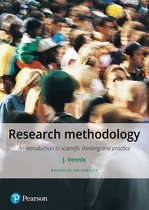
Research Methodology – Summary Book
1
,Table of Contents
Chapter 1 – the origins of science ...................................................................................... 3
Chapter 2 – The scientific method ..................................................................................... 5
Chapter 3 – a dominant paradigm .................................................................................... 9
Chapter 4 – quantitative research: background ............................................................... 13
Chapter 5 – research objective, research question and conceptual model ........................ 21
Chapter 6 – operationalization: ...................................................................................... 27
Chapter 7 – Data collection ............................................................................................. 31
Chapter 8 – Data preparation and scale construction ...................................................... 37
Chapter 9 – analysis of quantitative data ........................................................................ 40
Chapter 10 – Qualitative research: methodological background ...................................... 49
Chapter 11 – qualitative research: data collection and analysis: ...................................... 56
Chapter 12 – dynamic theories and models ..................................................................... 63
Chapter 13 – practice-oriented research and the role of problem structuring ................... 68
Chapter 14 – Logic of inquiry and research design: .......................................................... 74
2
, Chapter 1 – the origins of science
In this book the term science means all sciences (alpha, beta, gamma)
Management science: is the discipline of using scientific research-based principles,
strategies, and other analytical methods, such as mathematical modelling to improve any
organization’s ability to enact rational, meaningful business management decisions.
Difference philosophy and other branches of science:
- Other branches of science: focus very much on the empirical world and rely on
empirical research to generate knowledge (relies on observation to generate
knowledge)
- Philosophy: relies on reasoning (more speculative in nature)
The concepts of learning and knowledge in individuals and in science
Knowing and learning are two interrelated concepts. →It is through learning that we build up
knowledge about a variety of subjects (world around us and ourselves)
Individual learning
You can learn either through lessons, or through experience and through reasoning.
➔ many things can go wrong during learning. → information processing is not neutral →
Causes:
- Human beings are not clear logical thinkers
- Debate is not a good way to learn → best argument doesn’t always win (emotions),
especially when surrounded by spectators (saving your face is more important than finding
the truth) → consequence: an appealing fallacy is used. (attacking to person instead of the
argument)
- Before forming an opinion on a topic you need to consult all relevant information → difficult
because:
• too much information
• People suffer from selective perception (biased for things your care about most)
• People suffer from confirmation bias = the selective collection of evidence that
supports one’s point of view and discarding information which could refute one’s
opinion.
- Explaining things away/rationalizing after the fact: people are good at coming up with ad
hoc explanations
- Self-fulfilling prophecies: expectations lead to act in a certain way that which leads to the
expectation actually becoming true.
Learning also crucial in science and philosophy. → learning in science different than
individual learning: not only learning known knowledge but also scientist try to expand the
knowledge by doing research. → scientist had to think about how to do research through trial
and error (methodology = learn how to learn).
It took a long time to gain the knowledge we have today because everything had to build up
from scratch (even the methodology). And there was no arbiter to tell what is good or wrong.
3
, The anarchic-democracy in science leads to progress in science and philosophy because it is
a self-correcting system.
Characteristics of philosophers and scientists:
- Curiosity (wondering about the world)
- Skeptical (don’t believe things they are told automatically → in science you come up with
new knowledge)
- Persistence (willing to put a lot of effort and time in finding a solution for a problem)
- Thinking (scientist have superior critical, independent thinking skills, able to make the
necessary distinctions and produce arguments in a coherent and cognitive manner).
- Creative thinking (many scientists also excel in creative thinking)
→ scientists are independent thinkers.
The scientific revolution and the development of the scientific method
Ancient Greece as the cradle of science (and philosophy)
A lot of knowledge of the Greeks was heavily deducted from other civilization → but Greeks
did not only pass this knowledge on to others, but created also something new out of the
knowledge → they began to look for rational explanations of the phenomena/facts they
observed, rather than explaining natural phenomena as caused by gods.
The Greeks were also the first to pursue knowledge for its own sake (not only for practical
purposes)
The Greeks were responsible for creating a lot of new knowledge (mostly in mathematics and
astronomy).
The Greeks were the first to start thinking systematically and comprehensively about the
concept of knowledge itself and how one could make sure that the knowledge that was
discovered was true knowledge.
Plato and Aristotle:
The two had other ways of thinking:
- Plato: tries to fit Nature to a preconceived intellectual scheme → true knowledge can only
be acquired through reason (no senses etc.). → a priori thinker (fits well with his admiration
of mathematics)
- Aristotle: constructs his intellectual scheme to fit what is observed in Nature. → was more
open to empirical reality and our sensory perception as a source of knowledge. → he laid a
solid foundation for what we know as “logic”.
Why the Greek civilization?
The Greeks introduced a tradition of critique → they discussed explanations critically.
In the Greek civilization discussion and rhetoric were much more part of the common
adversarial culture compared to for example in China (e.g. in court, independent from the
rulers of the country etc.)
4
1
,Table of Contents
Chapter 1 – the origins of science ...................................................................................... 3
Chapter 2 – The scientific method ..................................................................................... 5
Chapter 3 – a dominant paradigm .................................................................................... 9
Chapter 4 – quantitative research: background ............................................................... 13
Chapter 5 – research objective, research question and conceptual model ........................ 21
Chapter 6 – operationalization: ...................................................................................... 27
Chapter 7 – Data collection ............................................................................................. 31
Chapter 8 – Data preparation and scale construction ...................................................... 37
Chapter 9 – analysis of quantitative data ........................................................................ 40
Chapter 10 – Qualitative research: methodological background ...................................... 49
Chapter 11 – qualitative research: data collection and analysis: ...................................... 56
Chapter 12 – dynamic theories and models ..................................................................... 63
Chapter 13 – practice-oriented research and the role of problem structuring ................... 68
Chapter 14 – Logic of inquiry and research design: .......................................................... 74
2
, Chapter 1 – the origins of science
In this book the term science means all sciences (alpha, beta, gamma)
Management science: is the discipline of using scientific research-based principles,
strategies, and other analytical methods, such as mathematical modelling to improve any
organization’s ability to enact rational, meaningful business management decisions.
Difference philosophy and other branches of science:
- Other branches of science: focus very much on the empirical world and rely on
empirical research to generate knowledge (relies on observation to generate
knowledge)
- Philosophy: relies on reasoning (more speculative in nature)
The concepts of learning and knowledge in individuals and in science
Knowing and learning are two interrelated concepts. →It is through learning that we build up
knowledge about a variety of subjects (world around us and ourselves)
Individual learning
You can learn either through lessons, or through experience and through reasoning.
➔ many things can go wrong during learning. → information processing is not neutral →
Causes:
- Human beings are not clear logical thinkers
- Debate is not a good way to learn → best argument doesn’t always win (emotions),
especially when surrounded by spectators (saving your face is more important than finding
the truth) → consequence: an appealing fallacy is used. (attacking to person instead of the
argument)
- Before forming an opinion on a topic you need to consult all relevant information → difficult
because:
• too much information
• People suffer from selective perception (biased for things your care about most)
• People suffer from confirmation bias = the selective collection of evidence that
supports one’s point of view and discarding information which could refute one’s
opinion.
- Explaining things away/rationalizing after the fact: people are good at coming up with ad
hoc explanations
- Self-fulfilling prophecies: expectations lead to act in a certain way that which leads to the
expectation actually becoming true.
Learning also crucial in science and philosophy. → learning in science different than
individual learning: not only learning known knowledge but also scientist try to expand the
knowledge by doing research. → scientist had to think about how to do research through trial
and error (methodology = learn how to learn).
It took a long time to gain the knowledge we have today because everything had to build up
from scratch (even the methodology). And there was no arbiter to tell what is good or wrong.
3
, The anarchic-democracy in science leads to progress in science and philosophy because it is
a self-correcting system.
Characteristics of philosophers and scientists:
- Curiosity (wondering about the world)
- Skeptical (don’t believe things they are told automatically → in science you come up with
new knowledge)
- Persistence (willing to put a lot of effort and time in finding a solution for a problem)
- Thinking (scientist have superior critical, independent thinking skills, able to make the
necessary distinctions and produce arguments in a coherent and cognitive manner).
- Creative thinking (many scientists also excel in creative thinking)
→ scientists are independent thinkers.
The scientific revolution and the development of the scientific method
Ancient Greece as the cradle of science (and philosophy)
A lot of knowledge of the Greeks was heavily deducted from other civilization → but Greeks
did not only pass this knowledge on to others, but created also something new out of the
knowledge → they began to look for rational explanations of the phenomena/facts they
observed, rather than explaining natural phenomena as caused by gods.
The Greeks were also the first to pursue knowledge for its own sake (not only for practical
purposes)
The Greeks were responsible for creating a lot of new knowledge (mostly in mathematics and
astronomy).
The Greeks were the first to start thinking systematically and comprehensively about the
concept of knowledge itself and how one could make sure that the knowledge that was
discovered was true knowledge.
Plato and Aristotle:
The two had other ways of thinking:
- Plato: tries to fit Nature to a preconceived intellectual scheme → true knowledge can only
be acquired through reason (no senses etc.). → a priori thinker (fits well with his admiration
of mathematics)
- Aristotle: constructs his intellectual scheme to fit what is observed in Nature. → was more
open to empirical reality and our sensory perception as a source of knowledge. → he laid a
solid foundation for what we know as “logic”.
Why the Greek civilization?
The Greeks introduced a tradition of critique → they discussed explanations critically.
In the Greek civilization discussion and rhetoric were much more part of the common
adversarial culture compared to for example in China (e.g. in court, independent from the
rulers of the country etc.)
4