Lecture 1 30-1
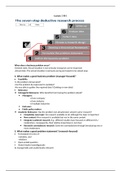
When does a business problem occur?
-Desired state: Actual situation is not seriously wrong but can be improved
-Actual state: The actual situation is seriously wrong and needs to be solved asap.
4. What makes a good business problem (manager-focused)?
Feasibility
-Is the problem demarcated?
-Can the problem be expressed in variables?
-Are you able to gather the required data? (Existing or new data)
Relevance
Managerial Relevance: Who benefits from having the problem solved?
Managers:
-of one company
-of one industry
-of multiple industries
End users
Public policy makers
Academic Relevance: Has the problem not already been solved in prior research?
Completely new topic: No research available at all, although the topic is important
New context: Prior research is available but not in the same context
Integrate scattered research: E.g., different studies have focused on different IVs /
moderators; consequently, their relative importance is not clear
Reconcile contradictory research: Solve the contradictions through introducing one or
more moderators
5. What makes a good problem statement? (research-focused)
Formulated in terms of:
-variables, and
-relations
Open-ended question
Stated clearly/unambiguously
(is managerially and academically relevant)
, 6. What makes good research questions?
Should collectively address the problem statement
One problem statement is translated into multiple research questions
First theoretical, then practical research questions
In the same order as they will be addressed in your research report!
Statedclearly/unambiguously
No vague elements
Theoretical research questions
-context question
-conceptualization question
-relationship questions
Practical research questions
-Relationship questions
-Implication question
7. Developing a theoretical framework
A Theoretical framework consists of:
Viariable definitions
-based on a careful literature review
-always use EXACTLY the same variable names throughout your research
Conceptual model – graphical representation
Variables are building blocks
-Dependent variables(criterion variable): The variable of primary interest
-Independent variables (predictor variable): influences the dependent
-Mediating variables: A variable that explains the mechanism at work between X and Y
Full mediation: X only has an effect on Y through MED
Partial mediation: X has an indirect and direct effect on Y through MED
-Moderating variables: A variable that alters the strength and sometimes even the direction of the
relationship between X and Y
Quasi moderation: MOD moderates the relationship between X and Y, but it also has a direct effect
on Y
Pure moderation: MOD moderates the relationship between X and Y, but it has no direct effect on Y
Relationships are arrows
-Main effect
-Direct/indirect effect
-Moderating effect
Hypotheses – relationships between variables
A tentative statement about the coherence between 2 or more variables
What makes a good hypothesis?
-Derived from theory
-Testable
-Unambigous
Directional hypotheses (one-sided)
-A merger is likely to decrease employee morale.
-The effect of employee morale on employee productivity is more negative for older employees.
Undirectionalhypotheses (two-sided)
-A merger is likely to affect employee morale.
-The effect of employee morale on employeebproductivity depends on employee age
, Null hypothesis
-Expresses no relationship between variables or no difference between groups
-Set up in order to be rejected (in favor of the alternate hypothesis)
Alternate hypothesis
-Expresses a relationship between variables or a difference between groups
= research hypothesis
Null hypotheses are rarely presented in research reports
Lecture 2 06-02
Choose a research design (stap 4)
Research Design = A plan for the collection, measurement, and analysis of data.
=Plan voor de verzameling, het meten en analyseren van jouw data. Hoe ga jij je onderzoek
aanpakken?
First research question, then research design.
Critical research design decions:
- Choosing between (deductive) research strategies
- Choosing between statistical techniques
- Choosing between sampling designs.
Research types:
Causal research: Causaal: oorzaak-gevolg relatie.
4 criteria voor bepalen of er sprake is van een causaal verband:
1) X and Y occur Significant correlation between X and Y
2) A logical explanation for the effect of X on Y
3) X precedes Y in time: the cause must come before the effect
4) There is no other cause (Z) that explains co-occurence of X and Y
-lab experiments: is a artificial (kunstmatig) environment, in which one or more Independent
variables are manipulated, after which the effect on the dependent varible is measured.
-field experiments: An experiment carried out in the natural environment, in which work/life goes as
usual, but manipulation is possible. Je hebt geen gecontroleerde omgeving, maar natuurlijke
omgeving.
Correlational research
-archival research: Research based on data that already exists
External archival research: data generated by sources outside the firm (publiekelijk, CBS)
Internal archival research: existing company data (in-house information)
-survey research: Research based on a questionnaire to which respondents record their answers,
typically with closely defined alterntives. Onderzoek gebaseerd op vragenlijst met gesloten antw.
Lecture 3 13-02
Choosing between statistical techniques
Raw data means nothing without the proper tools to analyze and interpret them Statistical
techniques Helpen van data ook kennis te maken
Descriptive statistics: Methods of summarizing the data in an informative way. Geven je eerst
informatie van jouw data, ze vatten het samen, en geven inzicht hoe de data eruitziet
-Measures of central tendency. Centrale maten: mean, median, mode
-Measures of dispersion. Verspreidingsmaten: Range, stadard deviation, variance, interquartile range
Inferential statistics: Methods to draw conclusions. Die kun je gebruiken om hypotheses te testen en
conclusies te trekken.
-Mean difference test
-Chi-square test
-Analysis of variance
When does a business problem occur?
-Desired state: Actual situation is not seriously wrong but can be improved
-Actual state: The actual situation is seriously wrong and needs to be solved asap.
4. What makes a good business problem (manager-focused)?
Feasibility
-Is the problem demarcated?
-Can the problem be expressed in variables?
-Are you able to gather the required data? (Existing or new data)
Relevance
Managerial Relevance: Who benefits from having the problem solved?
Managers:
-of one company
-of one industry
-of multiple industries
End users
Public policy makers
Academic Relevance: Has the problem not already been solved in prior research?
Completely new topic: No research available at all, although the topic is important
New context: Prior research is available but not in the same context
Integrate scattered research: E.g., different studies have focused on different IVs /
moderators; consequently, their relative importance is not clear
Reconcile contradictory research: Solve the contradictions through introducing one or
more moderators
5. What makes a good problem statement? (research-focused)
Formulated in terms of:
-variables, and
-relations
Open-ended question
Stated clearly/unambiguously
(is managerially and academically relevant)
, 6. What makes good research questions?
Should collectively address the problem statement
One problem statement is translated into multiple research questions
First theoretical, then practical research questions
In the same order as they will be addressed in your research report!
Statedclearly/unambiguously
No vague elements
Theoretical research questions
-context question
-conceptualization question
-relationship questions
Practical research questions
-Relationship questions
-Implication question
7. Developing a theoretical framework
A Theoretical framework consists of:
Viariable definitions
-based on a careful literature review
-always use EXACTLY the same variable names throughout your research
Conceptual model – graphical representation
Variables are building blocks
-Dependent variables(criterion variable): The variable of primary interest
-Independent variables (predictor variable): influences the dependent
-Mediating variables: A variable that explains the mechanism at work between X and Y
Full mediation: X only has an effect on Y through MED
Partial mediation: X has an indirect and direct effect on Y through MED
-Moderating variables: A variable that alters the strength and sometimes even the direction of the
relationship between X and Y
Quasi moderation: MOD moderates the relationship between X and Y, but it also has a direct effect
on Y
Pure moderation: MOD moderates the relationship between X and Y, but it has no direct effect on Y
Relationships are arrows
-Main effect
-Direct/indirect effect
-Moderating effect
Hypotheses – relationships between variables
A tentative statement about the coherence between 2 or more variables
What makes a good hypothesis?
-Derived from theory
-Testable
-Unambigous
Directional hypotheses (one-sided)
-A merger is likely to decrease employee morale.
-The effect of employee morale on employee productivity is more negative for older employees.
Undirectionalhypotheses (two-sided)
-A merger is likely to affect employee morale.
-The effect of employee morale on employeebproductivity depends on employee age
, Null hypothesis
-Expresses no relationship between variables or no difference between groups
-Set up in order to be rejected (in favor of the alternate hypothesis)
Alternate hypothesis
-Expresses a relationship between variables or a difference between groups
= research hypothesis
Null hypotheses are rarely presented in research reports
Lecture 2 06-02
Choose a research design (stap 4)
Research Design = A plan for the collection, measurement, and analysis of data.
=Plan voor de verzameling, het meten en analyseren van jouw data. Hoe ga jij je onderzoek
aanpakken?
First research question, then research design.
Critical research design decions:
- Choosing between (deductive) research strategies
- Choosing between statistical techniques
- Choosing between sampling designs.
Research types:
Causal research: Causaal: oorzaak-gevolg relatie.
4 criteria voor bepalen of er sprake is van een causaal verband:
1) X and Y occur Significant correlation between X and Y
2) A logical explanation for the effect of X on Y
3) X precedes Y in time: the cause must come before the effect
4) There is no other cause (Z) that explains co-occurence of X and Y
-lab experiments: is a artificial (kunstmatig) environment, in which one or more Independent
variables are manipulated, after which the effect on the dependent varible is measured.
-field experiments: An experiment carried out in the natural environment, in which work/life goes as
usual, but manipulation is possible. Je hebt geen gecontroleerde omgeving, maar natuurlijke
omgeving.
Correlational research
-archival research: Research based on data that already exists
External archival research: data generated by sources outside the firm (publiekelijk, CBS)
Internal archival research: existing company data (in-house information)
-survey research: Research based on a questionnaire to which respondents record their answers,
typically with closely defined alterntives. Onderzoek gebaseerd op vragenlijst met gesloten antw.
Lecture 3 13-02
Choosing between statistical techniques
Raw data means nothing without the proper tools to analyze and interpret them Statistical
techniques Helpen van data ook kennis te maken
Descriptive statistics: Methods of summarizing the data in an informative way. Geven je eerst
informatie van jouw data, ze vatten het samen, en geven inzicht hoe de data eruitziet
-Measures of central tendency. Centrale maten: mean, median, mode
-Measures of dispersion. Verspreidingsmaten: Range, stadard deviation, variance, interquartile range
Inferential statistics: Methods to draw conclusions. Die kun je gebruiken om hypotheses te testen en
conclusies te trekken.
-Mean difference test
-Chi-square test
-Analysis of variance