Digestive Systems HBS
Charley McClellan
P5
Introduction to digestive system
1
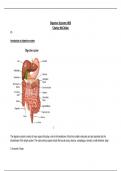
The digestive system consists of many organs that play a role in the breakdown of food into smaller molecules and are absorbed into the
bloodstream of the lymph system. The main primary organs include the buccal cavity, pharynx, oesophagus, stomach, small intestines, large
1 Newcastle College
,intestines, colon and rectum. These are the order in which food passes through. In addition, there are also some accessory organs - the
pancreas,liver and gallbladder in which food does not pass through but these organs secrete chemicals and enzymes that aid digestion.
Ingestion starts in the Buccal cavity where food is chewed up (process of mechanical digestion) into a soft bollus by various teeth. Firstly your
incisors will cut the food into smaller pieces and then your premolars will assist the molars into grinding the food up so it is ready to enter the
pharynx. The food will then get swallowed into the oesophagus due to the pharynx autonomic cranial reflex, allowing you to swallow. In the
Oesophagus, the peristalsis movement generated by the muscles causes the food to get pushed down into the stomach where food is
chemically digested. The Epithelial cells produce gastric juices containing acid and enzymes that aid digestion. The stomach then churns the
food into chyme due to again, the peristalsis movement in the walls. After 2- 3 hours the chyme starts to exit the stomach by the pyloric end,
due to the Acidity of the chyme, the Pyloric sphincter relaxes and allows the chyme to enter the duodenum. The duodenum digests any food
that hasn’t been yet digested in the stomach and then passes it onto the Jejunum that does the same until it reaches the Ileum in which
absorption occurs to take any vitamins and fluids out of the chyme before it exits the body. It then enters the large intestines which absorbs
any water that the ileum hasn’t absorbed and prepares the food into a stool before it reaches the colon. The stool then enters the colon, which
through peristalsis moves the stool into the anal canal where the external sphincter relaxes and allows the stool to exit the body.
Ingestion - This happens due to eating which breaks up organic material into proteins, fats and carbohydrates the body then converts this
energy into starch and polysaccharides.
Digestion - There are two different types of digestion, mechanical and chemical. Mechanical includes chewing and peristalsis, whereas
chemical involves enzymes e.g food being broken down via bile in the stomach or amylase in saliva that turns maltose into glucose. Amylase
also hydrolyses starch and glycogen into smaller polysaccharides and disaccharides.
Absorption - smaller molecules are taken into the bloodstream via diffusion (facilitated, transport and actor)or lymphatic system.
Egestion or Elimination - Undigested material passes out of the digestive compartment
Peristalsis - involuntary contraction and relaxation of smooth muscles to push the food through the digestive system.
, 2
2 Newcastle College
Charley McClellan
P5
Introduction to digestive system
1
The digestive system consists of many organs that play a role in the breakdown of food into smaller molecules and are absorbed into the
bloodstream of the lymph system. The main primary organs include the buccal cavity, pharynx, oesophagus, stomach, small intestines, large
1 Newcastle College
,intestines, colon and rectum. These are the order in which food passes through. In addition, there are also some accessory organs - the
pancreas,liver and gallbladder in which food does not pass through but these organs secrete chemicals and enzymes that aid digestion.
Ingestion starts in the Buccal cavity where food is chewed up (process of mechanical digestion) into a soft bollus by various teeth. Firstly your
incisors will cut the food into smaller pieces and then your premolars will assist the molars into grinding the food up so it is ready to enter the
pharynx. The food will then get swallowed into the oesophagus due to the pharynx autonomic cranial reflex, allowing you to swallow. In the
Oesophagus, the peristalsis movement generated by the muscles causes the food to get pushed down into the stomach where food is
chemically digested. The Epithelial cells produce gastric juices containing acid and enzymes that aid digestion. The stomach then churns the
food into chyme due to again, the peristalsis movement in the walls. After 2- 3 hours the chyme starts to exit the stomach by the pyloric end,
due to the Acidity of the chyme, the Pyloric sphincter relaxes and allows the chyme to enter the duodenum. The duodenum digests any food
that hasn’t been yet digested in the stomach and then passes it onto the Jejunum that does the same until it reaches the Ileum in which
absorption occurs to take any vitamins and fluids out of the chyme before it exits the body. It then enters the large intestines which absorbs
any water that the ileum hasn’t absorbed and prepares the food into a stool before it reaches the colon. The stool then enters the colon, which
through peristalsis moves the stool into the anal canal where the external sphincter relaxes and allows the stool to exit the body.
Ingestion - This happens due to eating which breaks up organic material into proteins, fats and carbohydrates the body then converts this
energy into starch and polysaccharides.
Digestion - There are two different types of digestion, mechanical and chemical. Mechanical includes chewing and peristalsis, whereas
chemical involves enzymes e.g food being broken down via bile in the stomach or amylase in saliva that turns maltose into glucose. Amylase
also hydrolyses starch and glycogen into smaller polysaccharides and disaccharides.
Absorption - smaller molecules are taken into the bloodstream via diffusion (facilitated, transport and actor)or lymphatic system.
Egestion or Elimination - Undigested material passes out of the digestive compartment
Peristalsis - involuntary contraction and relaxation of smooth muscles to push the food through the digestive system.
, 2
2 Newcastle College