4.2 #4 LG1: What is a self-managing team? Creation?
What is the role of an “external” leader in leading the team effectively?
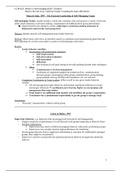
Manz & Sims, 1987 – The External Leadership of Self-Managing Teams
Self-managing Teams: usually include a whole task; members who each possess a variety of relevant
skills; much autonomy in decision making, compensation & feedback about group performance
characterized by the attempt to create a high degree of decision-making autonomy &
behavioral control at the work-group level
Purpose: identify specific self-management-team leader behaviors
Method: Observation, interviews, & literature search in a medium-sized manufacturing plant that had
been operating for several years under a system of self-managing work teams
Results:
- Leader behavior variables:
Encouraging self-management strategies:
Self-reinforcement
Self-observation/evaluation
Self-expectation
Rehearsal
Self-criticism & self-goal setting do not add anything beyond other techniques
Other:
Communicates to & from management
Facilitation of equipment/supplies & production flow, communication
between groups, encouraging within-group communication, group training,
group problem-solving, flexible task boundaries, etc. not relevant!
- Comparing Coordinators & Team Leaders: differ overall on any given leader-behavior
variable
All self-management leader behaviors demonstrate significant differences (except
encourages rehearsal) coordinators perceived sig. higher on encouraging self-
management than team leaders
Team leader is an additional team member who facilitates the group's organization
Coordinator has a fundamental responsibility to get the group to manage itself
Limitations:
- "Post-only" measurement, without control group
Cohen & Bailey, 1997
Supervisor behavior: e.g. behaviors that encouraged self-criticism & self-management
- Negative predictor of performance for self-directed work groups (opposing to Manz & Sims)
- Possible explanations:
Supervisors may tend to exhibit encouraging behavior with poorly performing groups
Supervisors may actually obstruct high performance by interfering
- Encouraging behaviors had no significant relationship to outcomes for traditionally managed
groups (they might be accustomed)
- Supervisor’s positive mood positively predicted prosocial behavior & negatively predicted
turnover
1
, 4.2 #4 LG1: What is a self-managing team? Creation?
What is the role of an “external” leader in leading the team effectively?
Druskat & Wheeler, 2003 – Effective Leadership of SMWT
Method:
- Critical
incident
interviews with
the external
leaders of
SMWT & their
team members
+ interviews &
surveys
provided by
managers
Results: leaders used their location to move back & forth between their teams & the organization
engaging in 4 categories of behavior:
1) Relating with team & organization members building political awareness & relationships to
create access to those who could provide information
Organization-focused behavior: building social & political awareness
helps developed access to people & places that allow to scout & obtain info
Team-focused behavior:
Building team trust: by showing fairness, reliability, & focus on teams' best
interest (without trust team felt vulnerable / subjected to leader)
Caring for team members: care-giving actions that show respect & concern
for individual team members
2) Scouting information & staying abreast of activities inside & outside their teams
Organization-focused behavior: seeking info from managers, peers & specialists
Powerful tool for influencing actions & decisions of everyone
Team-focused behavior: seeking info from inside their own team through:
Diagnosing member behavior: to get info about team & member needs,
problems, strengths, & weaknesses
Investigating problems systematically: collecting & analyzing data to trace
cause of a problem (e.g. member perspectives on it, its causes, & solution)
3) Persuading their teams to attend to organization needs/goals & persuading organization to
attend to team needs to empower own teams & generate resources for team success
Organization-focused behavior: obtaining external support
Allowed leader to empower team & increase its decision-making authority
Team-focused behavior: influencing the team which sometimes involved
encouraging a team to make effective choices
Helping team understand implications of their decisions & actions
Use of data & info most powerful tool for encouraging or influencing teams
4) Empowering their teams involves delegating decision authority & supporting that delegation
Team-focused behavior:
Delegating authority: highly stressful for leader (as he keeps responsibility)
Flexibility regarding team decisions
Coaching: strengthening member contributions, team’s confidence, & its
ability to manage itself, giving feedback, & modeling behaviors
all facilitate self-managing work team effectiveness
Limitations: Study was designed for theory building results must be interpreted & generalized with
caution until replicated
2
What is the role of an “external” leader in leading the team effectively?
Manz & Sims, 1987 – The External Leadership of Self-Managing Teams
Self-managing Teams: usually include a whole task; members who each possess a variety of relevant
skills; much autonomy in decision making, compensation & feedback about group performance
characterized by the attempt to create a high degree of decision-making autonomy &
behavioral control at the work-group level
Purpose: identify specific self-management-team leader behaviors
Method: Observation, interviews, & literature search in a medium-sized manufacturing plant that had
been operating for several years under a system of self-managing work teams
Results:
- Leader behavior variables:
Encouraging self-management strategies:
Self-reinforcement
Self-observation/evaluation
Self-expectation
Rehearsal
Self-criticism & self-goal setting do not add anything beyond other techniques
Other:
Communicates to & from management
Facilitation of equipment/supplies & production flow, communication
between groups, encouraging within-group communication, group training,
group problem-solving, flexible task boundaries, etc. not relevant!
- Comparing Coordinators & Team Leaders: differ overall on any given leader-behavior
variable
All self-management leader behaviors demonstrate significant differences (except
encourages rehearsal) coordinators perceived sig. higher on encouraging self-
management than team leaders
Team leader is an additional team member who facilitates the group's organization
Coordinator has a fundamental responsibility to get the group to manage itself
Limitations:
- "Post-only" measurement, without control group
Cohen & Bailey, 1997
Supervisor behavior: e.g. behaviors that encouraged self-criticism & self-management
- Negative predictor of performance for self-directed work groups (opposing to Manz & Sims)
- Possible explanations:
Supervisors may tend to exhibit encouraging behavior with poorly performing groups
Supervisors may actually obstruct high performance by interfering
- Encouraging behaviors had no significant relationship to outcomes for traditionally managed
groups (they might be accustomed)
- Supervisor’s positive mood positively predicted prosocial behavior & negatively predicted
turnover
1
, 4.2 #4 LG1: What is a self-managing team? Creation?
What is the role of an “external” leader in leading the team effectively?
Druskat & Wheeler, 2003 – Effective Leadership of SMWT
Method:
- Critical
incident
interviews with
the external
leaders of
SMWT & their
team members
+ interviews &
surveys
provided by
managers
Results: leaders used their location to move back & forth between their teams & the organization
engaging in 4 categories of behavior:
1) Relating with team & organization members building political awareness & relationships to
create access to those who could provide information
Organization-focused behavior: building social & political awareness
helps developed access to people & places that allow to scout & obtain info
Team-focused behavior:
Building team trust: by showing fairness, reliability, & focus on teams' best
interest (without trust team felt vulnerable / subjected to leader)
Caring for team members: care-giving actions that show respect & concern
for individual team members
2) Scouting information & staying abreast of activities inside & outside their teams
Organization-focused behavior: seeking info from managers, peers & specialists
Powerful tool for influencing actions & decisions of everyone
Team-focused behavior: seeking info from inside their own team through:
Diagnosing member behavior: to get info about team & member needs,
problems, strengths, & weaknesses
Investigating problems systematically: collecting & analyzing data to trace
cause of a problem (e.g. member perspectives on it, its causes, & solution)
3) Persuading their teams to attend to organization needs/goals & persuading organization to
attend to team needs to empower own teams & generate resources for team success
Organization-focused behavior: obtaining external support
Allowed leader to empower team & increase its decision-making authority
Team-focused behavior: influencing the team which sometimes involved
encouraging a team to make effective choices
Helping team understand implications of their decisions & actions
Use of data & info most powerful tool for encouraging or influencing teams
4) Empowering their teams involves delegating decision authority & supporting that delegation
Team-focused behavior:
Delegating authority: highly stressful for leader (as he keeps responsibility)
Flexibility regarding team decisions
Coaching: strengthening member contributions, team’s confidence, & its
ability to manage itself, giving feedback, & modeling behaviors
all facilitate self-managing work team effectiveness
Limitations: Study was designed for theory building results must be interpreted & generalized with
caution until replicated
2