
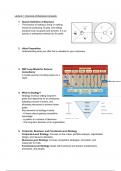
Lecture 1: Overview of Business Concepts
1. Classic Definition of Business
- The practice of making a living or making
money by producing, buying, and selling
products such as goods and services. It is an
activity or enterprise entered into for profit.
2. Value Proposition
- Understanding what you offer that is valuable to your customers.
3. SBP Loop Model for Science
Consultancy
- A model used for providing advice to a
client.
4. What is Strategy?
- Strategy involves setting long-term
goals and objectives for an enterprise,
adopting courses of action, and
allocating resources to achieve those
goals.
- Key elements of strategy include:
- A theory about gaining competitive
advantage.
- A pattern in a stream of decisions.
- The long-term direction of an organization.
5. Corporate, Business, and Functional-Level Strategy
- Corporate-Level Strategy: Focuses on the scope, portfolio analysis, organization
design, and resource allocation.
- Business-Level Strategy: Involves competitive strategies, innovation, and
responses to rivals.
- Functional-Level Strategy: Deals with functional and product market plans,
processes, and people.
,6. Why You Need Strategy
- Strategy is crucial for considering internal
and external factors affecting the business,
such as laws and staff management.
7. SWOT Matrix
- A tool used to form strategies
by analyzing strengths,
weaknesses, opportunities,
and threats.
8. Product Development
Process
- This involves steps from
identifying customer needs to
planning downstream
development. Not necessary to
memorize.
- mission statement → identify customer needs → establish target specifications →
generate product concepts → select product concepts → test product concepts →
set final specifications → plan downstream development → development plan
9. Product Concept Development
- Understanding the product dynamics to showcase its best qualities, solving problems
for specific users, and comparing it with existing products.
10. Product Needs
- Products must satisfy both practical and emotional needs.
11. Science-Based Innovation for Product
Development
- Technology Push (TP): Starts with technology and
looks for applications (e.g., internet, cell phones).
- Market Demand/Pull (MD): Starts with market demand
and seeks technological solutions.
12. Scientific Technological Profile
- Involves aspects like functionality, reliability,
feasibility, safety, side effects, and sustainability.
, 13. sociatal demand of technology development
14. Value Proposition
- How a company creates value for its
customers by meeting their needs.
- name your market as a person to
make it easier to fill this in
1. **SBP Loop Model**: Depicts the process used for science consultancy advice.
2. **SWOT Matrix**: Illustrates the SWOT analysis structure for generating strategic options.
3. **Science-Based Innovation Framework**: Shows the flow from scientific background to
problem identification and product requirements.
, Lecture 2
Layers of the Organizational Environment
● Macro Environment: Refers to the broad external conditions affecting the overall
business environment, encompassing factors that do not directly involve the
business.
Analyzing the Macro-Environment with PESTEL Analysis
● Political/Governmental: Involves aspects like
tax policy, trade restrictions, tariffs, and political
stability.
● Economic: Considers factors such as economic
growth, interest rates, exchange rates, and
inflation rates.
● Socio-Cultural: Includes demographics, social
attitudes, health consciousness, and social
trends.
● Technological: Focuses on the rate of
technological change, and product and process
innovation.
● Environmental/Ethical: Looks at sustainability,
global warming, and ethical concerns.
● Legal/Regulatory: Covers labor laws, consumer
rights, health and safety regulations, and product
labeling.
Political Environment
● Businesses can be impacted at different levels by
state involvement and political exposure.
Economic Cycles and Strategic Investments
● Understanding growth rates is crucial to
avoid overcapacity or undercapacity, which
can influence production planning for the
upcoming periods.
1. Classic Definition of Business
- The practice of making a living or making
money by producing, buying, and selling
products such as goods and services. It is an
activity or enterprise entered into for profit.
2. Value Proposition
- Understanding what you offer that is valuable to your customers.
3. SBP Loop Model for Science
Consultancy
- A model used for providing advice to a
client.
4. What is Strategy?
- Strategy involves setting long-term
goals and objectives for an enterprise,
adopting courses of action, and
allocating resources to achieve those
goals.
- Key elements of strategy include:
- A theory about gaining competitive
advantage.
- A pattern in a stream of decisions.
- The long-term direction of an organization.
5. Corporate, Business, and Functional-Level Strategy
- Corporate-Level Strategy: Focuses on the scope, portfolio analysis, organization
design, and resource allocation.
- Business-Level Strategy: Involves competitive strategies, innovation, and
responses to rivals.
- Functional-Level Strategy: Deals with functional and product market plans,
processes, and people.
,6. Why You Need Strategy
- Strategy is crucial for considering internal
and external factors affecting the business,
such as laws and staff management.
7. SWOT Matrix
- A tool used to form strategies
by analyzing strengths,
weaknesses, opportunities,
and threats.
8. Product Development
Process
- This involves steps from
identifying customer needs to
planning downstream
development. Not necessary to
memorize.
- mission statement → identify customer needs → establish target specifications →
generate product concepts → select product concepts → test product concepts →
set final specifications → plan downstream development → development plan
9. Product Concept Development
- Understanding the product dynamics to showcase its best qualities, solving problems
for specific users, and comparing it with existing products.
10. Product Needs
- Products must satisfy both practical and emotional needs.
11. Science-Based Innovation for Product
Development
- Technology Push (TP): Starts with technology and
looks for applications (e.g., internet, cell phones).
- Market Demand/Pull (MD): Starts with market demand
and seeks technological solutions.
12. Scientific Technological Profile
- Involves aspects like functionality, reliability,
feasibility, safety, side effects, and sustainability.
, 13. sociatal demand of technology development
14. Value Proposition
- How a company creates value for its
customers by meeting their needs.
- name your market as a person to
make it easier to fill this in
1. **SBP Loop Model**: Depicts the process used for science consultancy advice.
2. **SWOT Matrix**: Illustrates the SWOT analysis structure for generating strategic options.
3. **Science-Based Innovation Framework**: Shows the flow from scientific background to
problem identification and product requirements.
, Lecture 2
Layers of the Organizational Environment
● Macro Environment: Refers to the broad external conditions affecting the overall
business environment, encompassing factors that do not directly involve the
business.
Analyzing the Macro-Environment with PESTEL Analysis
● Political/Governmental: Involves aspects like
tax policy, trade restrictions, tariffs, and political
stability.
● Economic: Considers factors such as economic
growth, interest rates, exchange rates, and
inflation rates.
● Socio-Cultural: Includes demographics, social
attitudes, health consciousness, and social
trends.
● Technological: Focuses on the rate of
technological change, and product and process
innovation.
● Environmental/Ethical: Looks at sustainability,
global warming, and ethical concerns.
● Legal/Regulatory: Covers labor laws, consumer
rights, health and safety regulations, and product
labeling.
Political Environment
● Businesses can be impacted at different levels by
state involvement and political exposure.
Economic Cycles and Strategic Investments
● Understanding growth rates is crucial to
avoid overcapacity or undercapacity, which
can influence production planning for the
upcoming periods.



