Grammatica LKT 24/25 A,B,C & D
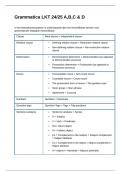
In het toetsafnamesysteem is onderstaande lijst met verschillende termen voor
grammaticale begrippen beschikbaar:
Clause Main clause = Independent clause
Relative clause Defining relative clause = Restrictive relative clause
Non-defining relative clause = Non-restrictive relative
clause
Determiners Demonstrative determiner = Demonstrative (as opposed
to Demonstrative pronoun)
Possessive determiner = Possessive (as opposed to
Possessive pronoun)
Nouns Uncountable nouns = Non-count nouns
Countable nouns = Count nouns
The possessive form of nouns = The genitive case
Noun group = Noun phrase
Agreement = Concord
Numbers Numbers = Numerals
Question tags Question Tags = Tags = Tag questions
Sentence analysis Sentence analysis = Syntax
S = Subject
V = Verb = Predicator
Od = Direct object
Oi = Indirect object
Cs = Complement to the subject = Subject complement
= Subject attribute
Co = Complement to the object = Object complement =
Object attribute
A = Adjunct = Adverbial = Adjunct adverbial
, C = Conjunction = Linking word
Verb group Verb group = Verb phrase
Verb Forms Continuous form = Progressive form
Verbs Modals = Modal verbs = Modal auxiliaries
Copula = Link verb
Main verb = Lexical verb = Notional verb = Ordinary
verb
Word class Word class = Parts of speech
Main Clause (Independent Clause)
A main clause, also called an independent clause, is a group of words that
contains a subject and a predicate (verb) and expresses a complete thought. This
means it can stand alone as a complete sentence. Every complete sentence has at
least one main clause.
Key Characteristics:
Subject: The person, place, thing, or idea that is doing or being something.
Verb/Predicate: The action or state of being of the subject.
Complete Thought: It can stand on its own as a sentence.
Examples of Main Clauses:
1. She runs every morning.
o Subject: She
o Verb: runs
o Complete thought: The sentence makes sense on its own.
2. The car stopped suddenly.
o Subject: The car
o Verb: stopped
o Complete thought: The sentence can stand alone.
3. John loves to read books.
o Subject: John
o Verb: loves
, o Complete thought: It expresses a full idea.
Example of Main Clauses in Compound Sentences:
A compound sentence contains two or more main clauses joined by a coordinating
conjunction (e.g., and, but, or, so, yet).
1. I went to the store, and I bought some milk.
o First main clause: I went to the store.
o Second main clause: I bought some milk.
o These are joined by the coordinating conjunction and.
2. She studied hard, but she didn’t pass the exam.
o First main clause: She studied hard.
o Second main clause: she didn’t pass the exam.
o Joined by but.
Main Clause Questions:
1. What is a main clause?
o A main clause is a clause that contains a subject and a verb and can
stand alone as a complete sentence.
2. Can a main clause be a sentence on its own?
o Yes, a main clause expresses a complete thought and can stand alone
as a sentence.
3. What is the difference between a main clause and a subordinate clause?
o A main clause can stand alone as a sentence, while a subordinate
clause cannot. Subordinate clauses depend on a main clause to make
sense.
4. How do you join two main clauses?
o Two main clauses can be joined using a coordinating conjunction (e.g.,
and, but, or) or a semicolon.
More Examples of Main Clauses:
1. They finished the project on time.
o Subject: They
o Verb: finished
o Complete thought: This stands alone as a sentence.
2. The dog barked loudly.
In het toetsafnamesysteem is onderstaande lijst met verschillende termen voor
grammaticale begrippen beschikbaar:
Clause Main clause = Independent clause
Relative clause Defining relative clause = Restrictive relative clause
Non-defining relative clause = Non-restrictive relative
clause
Determiners Demonstrative determiner = Demonstrative (as opposed
to Demonstrative pronoun)
Possessive determiner = Possessive (as opposed to
Possessive pronoun)
Nouns Uncountable nouns = Non-count nouns
Countable nouns = Count nouns
The possessive form of nouns = The genitive case
Noun group = Noun phrase
Agreement = Concord
Numbers Numbers = Numerals
Question tags Question Tags = Tags = Tag questions
Sentence analysis Sentence analysis = Syntax
S = Subject
V = Verb = Predicator
Od = Direct object
Oi = Indirect object
Cs = Complement to the subject = Subject complement
= Subject attribute
Co = Complement to the object = Object complement =
Object attribute
A = Adjunct = Adverbial = Adjunct adverbial
, C = Conjunction = Linking word
Verb group Verb group = Verb phrase
Verb Forms Continuous form = Progressive form
Verbs Modals = Modal verbs = Modal auxiliaries
Copula = Link verb
Main verb = Lexical verb = Notional verb = Ordinary
verb
Word class Word class = Parts of speech
Main Clause (Independent Clause)
A main clause, also called an independent clause, is a group of words that
contains a subject and a predicate (verb) and expresses a complete thought. This
means it can stand alone as a complete sentence. Every complete sentence has at
least one main clause.
Key Characteristics:
Subject: The person, place, thing, or idea that is doing or being something.
Verb/Predicate: The action or state of being of the subject.
Complete Thought: It can stand on its own as a sentence.
Examples of Main Clauses:
1. She runs every morning.
o Subject: She
o Verb: runs
o Complete thought: The sentence makes sense on its own.
2. The car stopped suddenly.
o Subject: The car
o Verb: stopped
o Complete thought: The sentence can stand alone.
3. John loves to read books.
o Subject: John
o Verb: loves
, o Complete thought: It expresses a full idea.
Example of Main Clauses in Compound Sentences:
A compound sentence contains two or more main clauses joined by a coordinating
conjunction (e.g., and, but, or, so, yet).
1. I went to the store, and I bought some milk.
o First main clause: I went to the store.
o Second main clause: I bought some milk.
o These are joined by the coordinating conjunction and.
2. She studied hard, but she didn’t pass the exam.
o First main clause: She studied hard.
o Second main clause: she didn’t pass the exam.
o Joined by but.
Main Clause Questions:
1. What is a main clause?
o A main clause is a clause that contains a subject and a verb and can
stand alone as a complete sentence.
2. Can a main clause be a sentence on its own?
o Yes, a main clause expresses a complete thought and can stand alone
as a sentence.
3. What is the difference between a main clause and a subordinate clause?
o A main clause can stand alone as a sentence, while a subordinate
clause cannot. Subordinate clauses depend on a main clause to make
sense.
4. How do you join two main clauses?
o Two main clauses can be joined using a coordinating conjunction (e.g.,
and, but, or) or a semicolon.
More Examples of Main Clauses:
1. They finished the project on time.
o Subject: They
o Verb: finished
o Complete thought: This stands alone as a sentence.
2. The dog barked loudly.