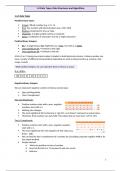
1.4 Data Types, Data Structures and Algorithms
1.4.1 Data Types
Primitive Data Types:
Integer: Whole number (e.g. 2, 0, -5)
Real: Any number with decimal places (e.g. 2.00, 5.83)
Boolean: Restricted to True or False
Character: A single symbol used by a computer
String: A collection of characters (can be a single character)
Positive Binary Integers:
Bit = A single binary digit. Eight bits are a byte. Four bits is a nibble.
Least significant bit = Furthest to the right.
Most significant bit = Furthest to the left.
A bit is 0 or 1. Having two states makes it simpler to build electronic devices. A binary number can
have a variety of different interpretations depending on what is being stored (e.g. numeric, text,
image, sound).
With positive integers, we can represent them in binary as usual.
(E.g.) 8 Bits:
128 64 32 16 8 4 2 1
Negative Binary Integers:
We can represent negative numbers in binary several ways:
Sign and Magnitude
Two’s Complement
Sign and Magnitude:
Positive numbers start with a zero, negative
numbers start with a 1.
Nothing else changes.
The most significant bit has become a ‘sign bit’, so it doesn’t represent an actual value.
Therefore, 8 bit numbers can only hold 7 bit values (but we now store -127 to 127).
Two’s Complement:
Positive numbers start with a zero, negative numbers
start with a 1.
The most significant bit is the negative of that value (e.g.
8 bits: -128).
We can find the two’s complement of a number by calculating using the negative MSB or by
the simple method.
Simple method:
o Write out positive version of number
o Invert all the bits (i.e. 1s become 0s and vice versa)
o Add one.
1
, Binary Addition and Subtraction:
Addition:
Because binary is base 2,
when we get 1 + 1, it
becomes 0 again and we
carry the 1.
Example: “95 + 222”
Here we have an overflow as we’re let with a 1 we need to carry.
We need an extra bit if there’s an overflow error.
Subtraction:
To subtract, we convert the number to subtract into two’s complement, then we add them.
Both numbers (to begin with) must be signed (i.e. 0 or 1 at start).
Hexadecimal:
Hexadecimal is base 16. The characters 0-9 are
normal, and the characters A-F represent 10-15.
Places start with 1 and go up in powers of 16.
It’s useful to represent large binary numbers in a
smaller number of digits.
They’re used to represent colours, MAC addresses, memory addresses, and more.
Hexadecimal to Binary:
Convert the hexadecimal digits into their decimal numbers (e.g. 9 = 9, B = 11)
Convert each of these into a binary nibble.
Combine the nibbles to form a single binary number.
Hexadecimal to Denary:
Convert the hexadecimal number into binary, then convert this into a denary number.
Alternatively, use the place values of hexadecimal (1, 16, 256…).
Floating-Point Binary:
To store fractional numbers in binary, we extend the number line from left to right. The
place values halve as we move from left to right (e.g. ½, ¼, 1/8) and we place a binary point
between the 1 and 1/2.
The number line begins with a negative value (e.g. -16)
Fixed Point Binary: The position of the point is fixed on the number line and the range of numbers
we can store is limited, and some numbers can’t be stored accurately (e.g. 1/3).
Positive: = 3.75
Negative: = -6.5
2
1.4.1 Data Types
Primitive Data Types:
Integer: Whole number (e.g. 2, 0, -5)
Real: Any number with decimal places (e.g. 2.00, 5.83)
Boolean: Restricted to True or False
Character: A single symbol used by a computer
String: A collection of characters (can be a single character)
Positive Binary Integers:
Bit = A single binary digit. Eight bits are a byte. Four bits is a nibble.
Least significant bit = Furthest to the right.
Most significant bit = Furthest to the left.
A bit is 0 or 1. Having two states makes it simpler to build electronic devices. A binary number can
have a variety of different interpretations depending on what is being stored (e.g. numeric, text,
image, sound).
With positive integers, we can represent them in binary as usual.
(E.g.) 8 Bits:
128 64 32 16 8 4 2 1
Negative Binary Integers:
We can represent negative numbers in binary several ways:
Sign and Magnitude
Two’s Complement
Sign and Magnitude:
Positive numbers start with a zero, negative
numbers start with a 1.
Nothing else changes.
The most significant bit has become a ‘sign bit’, so it doesn’t represent an actual value.
Therefore, 8 bit numbers can only hold 7 bit values (but we now store -127 to 127).
Two’s Complement:
Positive numbers start with a zero, negative numbers
start with a 1.
The most significant bit is the negative of that value (e.g.
8 bits: -128).
We can find the two’s complement of a number by calculating using the negative MSB or by
the simple method.
Simple method:
o Write out positive version of number
o Invert all the bits (i.e. 1s become 0s and vice versa)
o Add one.
1
, Binary Addition and Subtraction:
Addition:
Because binary is base 2,
when we get 1 + 1, it
becomes 0 again and we
carry the 1.
Example: “95 + 222”
Here we have an overflow as we’re let with a 1 we need to carry.
We need an extra bit if there’s an overflow error.
Subtraction:
To subtract, we convert the number to subtract into two’s complement, then we add them.
Both numbers (to begin with) must be signed (i.e. 0 or 1 at start).
Hexadecimal:
Hexadecimal is base 16. The characters 0-9 are
normal, and the characters A-F represent 10-15.
Places start with 1 and go up in powers of 16.
It’s useful to represent large binary numbers in a
smaller number of digits.
They’re used to represent colours, MAC addresses, memory addresses, and more.
Hexadecimal to Binary:
Convert the hexadecimal digits into their decimal numbers (e.g. 9 = 9, B = 11)
Convert each of these into a binary nibble.
Combine the nibbles to form a single binary number.
Hexadecimal to Denary:
Convert the hexadecimal number into binary, then convert this into a denary number.
Alternatively, use the place values of hexadecimal (1, 16, 256…).
Floating-Point Binary:
To store fractional numbers in binary, we extend the number line from left to right. The
place values halve as we move from left to right (e.g. ½, ¼, 1/8) and we place a binary point
between the 1 and 1/2.
The number line begins with a negative value (e.g. -16)
Fixed Point Binary: The position of the point is fixed on the number line and the range of numbers
we can store is limited, and some numbers can’t be stored accurately (e.g. 1/3).
Positive: = 3.75
Negative: = -6.5
2