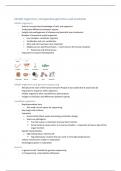
Model organisms, compara1ve genomics and evolu1on
Model organisms
- Used to increase basic knowledge of cells and organisms
- Understand differences between species
- Insights into pathogenesis of diseases and poten9al new treatments
- Number of important model organisms
o Less complex: unicellular organism
o Vertebrates and non-vertebrates
o Mice and rats have been very important
o Maybe you can add the primates -> most close to the human situa9on
§ Expensive and ethical issues
- Important to research development
Model organisms and genome sequencing
- Already at the start of the Human Genome Project it was stated that it would also be
important to sequence other organisms
- Smaller organisms were considered as pilot projects
- Insights in evolu9on and differences between species
Unicellular organisms
- Rapid genera9on 9me
o You need a lot of copies for sequencing
- Easy large scale cultures
- Important
o Economically (food, waste processing, produc9on drugs)
o Some are pathogenic
§ For that reason is important to know their func9on
§ Some bacteria causes ulcers in a human situa9on -> important to have a idea of the
organ func9on
- Specific characteris9cs
o high temperature, extreme pH
§ Taq polymerase: enzyme that can work in very high temperatures
- Cellular mechanisms similar to eukaryotes
- Homologous genes in eukaryotes
Bacteria
- In general small : feasible for genome sequencing
- 1 st Sequencing : Haemophilus influenzae
, o 1.83 Mb genome (limited size of the genome)
o Performed in 1995 with shotgun sequencing strategy
§ Isolate DNA -> make fragments -> sequence and a^er that you try to assembly the
fragments
o First free living organism that was sequenced
- Other bacteria
o Sanger Center sequenced many
o Currently several hundreds are sequenced for different reasons:
§ Medical relevance (Helicobacter Pylori, pep9c ulcers)
• Ulcers can be caused by Helicobacter pylori
§ Evolu9onary important (Archaeabacterie Methanococcus Jannaschii)
• Important to establish evolu9on
§ Model organism in research (E. coli, 4.6 Mb)
• Most use in life sciences research
Saccharomyces cerevisiae
- Unicellular yeast
- Gene9cally important model organism
- Many cellular processes are conserved up to human
- Sequenced by team lead by Prof. André Goffeau, UCL, Louvain-la-Neuve in 1996
- First sequence of eukaryo9c cell
- 6340 genes
- 60 % new genes without a known func9on in yeast
- Many genes homology with genes from mammals: 25% genes with unknown func9on
- First gene where introns and exons that are defined
- Important for research of life sciences
Mycoplasma genitalium
- Parasite of human genitalia
o Can grow on its own
- 482 genes
- 530 kb (known since 2008)
- Smallest genome, minimal genome?
o Minimal set of genes to have something surviving?
§ It’s quite close to it, so maybe this set of genes is close to the minimal set of genes
to have something survival
- First synthe9c model organism
o 10000 oligonucleo9des of 50 bp
§ Noval organisms by making use of these set of genes, by making a large number of
oligonucleo9des and binding them
=> Synthe9c biology, ar9ficial life
- Knocking out the genes to see which of the genes are essen9al to survive
Invertebrates
- Possible to study cell-cell interac9ons
- Easy and inexpensive
- Some9mes they lack important organs (central nervous system, immune system, skeleton)
- Homologous genes invertebrates
- High throughput drug screening
Model organisms
- Used to increase basic knowledge of cells and organisms
- Understand differences between species
- Insights into pathogenesis of diseases and poten9al new treatments
- Number of important model organisms
o Less complex: unicellular organism
o Vertebrates and non-vertebrates
o Mice and rats have been very important
o Maybe you can add the primates -> most close to the human situa9on
§ Expensive and ethical issues
- Important to research development
Model organisms and genome sequencing
- Already at the start of the Human Genome Project it was stated that it would also be
important to sequence other organisms
- Smaller organisms were considered as pilot projects
- Insights in evolu9on and differences between species
Unicellular organisms
- Rapid genera9on 9me
o You need a lot of copies for sequencing
- Easy large scale cultures
- Important
o Economically (food, waste processing, produc9on drugs)
o Some are pathogenic
§ For that reason is important to know their func9on
§ Some bacteria causes ulcers in a human situa9on -> important to have a idea of the
organ func9on
- Specific characteris9cs
o high temperature, extreme pH
§ Taq polymerase: enzyme that can work in very high temperatures
- Cellular mechanisms similar to eukaryotes
- Homologous genes in eukaryotes
Bacteria
- In general small : feasible for genome sequencing
- 1 st Sequencing : Haemophilus influenzae
, o 1.83 Mb genome (limited size of the genome)
o Performed in 1995 with shotgun sequencing strategy
§ Isolate DNA -> make fragments -> sequence and a^er that you try to assembly the
fragments
o First free living organism that was sequenced
- Other bacteria
o Sanger Center sequenced many
o Currently several hundreds are sequenced for different reasons:
§ Medical relevance (Helicobacter Pylori, pep9c ulcers)
• Ulcers can be caused by Helicobacter pylori
§ Evolu9onary important (Archaeabacterie Methanococcus Jannaschii)
• Important to establish evolu9on
§ Model organism in research (E. coli, 4.6 Mb)
• Most use in life sciences research
Saccharomyces cerevisiae
- Unicellular yeast
- Gene9cally important model organism
- Many cellular processes are conserved up to human
- Sequenced by team lead by Prof. André Goffeau, UCL, Louvain-la-Neuve in 1996
- First sequence of eukaryo9c cell
- 6340 genes
- 60 % new genes without a known func9on in yeast
- Many genes homology with genes from mammals: 25% genes with unknown func9on
- First gene where introns and exons that are defined
- Important for research of life sciences
Mycoplasma genitalium
- Parasite of human genitalia
o Can grow on its own
- 482 genes
- 530 kb (known since 2008)
- Smallest genome, minimal genome?
o Minimal set of genes to have something surviving?
§ It’s quite close to it, so maybe this set of genes is close to the minimal set of genes
to have something survival
- First synthe9c model organism
o 10000 oligonucleo9des of 50 bp
§ Noval organisms by making use of these set of genes, by making a large number of
oligonucleo9des and binding them
=> Synthe9c biology, ar9ficial life
- Knocking out the genes to see which of the genes are essen9al to survive
Invertebrates
- Possible to study cell-cell interac9ons
- Easy and inexpensive
- Some9mes they lack important organs (central nervous system, immune system, skeleton)
- Homologous genes invertebrates
- High throughput drug screening