Basic Textiles Reader 1
Fibers
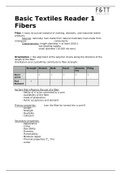
Fiber = basic structural material of clothing, domestic, and industrial textile
products.
Sources: naturally/ man-made from natural materials/ man-made from
(in)organic components.
Characteristics: length:diameter = at least 1000:1
low bending rigidity
small diameter (10-200 microns)
Orientation = the alignment of the polymer chains along the direction of the
length of the fiber.
Orientation and crystallinity contribute to fiber strength.
Strength Stretch Bulk Hand Absorbe Piling
ncy
Spun - + + + + +
yarns
Flat + - - - - -
filament
Factors that influence the use of a fiber:
- Ability of it to be converted to a yarn
- Availability of the fiber
- Costs of production
- Public acceptance and demand
Primary properties: (can the fiber be turned into a yarn?)
- Length
- Strength
- Flexibility
- Cohesion
Secondary properties:
- Appearance
- Crimp
- Dye-ability
- Fineness
- Flammability
- Moisture regain
- Thermal properties (Tg, Tm)
- Luster
, Tenacity is expressed as grams per tex. Tex = grams per 1000 meters.
Modulus = stiffness of the fiber
Luster = ability to reflect, absorb or transmit light.
Fibers can have various shapes (round cross-sectional, triangular, multilobal). The
shape of a fiber can affect the luster, appearance, and stiffness of the end-use
fabric.
Crimp = shape in fiber to make sure that fibers can connect together (twist).
Polyester doesn’t have crimp (so create yourself), cotton (naturally) does.
Mono-filament = one filament.
Multi-filament = multiple filaments.
Texturing = make crimp in a filament.
Natural fiber properties
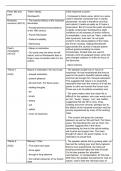
Cotton: takes approx. 50 from anthesis to open boll and the fibers die, drye, twist
and flatten. Now the cotton is ready for harvesting.
Fibers = seed cotton
Harvested in 2 ways: machines or by stripping.
Cotton ginning: separates seeds from cotton fibers, cleans fibers.
HVI also measures:
- Grade (trash content & color)
- fineness (micronaire = micrograms per inch)
- length (the higher the uniformity index, the better. Average = 80%)
- strength (tenacity units of grams per tex)
Ultraviolet radiation in sunlight breaks the chemical bonds in the polymer chain,
resulting in shorter chains with lower molecular weight, thus reducing fiber
strength.
Lumen = hollow part in the center inside untreated fibers. After treating fibers,
lumen can disappear.
Flax fiber = made of cellulose, used in making linen fabric.
Sheep’s wool: amino acids are formed into high molecular weight polypeptide
chains. = natural protein fibers. hydrophilic. Fibers are weaker than cotton fibers,
but more extensible.
Wool fibers cover well, resilience, insulation properties. Light in weight, can damage
quickly by alkaline chemicals (pay attention when bleaching).
Silk: protein fiber from insects. Only natural fiber available in continuous filament
form —> can be both filament and staple yarns.
Silk strand consists of 2 filaments held together by sericin. To destiffen —>
degumming (boiled).
Fibers
Fiber = basic structural material of clothing, domestic, and industrial textile
products.
Sources: naturally/ man-made from natural materials/ man-made from
(in)organic components.
Characteristics: length:diameter = at least 1000:1
low bending rigidity
small diameter (10-200 microns)
Orientation = the alignment of the polymer chains along the direction of the
length of the fiber.
Orientation and crystallinity contribute to fiber strength.
Strength Stretch Bulk Hand Absorbe Piling
ncy
Spun - + + + + +
yarns
Flat + - - - - -
filament
Factors that influence the use of a fiber:
- Ability of it to be converted to a yarn
- Availability of the fiber
- Costs of production
- Public acceptance and demand
Primary properties: (can the fiber be turned into a yarn?)
- Length
- Strength
- Flexibility
- Cohesion
Secondary properties:
- Appearance
- Crimp
- Dye-ability
- Fineness
- Flammability
- Moisture regain
- Thermal properties (Tg, Tm)
- Luster
, Tenacity is expressed as grams per tex. Tex = grams per 1000 meters.
Modulus = stiffness of the fiber
Luster = ability to reflect, absorb or transmit light.
Fibers can have various shapes (round cross-sectional, triangular, multilobal). The
shape of a fiber can affect the luster, appearance, and stiffness of the end-use
fabric.
Crimp = shape in fiber to make sure that fibers can connect together (twist).
Polyester doesn’t have crimp (so create yourself), cotton (naturally) does.
Mono-filament = one filament.
Multi-filament = multiple filaments.
Texturing = make crimp in a filament.
Natural fiber properties
Cotton: takes approx. 50 from anthesis to open boll and the fibers die, drye, twist
and flatten. Now the cotton is ready for harvesting.
Fibers = seed cotton
Harvested in 2 ways: machines or by stripping.
Cotton ginning: separates seeds from cotton fibers, cleans fibers.
HVI also measures:
- Grade (trash content & color)
- fineness (micronaire = micrograms per inch)
- length (the higher the uniformity index, the better. Average = 80%)
- strength (tenacity units of grams per tex)
Ultraviolet radiation in sunlight breaks the chemical bonds in the polymer chain,
resulting in shorter chains with lower molecular weight, thus reducing fiber
strength.
Lumen = hollow part in the center inside untreated fibers. After treating fibers,
lumen can disappear.
Flax fiber = made of cellulose, used in making linen fabric.
Sheep’s wool: amino acids are formed into high molecular weight polypeptide
chains. = natural protein fibers. hydrophilic. Fibers are weaker than cotton fibers,
but more extensible.
Wool fibers cover well, resilience, insulation properties. Light in weight, can damage
quickly by alkaline chemicals (pay attention when bleaching).
Silk: protein fiber from insects. Only natural fiber available in continuous filament
form —> can be both filament and staple yarns.
Silk strand consists of 2 filaments held together by sericin. To destiffen —>
degumming (boiled).