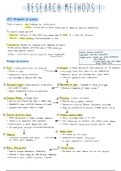
HCl : Philosophy of science
Division of Sciences -
arts ( literature ,
law
,
communication )
science
-
: natural
,
social & formal ( formal does not depend on empirical observations )
The scientific method uses both
•
empirical =
collection of data (facts ) using ,
evidence from the senses as a basis for conclusions
•
formal =
correct reasoning (conclusions) based on data
Commonalities between the consumer & the producer of science
→ when planning research you study works of those before
,
you
both
%Fedobseeua.c
→ Roles require curiosity
Athens : primarily theoretical
foofcajmombu.sn?Yaeaition7s
share commitment
amteoxdaan.de?e:na?7fgroiI?.es!obgse7e!
→ a to practice empiricism .
.
History of science →
theory predicts data
,
data supports
theory s through testing
① Plato -0
Strong Rationalism ,
no empiricism ③ Aristotle →
strong rationalism
,
some empiricism but not
systematic
•
theory of ideas To •
knowledge comes from ideas but also observations
•
Observations must be mistrusted • deduction = deduce new knowledge from certain truths
new knowledge by Reasoning from ideas induction generalize from observations
• • ⇐
f.
④ Alexandria (Egypt)
-
-
o
strong empiricism ,
no rationalism ③ Alexander
-
the great =
Conquerer of mainly asia &
egypt
new centre of science AT Hellenism of Greek 9
spreading culture
• •
-
o
•
careful observations ,
no focus on explanations
to
⑤ ⇐
Usptolemy ( almagest book)
⑧ htohammed ( islamic civilization)
• Said the sun & planets orbit earth in perfect circles •
Adopted ideas
by greeks t Hellenist s
-138
observations in consisted explained with elipses
•
were -0 •
Transplanting t
enriching Athenian t Alexandrian knowledge
( earth middle)
geocentric solar system as Made contributions to
(nr )
•
positional numeral
•
new
system .
O
&
⑧ Scientific
-
revolution G Goos ) ⑦ European
-
medieval period
•
Strong Re -
evaluation of natural
philosophy Athenian,
•
early =
knowledge based on the bible
•
Importance of observation from Alexandria ) BEG • late =
Rediscovery of aristotle when Arabic culture spread
•
mathematical ion of Reality (algebra from Islam ) •
Thomas Aquinas - b Reconciliation between aristotle t bible
• tech development ( telescope + microscope ) t book
printing
④ Copernicus
of ④ EQUI
•
Saw Copernicus was right
-
• introduced heliocentric solar system -
Bp o
experimentation (systemic manipulation)
but careful about spreading it
•
accurate observations t mathematicalion
.
l
④ Newton ( princip
-
a book
'
-
④ Johannes
-
Kepler
*
-
•
based on accurate astronomical observations •
discovered the orbit around the sun was elliptical
•
described a formal theory that fitted all Recent observations
→ silenced all critics scientific revolution complete
,
,Practices of empiricists -
o the theory - data
cycle ( predict ,
collect ,
test
,
update)
•
theory = a set of statements describing general principles about how variables Relate .
•
hypothesis = a prediction of the specific expected outcome if the theory is correct (situational )
data set of observations that support challenge the hypothesis 1 theory
•
= or
theory a Good
÷:aese
theories are
ok -
f Rec supported data (preferably
by large quantity evidence
•
& of
a
variety
.
§
•
Research questions •
falsifiable = a
theory must lead to an
hypothesis that could fail to support
* I
÷:÷÷÷÷÷÷÷:÷÷÷÷÷
+nannies.
. .
a
§ hypothesis e
-
O scientists evaluate theories based on the
weight of the evidence
"
t
support
data non
The method be used for both applied & basic Research :
empirical can
Basic
-
research Translational Research Applied Research
& T
e
T
g
•
goal is to enhance uses lessons from basic •
practical problems
apt
Research to develop &
general knowledge . conducted in Real
test the applications world contexts
may be applied
•
IRL
Later on
-
#
- .
Scientific sources
Publication process ( peer-Reviewed journals)
-
÷÷÷÷::÷÷÷:÷÷÷÷÷÷÷÷÷÷÷:÷÷÷÷÷÷:
① Researcher submits a manuscript to suitable journal
÷:÷÷÷÷÷÷÷÷:÷÷÷÷÷÷÷÷÷::
Conditional on minor revision ,
immediate acceptance
→ find original sources t be skeptical ④ author revises a Resubmits
-
-
Don 't base belief upon experience •
no control group
•
too many confounds o Confederate = actor for the experiment
but behavioral research is probabilistic = findings don't explain cases all the time
5examplesofbiasedthink.in#
/: thinning
① accepting a conclusion bc it makes sense / feels natural (believing a
good story)
:c. :a:::÷ :c:: . en
:: ::÷÷ :::: ::÷::÷:::::÷i ::c:
④ Bias blind spot = the belief we're
unlikely to fall to
prey
of
being biased ourselves
-
⑧
/
Pseudoscience -
B dare ma cation criteria of science
/
( order Scheider de )
PI!!: Jase: OY !! is!a%
"
:
observation y systematic empiricism ( unbiased observation
•
Resistance against scientific research 2) testable theories & hypotheses (falsifiable t data >
theory )
•
ignore I deny counter evidence 3) publicly ( peer
-
accessible Reviewed journal )
,: ÷:÷:÷÷:÷÷÷÷:÷÷::÷ ÷÷÷i÷ ÷:÷
:::÷::::::i..n↳..
Components of an em Peri cat journal article Fundamental assumptions of science
•
the existence ol a true (material) Reality
① abstract
:::::::m÷:÷÷::::::÷: : :::
.
. ' "
② Introduction -0 1St
paragraph : explains topic of the study
•
the discovered order is never final
2nd :
lays out the background for the research
3Rd : States specific Research
questions goals ,
t
hypotheses Reality & Construct in science
③ Method -0 explains in detail how the study was conducted
Reality = observable -
P data d Results
÷ : i:÷÷÷÷÷÷÷i÷÷÷÷:÷÷:÷ ÷ ÷i÷ ÷ ÷ ÷ ÷ ÷
2 discusses the study 's importance
.
Induction : from the observable data we induce
3. MAY discuss alternative explanations for the data
a non -
observable construct
⑥ References = full bibliographic list of all the sources
Hypothesis = a testable explanation ol a
-
T
I
phenomenon not
directly observable
I
↳ to test ,
weh-aueaniaaowha.my
-
a
hypothesis a prediction must
y
be derived from tailored to
explain the data leading to -
I
it a
#
,
"
f. £,
specific situation
"" "
!
II: : :::::: : : :*:
' '
prediction supports
.. . .. . . 1 Theory =
System of logically coherent constructs
/
I statements about a certain of
the
hypothesis l
area
Reality
l supported by data no contradictions
-
,
, qq.n.mg?gg;..ea,.,pa...,,y,.*
g÷g;÷,qy÷;÷,← wy.a.au.a.m.a.aa.apa.gg
.
for I falsifiable
the
hypothesis for a concrete situation
#
bold predictions ( good Theories ) -
l -
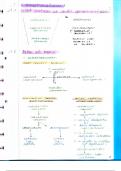
Verification vs falsification
data inconsistent with the prediction = falsification →
hypothesis is not true
BUT if the data is with the prediction its verified conditional
consistent we
Cannae say D
arguments
-
,
valid invalid invalid valid
confirmation of the ante cent Imp ) confirmation or the consequent derail of the ante cent derail of the consequent ( Mt )
1 I 2 are premises ( aannamens ) d are assumed to be true .
3 is the valid or invalid logical conclusion
, So how do we
verify a
hypothesis ? H -
-
a true hypothesis
~H= an untrue
hypothesis
I
hot
§
~ =
Ifethehebproeta.h.es?oni?s9oYreata
1-
true true
'
1 if hypothesis then
'
. prediction
✓
.
2 Prediction is true
2.thepreaictionisnoLCOR.pe#
.
-
3 r so does that mean the
yhp thesis is ?
-
.
o
3 . then the hypo this is not correct
↳ =
Valid
,
MT ↳ invalid confirmation
,
of the
consequent (
•
Hot
|
-
11 2.
-
.
if It
prediction ( P)
is not true
is
,
true
then P is not tru
✓
3 .
the prediction is not
,
not true
4. So the hypothesis is not
,
not true
5 .
So the
hypothesis is
probably true
→
theories &
hypotheses can never be proven ,
Approaches to science 1) Normative approach = how science should be done
only supported .
2) Historic approach = what scientists actually do
Week 2 oh 3. 5,6
Variables =
Something that varies ,
so at least two levels
constant something that could but only has level in the study in question
vary one
=
Researchers either
study
→ variable
in
any
measure or
manipulate a
•
measured variable =
one whose levels are simply observed and Recorded ( e.g .
IQ tests or height)
manipulated variable by (e.g manipulated (e.g age
•
=
controlled the researcher .
dosis ) -
D not
everything Cen be or unethical things )
→
each variable in a
study can be described in two
ways
1) conceptual
T ?
¥r%m" !
'
onalihed •
conceptual Variables abstract time socializing's
'
" =
concepts ( e.g .
concept
o
conceptual definitions = the careful definition of conceptual variables leg . what do we mean with
'
socializing
'
)
Lto measurable 2) Operational .
. .
•
Variables
> both Relating to the specific (test) situation
•
definitions
Division of Sciences -
arts ( literature ,
law
,
communication )
science
-
: natural
,
social & formal ( formal does not depend on empirical observations )
The scientific method uses both
•
empirical =
collection of data (facts ) using ,
evidence from the senses as a basis for conclusions
•
formal =
correct reasoning (conclusions) based on data
Commonalities between the consumer & the producer of science
→ when planning research you study works of those before
,
you
both
%Fedobseeua.c
→ Roles require curiosity
Athens : primarily theoretical
foofcajmombu.sn?Yaeaition7s
share commitment
amteoxdaan.de?e:na?7fgroiI?.es!obgse7e!
→ a to practice empiricism .
.
History of science →
theory predicts data
,
data supports
theory s through testing
① Plato -0
Strong Rationalism ,
no empiricism ③ Aristotle →
strong rationalism
,
some empiricism but not
systematic
•
theory of ideas To •
knowledge comes from ideas but also observations
•
Observations must be mistrusted • deduction = deduce new knowledge from certain truths
new knowledge by Reasoning from ideas induction generalize from observations
• • ⇐
f.
④ Alexandria (Egypt)
-
-
o
strong empiricism ,
no rationalism ③ Alexander
-
the great =
Conquerer of mainly asia &
egypt
new centre of science AT Hellenism of Greek 9
spreading culture
• •
-
o
•
careful observations ,
no focus on explanations
to
⑤ ⇐
Usptolemy ( almagest book)
⑧ htohammed ( islamic civilization)
• Said the sun & planets orbit earth in perfect circles •
Adopted ideas
by greeks t Hellenist s
-138
observations in consisted explained with elipses
•
were -0 •
Transplanting t
enriching Athenian t Alexandrian knowledge
( earth middle)
geocentric solar system as Made contributions to
(nr )
•
positional numeral
•
new
system .
O
&
⑧ Scientific
-
revolution G Goos ) ⑦ European
-
medieval period
•
Strong Re -
evaluation of natural
philosophy Athenian,
•
early =
knowledge based on the bible
•
Importance of observation from Alexandria ) BEG • late =
Rediscovery of aristotle when Arabic culture spread
•
mathematical ion of Reality (algebra from Islam ) •
Thomas Aquinas - b Reconciliation between aristotle t bible
• tech development ( telescope + microscope ) t book
printing
④ Copernicus
of ④ EQUI
•
Saw Copernicus was right
-
• introduced heliocentric solar system -
Bp o
experimentation (systemic manipulation)
but careful about spreading it
•
accurate observations t mathematicalion
.
l
④ Newton ( princip
-
a book
'
-
④ Johannes
-
Kepler
*
-
•
based on accurate astronomical observations •
discovered the orbit around the sun was elliptical
•
described a formal theory that fitted all Recent observations
→ silenced all critics scientific revolution complete
,
,Practices of empiricists -
o the theory - data
cycle ( predict ,
collect ,
test
,
update)
•
theory = a set of statements describing general principles about how variables Relate .
•
hypothesis = a prediction of the specific expected outcome if the theory is correct (situational )
data set of observations that support challenge the hypothesis 1 theory
•
= or
theory a Good
÷:aese
theories are
ok -
f Rec supported data (preferably
by large quantity evidence
•
& of
a
variety
.
§
•
Research questions •
falsifiable = a
theory must lead to an
hypothesis that could fail to support
* I
÷:÷÷÷÷÷÷÷:÷÷÷÷÷
+nannies.
. .
a
§ hypothesis e
-
O scientists evaluate theories based on the
weight of the evidence
"
t
support
data non
The method be used for both applied & basic Research :
empirical can
Basic
-
research Translational Research Applied Research
& T
e
T
g
•
goal is to enhance uses lessons from basic •
practical problems
apt
Research to develop &
general knowledge . conducted in Real
test the applications world contexts
may be applied
•
IRL
Later on
-
#
- .
Scientific sources
Publication process ( peer-Reviewed journals)
-
÷÷÷÷::÷÷÷:÷÷÷÷÷÷÷÷÷÷÷:÷÷÷÷÷÷:
① Researcher submits a manuscript to suitable journal
÷:÷÷÷÷÷÷÷÷:÷÷÷÷÷÷÷÷÷::
Conditional on minor revision ,
immediate acceptance
→ find original sources t be skeptical ④ author revises a Resubmits
-
-
Don 't base belief upon experience •
no control group
•
too many confounds o Confederate = actor for the experiment
but behavioral research is probabilistic = findings don't explain cases all the time
5examplesofbiasedthink.in#
/: thinning
① accepting a conclusion bc it makes sense / feels natural (believing a
good story)
:c. :a:::÷ :c:: . en
:: ::÷÷ :::: ::÷::÷:::::÷i ::c:
④ Bias blind spot = the belief we're
unlikely to fall to
prey
of
being biased ourselves
-
⑧
/
Pseudoscience -
B dare ma cation criteria of science
/
( order Scheider de )
PI!!: Jase: OY !! is!a%
"
:
observation y systematic empiricism ( unbiased observation
•
Resistance against scientific research 2) testable theories & hypotheses (falsifiable t data >
theory )
•
ignore I deny counter evidence 3) publicly ( peer
-
accessible Reviewed journal )
,: ÷:÷:÷÷:÷÷÷÷:÷÷::÷ ÷÷÷i÷ ÷:÷
:::÷::::::i..n↳..
Components of an em Peri cat journal article Fundamental assumptions of science
•
the existence ol a true (material) Reality
① abstract
:::::::m÷:÷÷::::::÷: : :::
.
. ' "
② Introduction -0 1St
paragraph : explains topic of the study
•
the discovered order is never final
2nd :
lays out the background for the research
3Rd : States specific Research
questions goals ,
t
hypotheses Reality & Construct in science
③ Method -0 explains in detail how the study was conducted
Reality = observable -
P data d Results
÷ : i:÷÷÷÷÷÷÷i÷÷÷÷:÷÷:÷ ÷ ÷i÷ ÷ ÷ ÷ ÷ ÷
2 discusses the study 's importance
.
Induction : from the observable data we induce
3. MAY discuss alternative explanations for the data
a non -
observable construct
⑥ References = full bibliographic list of all the sources
Hypothesis = a testable explanation ol a
-
T
I
phenomenon not
directly observable
I
↳ to test ,
weh-aueaniaaowha.my
-
a
hypothesis a prediction must
y
be derived from tailored to
explain the data leading to -
I
it a
#
,
"
f. £,
specific situation
"" "
!
II: : :::::: : : :*:
' '
prediction supports
.. . .. . . 1 Theory =
System of logically coherent constructs
/
I statements about a certain of
the
hypothesis l
area
Reality
l supported by data no contradictions
-
,
, qq.n.mg?gg;..ea,.,pa...,,y,.*
g÷g;÷,qy÷;÷,← wy.a.au.a.m.a.aa.apa.gg
.
for I falsifiable
the
hypothesis for a concrete situation
#
bold predictions ( good Theories ) -
l -
Verification vs falsification
data inconsistent with the prediction = falsification →
hypothesis is not true
BUT if the data is with the prediction its verified conditional
consistent we
Cannae say D
arguments
-
,
valid invalid invalid valid
confirmation of the ante cent Imp ) confirmation or the consequent derail of the ante cent derail of the consequent ( Mt )
1 I 2 are premises ( aannamens ) d are assumed to be true .
3 is the valid or invalid logical conclusion
, So how do we
verify a
hypothesis ? H -
-
a true hypothesis
~H= an untrue
hypothesis
I
hot
§
~ =
Ifethehebproeta.h.es?oni?s9oYreata
1-
true true
'
1 if hypothesis then
'
. prediction
✓
.
2 Prediction is true
2.thepreaictionisnoLCOR.pe#
.
-
3 r so does that mean the
yhp thesis is ?
-
.
o
3 . then the hypo this is not correct
↳ =
Valid
,
MT ↳ invalid confirmation
,
of the
consequent (
•
Hot
|
-
11 2.
-
.
if It
prediction ( P)
is not true
is
,
true
then P is not tru
✓
3 .
the prediction is not
,
not true
4. So the hypothesis is not
,
not true
5 .
So the
hypothesis is
probably true
→
theories &
hypotheses can never be proven ,
Approaches to science 1) Normative approach = how science should be done
only supported .
2) Historic approach = what scientists actually do
Week 2 oh 3. 5,6
Variables =
Something that varies ,
so at least two levels
constant something that could but only has level in the study in question
vary one
=
Researchers either
study
→ variable
in
any
measure or
manipulate a
•
measured variable =
one whose levels are simply observed and Recorded ( e.g .
IQ tests or height)
manipulated variable by (e.g manipulated (e.g age
•
=
controlled the researcher .
dosis ) -
D not
everything Cen be or unethical things )
→
each variable in a
study can be described in two
ways
1) conceptual
T ?
¥r%m" !
'
onalihed •
conceptual Variables abstract time socializing's
'
" =
concepts ( e.g .
concept
o
conceptual definitions = the careful definition of conceptual variables leg . what do we mean with
'
socializing
'
)
Lto measurable 2) Operational .
. .
•
Variables
> both Relating to the specific (test) situation
•
definitions