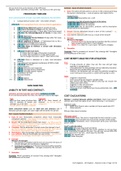
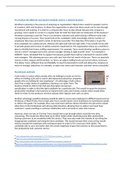
Set out time limits at the bottom of the CPR book. Contract - Cause of action structure:
Litigation Exam: Civil 65%, Criminal 35% - two exams on the same day
1. Duty: The duties of both parties is set out in the contract governing
the parties’ relationships. – Look at express and implied terms.
PROCEDURE TIMELINE
Implied terms:
From commencement of claim: start ADR, Settlement, Part 36 offers s.13 SGA 1982 Reasonable care + skill
1. Comply with pre-action rules – send Letter of Claim If contract is for Sale of goods also look at the below:
s.14(2) SGA 1979 Satisfactory quality
CPR 23-25 From issuing Claim Form: start any Interim applications s.14(3) SGA 1979 Fitness for purpose
s.13 SGA 1979 Sale by description, products sold by description
2. CPR 7.5 Serve Claim Form within 4 months of issue should match the description
3. CPR 7 Serve Particulars of Claim with the Claim Form
If PoC is served separately, 14 days after Claim Form served 2. Breach: Did the defendant breach a term of the contract? – eg.
4. CPR 10.3 File Acknowledgement of Service 14 days after Express or implied term
PoC 3. Loss: Did the claimant suffer loss as a result of the breach?
5. CPR 14 Admissions
6. CPR 15.4(1)(a)-(b) File the Defence 28 days after PoC (only 4. Damage:
if acknowledged service) Measure of damages:
7. CPR 12 Judgment in default – If Defendant fails to file a 1. Contract claims: Put injured party in position had the contract
Defence/Acknowledgement of Service been properly performed. C must mitigate.
8. CPR 26.3 Notice of proposed allocation 2. Debts: it is a claim for a sum owed. No need to mitigate.
CPR 15.8 Reply to Defence is served with Directions
Questionnaire 5. Remedies
9. CPR 3.13 If multi track claim: Conclude: Client’s prospects of success? Any missing info? Strengths
If < £50k: File first page of Precedent H with DQ and weaknesses of the case?
If > £50k: File Precedent H 21 days before CMC
File the budget discussion report 7 days before CMC
10. CPR 26.5 Claim is allocated to a track, hold allocation COST-BENEFIT ANALYSIS FOR LITIGATION:
hearing
11. Case and costs management conference (CCMC) is held Pros:
12. CPR 26-29 Directions • If large amounts at stake: may win the case and get large
13. Instruct experts amounts in compensation
14. CPR 31 Disclosure and inspection • If the defendant has deep pockets such as indemnity insurance:
15. CPR 32 Exchange witness statements likely that any compensation will be paid
16. CPR 35 Exchange experts’ reports • Publicity: the defendant will not want the publicity brought by
17. Preparation for trial court hearing and may prefer to settle before going to court.
18. Pre-trial checklist
19. Trial Cons:
20. CPR 52 Appeals • Litigation is expensive
21. CPR 70 Enforcement • Time-consuming and requires complex steps
• May need to pay legal fees upfront and may not recover the
whole costs even if wins
• Litigation is risky and uncertain
CASE ANALYSIS • Difficult to prove negligence
• If the case is lost, C will likely have to pay substantial costs – CPR
LIABILITY IN TORT AND CONTRACT: 44.2(2)(a)
Limitation periods (calculate exact date): Limitation Act 1980
If not commenced within this time, the claimant is barred damages. COST CALCULATIONS:
Tort: Contract: Retainer = contract between solicitor and client. Client must instruct
s.2 6 yrs from cause of action date s.5 6 yrs from breach of solicitor who must then agree to act. Initial interview = not retainer.
even if unaware of breach and contract – eg. did not satisfy
damages occurred later. – eg. date obligations Solicitors’ costs:
of poor advice, not date of retainer 1. profit costs (hourly rate x numbers of hours spent) plus VAT
2. disbursements
Claim concurrent duties (sue for both tort and contract) and if
limitation period is tight, one claim might still fall within the period. Bill your time every 6 minutes.
Tort - Cause of action structure:
Who pays costs?
1. Duty of care: Reasonably competent advice from reasonably Solicitor/client costs: The client is responsible for their solicitor’s costs.
competent solicitor. – Sue lawyer in tort and the LLP for breach of CPR 44.2(1)(a) court will take into account the conduct of the parties.
contract (LLP has deeper pockets) CPR 44.2(2)(a) Party/party costs: unsuccessful party pays successful
2. Breach: Did the defendant breach their duty? – eg. What was the party’s costs
solicitor’s specialism? Would similarly qualified property lawyers
advise differently? Caveated advice? Court’s wide discretion:
3. Causation: Did the defendant’s breach cause the claimant’s loss? – CPR 44.2(1) Who pays how much and when
eg. Did the solicitor’s breach cause the loss suffered? Did X rely on CPR 44.2(4)-(5) Factors affecting how much: whether or not you have
this advice? What would X have done if caveated advice? acted reasonably throughout the case. You will only recover 60%-70%
4. Remoteness: Was the damage suffered reasonably foreseeable? of the costs even if you win – client pays the shortfall.
5. Loss suffered: Must be foreseeable not too remote. – eg. £5m loss CPR 44.4 The amount paid
for property, but damages recoverable = £5m premium CPR 44.7 When they pay
6. Damage:
Measure of damages:
1. Put claimant in position had the tort not occurred. Be wary of
remote damages and contributory negligence.
2. Contributory negligence: if the loss have been partly caused by
claimant’s own negligence – damages received by the claimant
will be reduced.
7. Remedies
Conclude: Client’s prospects of success? Any missing info? Strengths
and weaknesses of the case?
Civil Litigation – All chapters – Revision notes | Page 1 of 19
, FUNDING COMMENCEMENT OF CLAIM
LEGAL AID FUNDING: CPR 1.1 Overriding objective: cases must be dealt with justly +
proportionately
Which type of claims might qualify?
Statements of case are: Claim Form + Particulars (if separate from
The following will not be funded – alternative funding needed: Claim Form) + Defence + Counterclaim
1. personal injury or death – but injury due to clinical negligence
is not excluded. PRE-ACTION RULES:
2. conveyancing, boundary disputes, defamation, wills/trust
law, company/partnership law, contract claims
3. employment cases negligence and consumer cases Para 3 Practice Direction on Pre-Action Conduct Parties must:
• Exchange adequate info to understand each other’s position
What type of funding is available? • Consider ADR
• Lessen the costs of resolving the dispute
Legal help: helping with preparing a case, but not litigation
Help at court: allows advocates to speak for the client at a court hearing Para 8 PD PAC Litigation should be the last resort, consider ADR first
without acting formally – one-off help for one trial. Para 13 PD PAC When giving directions, court takes into account non-
Legal representation: covers preparation + litigation + representation. compliance but not minor/technical breaches
CPR 44.2(5)(a) When making costs orders, court takes into account non-
Assessing whether a client qualifies for help: compliance with pre-action protocols before and during proceedings
Only available to individuals. Must pass both the merits + means test. Procedure:
1. Claimant will send out a Letter of Claim to D
Merits: 2. D need not send out an Acknowledgement, but must send a
Moderate prospect of success is enough. Letter of Response:
Will be refused if: unlikely to win more than the case costs, alternative • If there is a deadline in the Letter of Claim, within the
funding available, suitable for the small claims track, complaints deadline
procedure/ADR is not exhausted, unreasonable for the public to fund • If no deadline and the claim is a simple claim, within 14
the case days of the date of the Letter of Claim
• If no deadline and the claim is complex, within 3 months
Means: from the date of the Letter of Claim
If the client or their partner receives benefit (e.g. income support) they
are eligible. PROFESSIONAL NEGLIGENCE PRE-ACTION RULES:
If no benefits, then consider client’s capital and income: For claims against professionals only (eg. not cleaners).
1. Capital: disposable capital is max. £8,000. (+ Look to partner) Para 5.4 If reasonable chance of bringing claim against potential D, send
2. Income: gross monthly income is max. £2,657 + disposable Preliminary Notice. Acknowledge this within 21 days.
income is max £733 per month. (+ Look to partner) Para 6.1 When claimant decides on the grounds, sends Letter of Claim
Costs consequences of legal aid funding: Para 8.2 Other side has 3 months to investigate claim, then sends:
If a client keeps/gains money or property at the end of their case, then • Letter of Response with response to allegations and/or
they may have to repay some or all of the legal aid costs. This is done • Without prejudice (WP) Letter of Settlement
through a statutory charge.
Para 9.4 If offers to settle or admits part of the claim, parties negotiate
Example of statutory charge on the money/property: for max 6 months from Letter of Acknowledgement
Para 14.3 If don’t agree, claimant sends written notice 14 days before
If client wins damages of £20,000 issuing proceedings
Court orders costs of £4,000, LAA costs of £5,000
Statutory charge on damages: £5,000 - £4,000 = £1,000
WHICH COURT?
NO WIN NO FEE AGREEMENTS: Easy to confuse this question with allocation to tracks. (Small claims
track, fast track, multi-track)
Conditional fee agreements (CFA):
Which Court to choose?
If the client wins the case:
Pays to the solicitor: basic fee, disbursements, success fee (pays out PD7A para 2.1
of pocket), insurance premium (pays out of pocket). Start with the value of claim. – eg. £125,000
Recovers from the other side: solicitor’s basic fee, solicitor’s Less than £100,000 even if complex –
disbursements, damages County Court. If deemed complex, case will
be transferred later.
If the client loses the case: More £100,000 or more – client has a
Pays to the solicitor: disbursements, insurance premium and damages choice: County Court and High Court has
if there is a successful counterclaim concurrent jurisdiction.
Recovers from the other side: nothing
If there is a choice, consider the factors in PD 7A para 2.4:
Damages based agreements (DBA): (1) Financial value – over £100,000 by much? CPR 16.3(5)
CPR 16.3(6) CPR 26.8 Financial value = how much we expect to
If lawyers lose the case, they do not recover any fees. recover minus interest or costs for any counterclaim.
If lawyers win the case, the max recoverable amount is capped: £125,000 is only £25,000 above the High Court threshold of
1. at 25% of the damages in personal injury cases, £100,000 - commence the case in the County Court.
2. 35% of damages in employment tribunal cases and (2) Complexity – breach of contract, straightforward
3. 50% of damages in all other cases. Non-payment of an invoice for £125,000, simple debt claim.
(3) Importance to the public – not public interest
INSURANCE: CPR 30.3(2) – only consider this if it is unclear after all the above.
If the policy was entered into after 1 Apr 2013: Insurance premium is Which High Court division?
not recoverable from the other side if the policy-holder then wins at • Queen’s Bench Division – contract, tort
trial and is awarded its costs. • Chancery Division – IP, land
• Family Division – family law cases
Before the event (BTE) insurance: After the event (ATE) insurance:
BTE insurance provides the client Criteria: merits of the case + the level What if the case is brought in the wrong court?
with an indemnity for the cost of any of cover required, i.e. whether a CPR 30.3 Transfer is likely.
legal fees incurred as a result of any particular insurance company is
such future litigation. BTE premiums willing to take on the risk and on
are relatively low (less than 1% of what terms. ATE premiums are more CPR 30.3(2) Transfer order factors:
the insurance cover). expensive (more than 25% of the • Financial value, complexity, public interest factors as above
insurance cover). • Convenience, fair to transfer
• Availability of specialist judge in regional specialist court
• Facilities for disabled/potential witnesses
Civil Litigation – All chapters – Revision notes | Page 2 of 19
Litigation Exam: Civil 65%, Criminal 35% - two exams on the same day
1. Duty: The duties of both parties is set out in the contract governing
the parties’ relationships. – Look at express and implied terms.
PROCEDURE TIMELINE
Implied terms:
From commencement of claim: start ADR, Settlement, Part 36 offers s.13 SGA 1982 Reasonable care + skill
1. Comply with pre-action rules – send Letter of Claim If contract is for Sale of goods also look at the below:
s.14(2) SGA 1979 Satisfactory quality
CPR 23-25 From issuing Claim Form: start any Interim applications s.14(3) SGA 1979 Fitness for purpose
s.13 SGA 1979 Sale by description, products sold by description
2. CPR 7.5 Serve Claim Form within 4 months of issue should match the description
3. CPR 7 Serve Particulars of Claim with the Claim Form
If PoC is served separately, 14 days after Claim Form served 2. Breach: Did the defendant breach a term of the contract? – eg.
4. CPR 10.3 File Acknowledgement of Service 14 days after Express or implied term
PoC 3. Loss: Did the claimant suffer loss as a result of the breach?
5. CPR 14 Admissions
6. CPR 15.4(1)(a)-(b) File the Defence 28 days after PoC (only 4. Damage:
if acknowledged service) Measure of damages:
7. CPR 12 Judgment in default – If Defendant fails to file a 1. Contract claims: Put injured party in position had the contract
Defence/Acknowledgement of Service been properly performed. C must mitigate.
8. CPR 26.3 Notice of proposed allocation 2. Debts: it is a claim for a sum owed. No need to mitigate.
CPR 15.8 Reply to Defence is served with Directions
Questionnaire 5. Remedies
9. CPR 3.13 If multi track claim: Conclude: Client’s prospects of success? Any missing info? Strengths
If < £50k: File first page of Precedent H with DQ and weaknesses of the case?
If > £50k: File Precedent H 21 days before CMC
File the budget discussion report 7 days before CMC
10. CPR 26.5 Claim is allocated to a track, hold allocation COST-BENEFIT ANALYSIS FOR LITIGATION:
hearing
11. Case and costs management conference (CCMC) is held Pros:
12. CPR 26-29 Directions • If large amounts at stake: may win the case and get large
13. Instruct experts amounts in compensation
14. CPR 31 Disclosure and inspection • If the defendant has deep pockets such as indemnity insurance:
15. CPR 32 Exchange witness statements likely that any compensation will be paid
16. CPR 35 Exchange experts’ reports • Publicity: the defendant will not want the publicity brought by
17. Preparation for trial court hearing and may prefer to settle before going to court.
18. Pre-trial checklist
19. Trial Cons:
20. CPR 52 Appeals • Litigation is expensive
21. CPR 70 Enforcement • Time-consuming and requires complex steps
• May need to pay legal fees upfront and may not recover the
whole costs even if wins
• Litigation is risky and uncertain
CASE ANALYSIS • Difficult to prove negligence
• If the case is lost, C will likely have to pay substantial costs – CPR
LIABILITY IN TORT AND CONTRACT: 44.2(2)(a)
Limitation periods (calculate exact date): Limitation Act 1980
If not commenced within this time, the claimant is barred damages. COST CALCULATIONS:
Tort: Contract: Retainer = contract between solicitor and client. Client must instruct
s.2 6 yrs from cause of action date s.5 6 yrs from breach of solicitor who must then agree to act. Initial interview = not retainer.
even if unaware of breach and contract – eg. did not satisfy
damages occurred later. – eg. date obligations Solicitors’ costs:
of poor advice, not date of retainer 1. profit costs (hourly rate x numbers of hours spent) plus VAT
2. disbursements
Claim concurrent duties (sue for both tort and contract) and if
limitation period is tight, one claim might still fall within the period. Bill your time every 6 minutes.
Tort - Cause of action structure:
Who pays costs?
1. Duty of care: Reasonably competent advice from reasonably Solicitor/client costs: The client is responsible for their solicitor’s costs.
competent solicitor. – Sue lawyer in tort and the LLP for breach of CPR 44.2(1)(a) court will take into account the conduct of the parties.
contract (LLP has deeper pockets) CPR 44.2(2)(a) Party/party costs: unsuccessful party pays successful
2. Breach: Did the defendant breach their duty? – eg. What was the party’s costs
solicitor’s specialism? Would similarly qualified property lawyers
advise differently? Caveated advice? Court’s wide discretion:
3. Causation: Did the defendant’s breach cause the claimant’s loss? – CPR 44.2(1) Who pays how much and when
eg. Did the solicitor’s breach cause the loss suffered? Did X rely on CPR 44.2(4)-(5) Factors affecting how much: whether or not you have
this advice? What would X have done if caveated advice? acted reasonably throughout the case. You will only recover 60%-70%
4. Remoteness: Was the damage suffered reasonably foreseeable? of the costs even if you win – client pays the shortfall.
5. Loss suffered: Must be foreseeable not too remote. – eg. £5m loss CPR 44.4 The amount paid
for property, but damages recoverable = £5m premium CPR 44.7 When they pay
6. Damage:
Measure of damages:
1. Put claimant in position had the tort not occurred. Be wary of
remote damages and contributory negligence.
2. Contributory negligence: if the loss have been partly caused by
claimant’s own negligence – damages received by the claimant
will be reduced.
7. Remedies
Conclude: Client’s prospects of success? Any missing info? Strengths
and weaknesses of the case?
Civil Litigation – All chapters – Revision notes | Page 1 of 19
, FUNDING COMMENCEMENT OF CLAIM
LEGAL AID FUNDING: CPR 1.1 Overriding objective: cases must be dealt with justly +
proportionately
Which type of claims might qualify?
Statements of case are: Claim Form + Particulars (if separate from
The following will not be funded – alternative funding needed: Claim Form) + Defence + Counterclaim
1. personal injury or death – but injury due to clinical negligence
is not excluded. PRE-ACTION RULES:
2. conveyancing, boundary disputes, defamation, wills/trust
law, company/partnership law, contract claims
3. employment cases negligence and consumer cases Para 3 Practice Direction on Pre-Action Conduct Parties must:
• Exchange adequate info to understand each other’s position
What type of funding is available? • Consider ADR
• Lessen the costs of resolving the dispute
Legal help: helping with preparing a case, but not litigation
Help at court: allows advocates to speak for the client at a court hearing Para 8 PD PAC Litigation should be the last resort, consider ADR first
without acting formally – one-off help for one trial. Para 13 PD PAC When giving directions, court takes into account non-
Legal representation: covers preparation + litigation + representation. compliance but not minor/technical breaches
CPR 44.2(5)(a) When making costs orders, court takes into account non-
Assessing whether a client qualifies for help: compliance with pre-action protocols before and during proceedings
Only available to individuals. Must pass both the merits + means test. Procedure:
1. Claimant will send out a Letter of Claim to D
Merits: 2. D need not send out an Acknowledgement, but must send a
Moderate prospect of success is enough. Letter of Response:
Will be refused if: unlikely to win more than the case costs, alternative • If there is a deadline in the Letter of Claim, within the
funding available, suitable for the small claims track, complaints deadline
procedure/ADR is not exhausted, unreasonable for the public to fund • If no deadline and the claim is a simple claim, within 14
the case days of the date of the Letter of Claim
• If no deadline and the claim is complex, within 3 months
Means: from the date of the Letter of Claim
If the client or their partner receives benefit (e.g. income support) they
are eligible. PROFESSIONAL NEGLIGENCE PRE-ACTION RULES:
If no benefits, then consider client’s capital and income: For claims against professionals only (eg. not cleaners).
1. Capital: disposable capital is max. £8,000. (+ Look to partner) Para 5.4 If reasonable chance of bringing claim against potential D, send
2. Income: gross monthly income is max. £2,657 + disposable Preliminary Notice. Acknowledge this within 21 days.
income is max £733 per month. (+ Look to partner) Para 6.1 When claimant decides on the grounds, sends Letter of Claim
Costs consequences of legal aid funding: Para 8.2 Other side has 3 months to investigate claim, then sends:
If a client keeps/gains money or property at the end of their case, then • Letter of Response with response to allegations and/or
they may have to repay some or all of the legal aid costs. This is done • Without prejudice (WP) Letter of Settlement
through a statutory charge.
Para 9.4 If offers to settle or admits part of the claim, parties negotiate
Example of statutory charge on the money/property: for max 6 months from Letter of Acknowledgement
Para 14.3 If don’t agree, claimant sends written notice 14 days before
If client wins damages of £20,000 issuing proceedings
Court orders costs of £4,000, LAA costs of £5,000
Statutory charge on damages: £5,000 - £4,000 = £1,000
WHICH COURT?
NO WIN NO FEE AGREEMENTS: Easy to confuse this question with allocation to tracks. (Small claims
track, fast track, multi-track)
Conditional fee agreements (CFA):
Which Court to choose?
If the client wins the case:
Pays to the solicitor: basic fee, disbursements, success fee (pays out PD7A para 2.1
of pocket), insurance premium (pays out of pocket). Start with the value of claim. – eg. £125,000
Recovers from the other side: solicitor’s basic fee, solicitor’s Less than £100,000 even if complex –
disbursements, damages County Court. If deemed complex, case will
be transferred later.
If the client loses the case: More £100,000 or more – client has a
Pays to the solicitor: disbursements, insurance premium and damages choice: County Court and High Court has
if there is a successful counterclaim concurrent jurisdiction.
Recovers from the other side: nothing
If there is a choice, consider the factors in PD 7A para 2.4:
Damages based agreements (DBA): (1) Financial value – over £100,000 by much? CPR 16.3(5)
CPR 16.3(6) CPR 26.8 Financial value = how much we expect to
If lawyers lose the case, they do not recover any fees. recover minus interest or costs for any counterclaim.
If lawyers win the case, the max recoverable amount is capped: £125,000 is only £25,000 above the High Court threshold of
1. at 25% of the damages in personal injury cases, £100,000 - commence the case in the County Court.
2. 35% of damages in employment tribunal cases and (2) Complexity – breach of contract, straightforward
3. 50% of damages in all other cases. Non-payment of an invoice for £125,000, simple debt claim.
(3) Importance to the public – not public interest
INSURANCE: CPR 30.3(2) – only consider this if it is unclear after all the above.
If the policy was entered into after 1 Apr 2013: Insurance premium is Which High Court division?
not recoverable from the other side if the policy-holder then wins at • Queen’s Bench Division – contract, tort
trial and is awarded its costs. • Chancery Division – IP, land
• Family Division – family law cases
Before the event (BTE) insurance: After the event (ATE) insurance:
BTE insurance provides the client Criteria: merits of the case + the level What if the case is brought in the wrong court?
with an indemnity for the cost of any of cover required, i.e. whether a CPR 30.3 Transfer is likely.
legal fees incurred as a result of any particular insurance company is
such future litigation. BTE premiums willing to take on the risk and on
are relatively low (less than 1% of what terms. ATE premiums are more CPR 30.3(2) Transfer order factors:
the insurance cover). expensive (more than 25% of the • Financial value, complexity, public interest factors as above
insurance cover). • Convenience, fair to transfer
• Availability of specialist judge in regional specialist court
• Facilities for disabled/potential witnesses
Civil Litigation – All chapters – Revision notes | Page 2 of 19