HISTORY ESSAY PLANS
RED - PEOPLE
BLUE - KEY IDEAS
PURPLE - EXAMPLES
TUDOR
Henry VII
‘Henry VII’s consolidation of power in the years 1485-1499 was the result of his personal
strengths’. Explain why you agree or disagree with this view
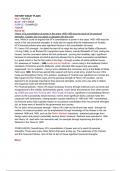
Intro: Whilst it could be argued that H7's consolidation of power in the years 1485-1499 was the
result of his own personal strengths, it could also be argued that the weaknesses of Yorkists,
H7's financial policies were also significant factors in his consolidation of power.
P1: Henry VII’s strength - he dated the start of his reign the day before the Battle of Bosworth
(12 Aug 1485), so all Richard III’s supporters were traitors, married Elizabeth of York, uniting the
houses, has his coronation before the first parliament - proving his hereditary right, significant
because his shrewdness and skill at planning allowed him to achieve successful consolidation
to a great extent in the the first years of his reign - through a series of astute political moves.
P2: weakness of Yorkists - 1486 Lovell and the Staffords - minor rising in the traditional Yorkist
heartland of Yorkshire and the Midlands, which attracted little support and was easily
suppressed. Simnel rebellion - henry’s army defeated the mercenary army at the Battle of Stoke
Field June 1486, Simnel has gained little support and had a small army, ended the war of the
roses and strengthens Henry VII’s position, weakness of Yorkists was significant as it shows the
little support for the Yorkist cause and the growing strength of Henry VII’s position, can be
deemed to be of greater importance than personal strengths, as his army was able to defeat
and suppress rivals and eliminate threats
P3: Financial policies - Henry VII raised necessary income through methods such as bonds and
recognisance to the nobility, parliamentary grants, crown lands and pensions from other powers
eg. £5000 per year from France after 1942 Treaty of Etaples, significant in consolidating Henry’s
power as the successfully raised revenue, not his most significant factor, policies made him
unpopular with landowners, raising taxation caused rebellions in 1489 and 1497, nevertheless,
his financial policy had a greater impact on successful consolidation than his personal strengths
did, as these were of benefit to the government and country.
P4: he didn’t show personal strength - Henry VII’s claim to the throne was weak - through his
mother, his insecure position can be emphasised through knowledge of the threats to his rule
between 1486 and 1499, such as the Perkin Warbeck imposture - attracted patronage from
foreign rulers and posed a potentially serious threat. However, Warbeck was executed in 1499
and Henry VII dealt with rival claimants well, for example through imprisoning the Earl of
Warwick in the Tower in 1485
CONCLUSION: Overall Henry VII’s consolidation of power was not a result of personal
strengths, There were many other factors that were at play eg. The weakness of the Yorkists
and the Financial Policies, onto of this he did not have significant personal strengths.
Mary I
RED - PEOPLE
BLUE - KEY IDEAS
PURPLE - EXAMPLES
TUDOR
Henry VII
‘Henry VII’s consolidation of power in the years 1485-1499 was the result of his personal
strengths’. Explain why you agree or disagree with this view
Intro: Whilst it could be argued that H7's consolidation of power in the years 1485-1499 was the
result of his own personal strengths, it could also be argued that the weaknesses of Yorkists,
H7's financial policies were also significant factors in his consolidation of power.
P1: Henry VII’s strength - he dated the start of his reign the day before the Battle of Bosworth
(12 Aug 1485), so all Richard III’s supporters were traitors, married Elizabeth of York, uniting the
houses, has his coronation before the first parliament - proving his hereditary right, significant
because his shrewdness and skill at planning allowed him to achieve successful consolidation
to a great extent in the the first years of his reign - through a series of astute political moves.
P2: weakness of Yorkists - 1486 Lovell and the Staffords - minor rising in the traditional Yorkist
heartland of Yorkshire and the Midlands, which attracted little support and was easily
suppressed. Simnel rebellion - henry’s army defeated the mercenary army at the Battle of Stoke
Field June 1486, Simnel has gained little support and had a small army, ended the war of the
roses and strengthens Henry VII’s position, weakness of Yorkists was significant as it shows the
little support for the Yorkist cause and the growing strength of Henry VII’s position, can be
deemed to be of greater importance than personal strengths, as his army was able to defeat
and suppress rivals and eliminate threats
P3: Financial policies - Henry VII raised necessary income through methods such as bonds and
recognisance to the nobility, parliamentary grants, crown lands and pensions from other powers
eg. £5000 per year from France after 1942 Treaty of Etaples, significant in consolidating Henry’s
power as the successfully raised revenue, not his most significant factor, policies made him
unpopular with landowners, raising taxation caused rebellions in 1489 and 1497, nevertheless,
his financial policy had a greater impact on successful consolidation than his personal strengths
did, as these were of benefit to the government and country.
P4: he didn’t show personal strength - Henry VII’s claim to the throne was weak - through his
mother, his insecure position can be emphasised through knowledge of the threats to his rule
between 1486 and 1499, such as the Perkin Warbeck imposture - attracted patronage from
foreign rulers and posed a potentially serious threat. However, Warbeck was executed in 1499
and Henry VII dealt with rival claimants well, for example through imprisoning the Earl of
Warwick in the Tower in 1485
CONCLUSION: Overall Henry VII’s consolidation of power was not a result of personal
strengths, There were many other factors that were at play eg. The weakness of the Yorkists
and the Financial Policies, onto of this he did not have significant personal strengths.
Mary I