PSYCHOPATHOLOGY
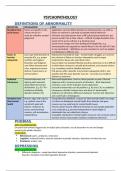
DEFINITIONS OF ABNORMALITY
DEFINITION EXPLANATION AO3
Deviation from Norms are specific to the Application: used to define disorders in clinical practice, e.g. APD as
social norms culture we live in + failure to conform to culturally acceptable ethical behaviour
made by collective societal Someone may label person from a diff cultural group abnormal, but
judgement person wouldn’t be in their culture – difficult to judge deviation from
social norms across cultures. E.g. hearing voices
Social norms change over time leading to hindsight bias, e.g.
homosexuality was regarded as mental illness in the UK until 1973 but
is now normalised – definitions are not consistent so can’t be applied
to individuals in different eras
Failure to Cant cope with demands of Represents threshold for help – mental health struggles are common
function everyday life, e.g. proper but criterion of failure to function adequately used to target
adequately nutrition and hygiene. treatments to those who need them most
Rosenhan and Seligman: Easy to label non-standard lifestyle practices abnormal, so it is difficult
cant follow interpersonal to label when someone is actually dysfunctional, and unusual choices
rules, experiences severe (e.g. travelling) could be labelled abnormal
distress, threat/worry to One person with a disorder may function adequately with it, and
self and others another with the same disorder may not – but only one would be
defined as abnormal
Statistical Unusual behaviour not Real-world application: Used in clinical practice as part of formal
infrequency aligning with expected diagnosis and to measure severity of disorders – Beck depression
data/within the normal inventory: score of 30+ indicates severe depression
distribution. E.g. IQ <70 = Unusual characteristics can be positive e.g. IQ over 130, so statistical
intellectual disability infrequency shouldn’t always form sole basis of ‘abnormality’
disorder (bottom 2%) Arbitrary cut off points: differences between 'normal' and 'abnormal'
and could lead to misdiagnosis
Deviation from Doesn't align with criteria, Comprehensive definition: concept of ‘ideal mental health’ has range
ideal mental e.g. realistic view of the of criteria to distinguish mental health from disorder and gives
health world/self, good self- reasons we may seek help for mental health issues
esteem, resistance to May be culture-bound: different elements are not equally applicable
stress, environmental cross-culturally e.g. personal independence valued highly in
mastery, self-actualisation, individualist but not collectivist cultures
independence Unrealistic standard for mental health: issues are very common and so
by these means most people would be considered abnormal
PHOBIAS
DSM-5 CLASSIFICATION:
Excessive fear/anxiety triggered by an object/place/situation, out of proportion to any real danger
posed by the phobic stimulus
SYMPTOMS:
Behavioural: panic, avoidance, endurance
Cognitive: irrational beliefs, selective attention to phobic stimulus, distortions of what they see
Emotional: anxiety, fear
DEPRESSION
DSM-5 CLASSIFICATION:
Different categories = major/persistent depressive disorder, premenstrual dysphoric
disorder, disruptive mood dysregulation disorder
, CHARACTERISTICS:
Behavioural: disruption to eating/sleeping/activity levels, aggression/self-harm
Cognitive: poor concentration, absolutist thinking, negativity
Emotional: lowered mood, anger, low self-esteem
OCD
DSM-5 CLASSIFICATION:
Characterized by recurrent, persistent thoughts/urges/images and individual attempts to
ignore or suppress them – could be through fulfilment
CHARACTERISTICS:
Behavioural: compulsions are repetitive, compulsions reduce anxiety, avoidance
Cognitive: cognitive coping strategies, obsessive thoughts, insight into excessive anxiety
Emotional: anxiety, distress, guilt, and disgust
BEHAVIOURAL APPROACH EXPLAINING PHOBIAS
AO3
TWO PROCESS MODEL - MOWRER
Acquisition of phobias by classical conditioning - association of fear with phobic stimulus
Maintenance of phobias by operant conditioning: positive reinforcement (comfort) and negative
reinforcement (running away from the phobic object)
AO3
Watson and Rayner: Little albert observed with numerous objects (checks for existing
phobias). Given a white rat, and a loud noise occurs every time he touches it. He then
showed fear towards rat + other white fluffy objects (generalisation). Supports classical
conditioning causing phobias - HOWEVER idiographic
Application: used in therapy for treating phobias, e.g. through flooding and systematic
desensitisation – Gilroy et al
Reductionist: Doesn’t address the cognitive components of phobias – is focussed on
behavioural symptoms that are observable, for example avoidance. However, the theory
does not provide an adequate explanation for cognitive components, e.g. irrational beliefs
Doesn’t explain phobias that develop without a traumatic experience to condition them into
fearing the stimulus. Other explanations, e.g. evolutionary theory, may be better as they do
explain these cases of phobias
BEHAVIOURAL APPROACH TO TREATING PHOBIAS
SYSTEMATIC DESENSITISATION
AO1
Behavioural therapy used to reduce behavioural anxiety through classical conditioning to create a
new response = COUNTERCONDITIONING
Processes involved:
Relaxation (taught relaxation techniques)
Anxiety hierarchy (agreed list of anxiety provoking situations)
Reciprocal inhibition (relaxation + anxiety-provoking situation)
Complete treatment (complete treatment)
AO3
Gilroy et al: group of 42 treated for spider phobia with SD less fearful after 3 and 33 months
than a control group treated by relaxation without exposure
DEFINITIONS OF ABNORMALITY
DEFINITION EXPLANATION AO3
Deviation from Norms are specific to the Application: used to define disorders in clinical practice, e.g. APD as
social norms culture we live in + failure to conform to culturally acceptable ethical behaviour
made by collective societal Someone may label person from a diff cultural group abnormal, but
judgement person wouldn’t be in their culture – difficult to judge deviation from
social norms across cultures. E.g. hearing voices
Social norms change over time leading to hindsight bias, e.g.
homosexuality was regarded as mental illness in the UK until 1973 but
is now normalised – definitions are not consistent so can’t be applied
to individuals in different eras
Failure to Cant cope with demands of Represents threshold for help – mental health struggles are common
function everyday life, e.g. proper but criterion of failure to function adequately used to target
adequately nutrition and hygiene. treatments to those who need them most
Rosenhan and Seligman: Easy to label non-standard lifestyle practices abnormal, so it is difficult
cant follow interpersonal to label when someone is actually dysfunctional, and unusual choices
rules, experiences severe (e.g. travelling) could be labelled abnormal
distress, threat/worry to One person with a disorder may function adequately with it, and
self and others another with the same disorder may not – but only one would be
defined as abnormal
Statistical Unusual behaviour not Real-world application: Used in clinical practice as part of formal
infrequency aligning with expected diagnosis and to measure severity of disorders – Beck depression
data/within the normal inventory: score of 30+ indicates severe depression
distribution. E.g. IQ <70 = Unusual characteristics can be positive e.g. IQ over 130, so statistical
intellectual disability infrequency shouldn’t always form sole basis of ‘abnormality’
disorder (bottom 2%) Arbitrary cut off points: differences between 'normal' and 'abnormal'
and could lead to misdiagnosis
Deviation from Doesn't align with criteria, Comprehensive definition: concept of ‘ideal mental health’ has range
ideal mental e.g. realistic view of the of criteria to distinguish mental health from disorder and gives
health world/self, good self- reasons we may seek help for mental health issues
esteem, resistance to May be culture-bound: different elements are not equally applicable
stress, environmental cross-culturally e.g. personal independence valued highly in
mastery, self-actualisation, individualist but not collectivist cultures
independence Unrealistic standard for mental health: issues are very common and so
by these means most people would be considered abnormal
PHOBIAS
DSM-5 CLASSIFICATION:
Excessive fear/anxiety triggered by an object/place/situation, out of proportion to any real danger
posed by the phobic stimulus
SYMPTOMS:
Behavioural: panic, avoidance, endurance
Cognitive: irrational beliefs, selective attention to phobic stimulus, distortions of what they see
Emotional: anxiety, fear
DEPRESSION
DSM-5 CLASSIFICATION:
Different categories = major/persistent depressive disorder, premenstrual dysphoric
disorder, disruptive mood dysregulation disorder
, CHARACTERISTICS:
Behavioural: disruption to eating/sleeping/activity levels, aggression/self-harm
Cognitive: poor concentration, absolutist thinking, negativity
Emotional: lowered mood, anger, low self-esteem
OCD
DSM-5 CLASSIFICATION:
Characterized by recurrent, persistent thoughts/urges/images and individual attempts to
ignore or suppress them – could be through fulfilment
CHARACTERISTICS:
Behavioural: compulsions are repetitive, compulsions reduce anxiety, avoidance
Cognitive: cognitive coping strategies, obsessive thoughts, insight into excessive anxiety
Emotional: anxiety, distress, guilt, and disgust
BEHAVIOURAL APPROACH EXPLAINING PHOBIAS
AO3
TWO PROCESS MODEL - MOWRER
Acquisition of phobias by classical conditioning - association of fear with phobic stimulus
Maintenance of phobias by operant conditioning: positive reinforcement (comfort) and negative
reinforcement (running away from the phobic object)
AO3
Watson and Rayner: Little albert observed with numerous objects (checks for existing
phobias). Given a white rat, and a loud noise occurs every time he touches it. He then
showed fear towards rat + other white fluffy objects (generalisation). Supports classical
conditioning causing phobias - HOWEVER idiographic
Application: used in therapy for treating phobias, e.g. through flooding and systematic
desensitisation – Gilroy et al
Reductionist: Doesn’t address the cognitive components of phobias – is focussed on
behavioural symptoms that are observable, for example avoidance. However, the theory
does not provide an adequate explanation for cognitive components, e.g. irrational beliefs
Doesn’t explain phobias that develop without a traumatic experience to condition them into
fearing the stimulus. Other explanations, e.g. evolutionary theory, may be better as they do
explain these cases of phobias
BEHAVIOURAL APPROACH TO TREATING PHOBIAS
SYSTEMATIC DESENSITISATION
AO1
Behavioural therapy used to reduce behavioural anxiety through classical conditioning to create a
new response = COUNTERCONDITIONING
Processes involved:
Relaxation (taught relaxation techniques)
Anxiety hierarchy (agreed list of anxiety provoking situations)
Reciprocal inhibition (relaxation + anxiety-provoking situation)
Complete treatment (complete treatment)
AO3
Gilroy et al: group of 42 treated for spider phobia with SD less fearful after 3 and 33 months
than a control group treated by relaxation without exposure