100% tevredenheidsgarantie Direct beschikbaar na je betaling Lees online óf als PDF Geen vaste maandelijkse kosten 4.2 TrustPilot
logo-home
Tentamen (uitwerkingen)

EMA1501 Assignment 4 2024 | Due 20 August 2024

Beoordeling
-
Verkocht
1
Pagina's
8
Cijfer
A+
Geüpload op
06-08-2024
Geschreven in
2024/2025

EMA1501 Assignment 4 2024 | Due 20 August 2024. All questions answered. Question 1 The diagram below is the data handling cycle, and it is used in emergent mathematics as a tool to collect, organise, represent, and interpret numerical information or data. 1. In the Foundation Phase, learners are taught to work with all four elements of the data handling process, however, in the Grade R classroom, learners are taught how to work with data, starting with collecting, sorting and then representing the data. In two to three sentences, explain why Grade R learners only stop at representing the data. (2) 2. In your own words, compare and contrast the sequence in which Grade R learners master data handling skills to the sequence in which Grades 1 to 3 master data handling. Write it in two paragraphs of about 5 to 6 lines or about 100 words each. (5x2=10) 3. Read the case study below, and then follow the instructions provided at the bottom: In Miss Mofokeng’s classroom, it’s circle time in the morning; the discussion is based on the theme of the week; “feelings”. Miss Mofokeng asks each child to pick out a face from the container full of cardboard cutout emojis that show how they feel that morning. The emojis show the following expressions: sad, happy, tired, excited, and worried. Miss Mofokeng now has twenty cutouts in the middle of the circle. 3.1. Suppose you are Miss Mofokeng; plan and involve learners in a data handling activity based on the case study above. In your activity, include • the problem statement/question (2) • present the activity using the steps of the data handling cycle. This should also include at least three questions in each step, as well as illustrations to guide the children in the process. (4x7=28) 3.2. After completing the activity in 3.1, answer the following questions: • Did the data-handling process solve the investigation? (1) • What went well? (2) • What would you do differently next time (remember, there is always room for improvement)? Question 2 Assessment is an important part of teaching and learning and should, therefore be part of everyday practice. Assessments help the teacher to gauge how children are progressing, to recognize their needs and then plan activities to support learning. 2.1. Think and reflect on your days as a primary or high school student. Write down three things you recall liking about assessment and three things you recall disliking about assessment. Give reasons for both the things you liked and disliked about assessment. Remember, these should be based on your personal experiences with assessment while in school. (5x2=10) 2.2. There are varying views about the purposes of assessment. One view is that assessment aims to establish what the child has learnt and what the child has not learnt. Another view is that assessment should be used during the learning process to support the child’s learning. Argue or motivate why assessment is not only a tool for testing children’s learning, but also a tool to support learning. (2x4=8) 2.3 Within the context of early childhood teaching, do you agree or disagree with the views in 2.2. above?? Corroborate your opinion. (5) 2.4 In 3 paragraphs of 5 to 6 lines or 100 words, name (1x3=3) and categorize 5x3=15) the 3 assessment methods most appropriate to emergent mathematics. 2.5. A checklist is a recording tool developed from a range of learning objectives or assessment criteria found in curriculum policies. Using the steps from your learning guide, design your own checklist for an activity on counting that is appropriate for Grade R. (6) The checklist should have at least (6) criteria. (12) [52] TOTAL: 100

Meer zien Lees minder
Instelling
Vak


Oeps! We kunnen je document nu niet laden. Probeer het nog eens of neem contact op met support.

Gekoppeld boek

Geschreven voor

Instelling
Vak

Documentinformatie

Geüpload op
6 augustus 2024
Aantal pagina's
8
Geschreven in
2024/2025
Type
Tentamen (uitwerkingen)
Bevat
Vragen en antwoorden

Onderwerpen

Voorbeeld van de inhoud

, PLEASE USE THIS DOCUMENT AS A GUIDE TO ANSWER YOUR ASSIGNMENT

Please note that the author of this document will not responsibility for any plagiarizing you
commit.

 Question 1

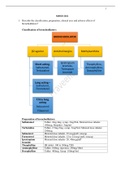
The diagram below is the data handling cycle, and it is used in emergent mathematics as a tool to
collect, organise, represent, and interpret numerical information or data.


1. In the Foundation Phase, learners are taught to work with all four elements of the data
handling process, however, in the Grade R classroom, learners are taught how to work with data,
starting with collecting, sorting and then representing the data. In two to three sentences, explain
why Grade R learners only stop at representing the data.

Grade R learners stop at representing the data because their cognitive development is still in the early
stages. At this age, children are primarily focused on developing basic skills such as observation and
categorization, which are foundational for understanding more complex processes. Representing data
visually helps them to concretize abstract concepts and prepares them for future steps of interpreting
and analyzing data, which require more advanced critical thinking skills.

2. In your own words, compare and contrast the sequence in which Grade R learners master
data handling skills to the sequence in which Grades 1 to 3 master data handling. Write it in two
paragraphs of about 5 to 6 lines or about 100 words each.

In Grade R, learners master data handling skills by first learning to collect data through simple
observations and experiences. They then progress to sorting the data into basic categories, such as
color, shape, or size. This process helps them develop organizational skills and understand the
concept of grouping. Finally, they represent the data using visual aids like charts or pictures, which
aids in reinforcing their understanding of the relationships between different sets of data

Maak kennis met de verkoper

Seller avatar
De reputatie van een verkoper is gebaseerd op het aantal documenten dat iemand tegen betaling verkocht heeft en de beoordelingen die voor die items ontvangen zijn. Er zijn drie niveau’s te onderscheiden: brons, zilver en goud. Hoe beter de reputatie, hoe meer de kwaliteit van zijn of haar werk te vertrouwen is.
Aimark94 University of South Africa (Unisa)
Volgen Je moet ingelogd zijn om studenten of vakken te kunnen volgen
Verkocht
6579
Lid sinds
6 jaar
Aantal volgers
3168
Documenten
1329
Laatst verkocht
4 dagen geleden
Simple & Affordable Study Materials

Study Packs & Assignments

4,2

522 beoordelingen

5
277
4
125
3
74
2
14
1
32

Recent door jou bekeken

Waarom studenten kiezen voor Stuvia

Gemaakt door medestudenten, geverifieerd door reviews

Kwaliteit die je kunt vertrouwen: geschreven door studenten die slaagden en beoordeeld door anderen die dit document gebruikten.

Niet tevreden? Kies een ander document

Geen zorgen! Je kunt voor hetzelfde geld direct een ander document kiezen dat beter past bij wat je zoekt.

Betaal zoals je wilt, start meteen met leren

Geen abonnement, geen verplichtingen. Betaal zoals je gewend bent via iDeal of creditcard en download je PDF-document meteen.

Student with book image

“Gekocht, gedownload en geslaagd. Zo makkelijk kan het dus zijn.”

Alisha Student

Veelgestelde vragen