2014
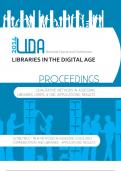
IDA Biennial Course and Conference
LIBRARIES IN THE DIGITAL AGE
PROCEEDINGS
QUALITATIVE METHODS IN ASSESSING
LIBRARIES, USERS, & USE: APPLICATIONS, RESULTS
ALTMETRICS - NEW METHODS IN ASSESSING SCHOLARLY
COMMUNICATION AND LIBRARIES: APPLICATIONS, RESULTS
, Libraries In the Digital Age (LIDA)
Zadar, Croatia, 16-20 June, 2014
Co-directors:
Tatjana Aparac-Jelusic (Department of Library and Information Science, University of
Zadar, Croatia) and Tefko Saracevic (School of Communication and Information, Rutgers
University, New Jersey, USA)
Organized by:
Department of Library and Information Science, University of Zadar, Croatia
School of Communication and Information, Rutgers University, New Jersey, USA
Faculty of Humanities and Social Sciences, University of Osijek, Croatia
ISBN
978-953-314-077-3
, LIBRARIES IN THE DIGITAL AGE (LIDA)
ASSESSING LIBRARIES AND
LIBRARY USERS AND USE
Proceedings of the 13th international conference
Libraries in the Digital Age (LIDA), Zadar, 16-20 June 2014
Edited by
Sanjica Faletar Tanacković
and Boris Bosančić
University of Zadar, Zadar &
Faculty of Humanities and Social Sciences, University of Osijek,
2014.
, Table of Contents
Foreword
Theme 1
Nicole Boubée: The cross self-confrontation method and challenges
in researching the active information-seeking of young people ................................................... 3
Donald O. Case: Sixty years of measuring the use of information and its sources:
from consultation to application ..................................................................................................13
Linda Z. Cooper: Proposal for a qualitative study of LIS students' self-assessment
of growth and direction using Dervin’s sense-making methodology applied to
intrapersonal examination of their ongoing eportfolio development...........................................21
Sheila Corrall: Library service capital: the case for measuring and
managing intangible assets ........................................................................................................21
Martina Dragija Ivanović: The impact of public libraries on small rural
communities: challenges to conducting research .......................................................................33
Evelyn Dröge, Julia Iwanowa, Steffen Hennicke: A specialisation of the
Europeana Data Model for the representation of manuscripts: The DM2E model ....................41
Silvana Šehić, Sanjica Faletar Tanacković: Exploration of academic information
seeking and library use of the blind and visually impaired students in Croatia .........................51
Isabelle Fabre, Cécile Gardiès: Expected usage and perceived usage, photography
as a methodological tool: the case of a learning centre in France .............................................59
Sanjica Faletar Tanacković, Darko Lacović, Gordana Gašo: Student use of library
physical spaces: unobtrusive observation of study spaces in an academic library ...................69
Carol A. Gordon: The convergence of performance and program assessment:
a multi-dimensional action research model for libraries .............................................................79
Cathal Hoare, Humphrey Sorensen: A reporting framework
for search session evaluation .....................................................................................................89
Isto Huvila: Where is the library, or is it an archive? Assessing the impact
and implications of archaeological information collections.........................................................97
Matthew Kelly: Assessing the relative value of domain knowledge for civil
society's libraries: the role of core collections ..........................................................................101
IDA Biennial Course and Conference
LIBRARIES IN THE DIGITAL AGE
PROCEEDINGS
QUALITATIVE METHODS IN ASSESSING
LIBRARIES, USERS, & USE: APPLICATIONS, RESULTS
ALTMETRICS - NEW METHODS IN ASSESSING SCHOLARLY
COMMUNICATION AND LIBRARIES: APPLICATIONS, RESULTS
, Libraries In the Digital Age (LIDA)
Zadar, Croatia, 16-20 June, 2014
Co-directors:
Tatjana Aparac-Jelusic (Department of Library and Information Science, University of
Zadar, Croatia) and Tefko Saracevic (School of Communication and Information, Rutgers
University, New Jersey, USA)
Organized by:
Department of Library and Information Science, University of Zadar, Croatia
School of Communication and Information, Rutgers University, New Jersey, USA
Faculty of Humanities and Social Sciences, University of Osijek, Croatia
ISBN
978-953-314-077-3
, LIBRARIES IN THE DIGITAL AGE (LIDA)
ASSESSING LIBRARIES AND
LIBRARY USERS AND USE
Proceedings of the 13th international conference
Libraries in the Digital Age (LIDA), Zadar, 16-20 June 2014
Edited by
Sanjica Faletar Tanacković
and Boris Bosančić
University of Zadar, Zadar &
Faculty of Humanities and Social Sciences, University of Osijek,
2014.
, Table of Contents
Foreword
Theme 1
Nicole Boubée: The cross self-confrontation method and challenges
in researching the active information-seeking of young people ................................................... 3
Donald O. Case: Sixty years of measuring the use of information and its sources:
from consultation to application ..................................................................................................13
Linda Z. Cooper: Proposal for a qualitative study of LIS students' self-assessment
of growth and direction using Dervin’s sense-making methodology applied to
intrapersonal examination of their ongoing eportfolio development...........................................21
Sheila Corrall: Library service capital: the case for measuring and
managing intangible assets ........................................................................................................21
Martina Dragija Ivanović: The impact of public libraries on small rural
communities: challenges to conducting research .......................................................................33
Evelyn Dröge, Julia Iwanowa, Steffen Hennicke: A specialisation of the
Europeana Data Model for the representation of manuscripts: The DM2E model ....................41
Silvana Šehić, Sanjica Faletar Tanacković: Exploration of academic information
seeking and library use of the blind and visually impaired students in Croatia .........................51
Isabelle Fabre, Cécile Gardiès: Expected usage and perceived usage, photography
as a methodological tool: the case of a learning centre in France .............................................59
Sanjica Faletar Tanacković, Darko Lacović, Gordana Gašo: Student use of library
physical spaces: unobtrusive observation of study spaces in an academic library ...................69
Carol A. Gordon: The convergence of performance and program assessment:
a multi-dimensional action research model for libraries .............................................................79
Cathal Hoare, Humphrey Sorensen: A reporting framework
for search session evaluation .....................................................................................................89
Isto Huvila: Where is the library, or is it an archive? Assessing the impact
and implications of archaeological information collections.........................................................97
Matthew Kelly: Assessing the relative value of domain knowledge for civil
society's libraries: the role of core collections ..........................................................................101