SMCR Exam
Week 1
Inferential statistics helps us to generalize conclusions; make statements about larger set of
observations
- Offers us a p-value and a CI
Sampling distribution → a crucial link between the population and the sample
- Random sample is sometimes not representative of the population
- Score of a first sample on a new variable
E.g. variable - No.of yellow candies = sample statistic
Possible values (possible no. of candies) = sampling space
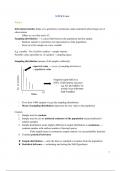
Sampling distribution (means of all samples collected)
- If we draw 1000 samples we get the sampling distribution
- Mean of sampling distribution represents the true value in the population
Caution:
1. Sample must be random
2. Sample must be (is) an unbiased estimator of the population (mean) (unbiased =
random sample)
3. Sample distribution looks slightly different if sample distribution is continuous →
contains number with endless number of decimal spaces
- If the sample mean is continuous sample statistic we use probability densities
4. Consider practical relevance
★ Sample distribution → only the data we sampled to examine from the population
★ Statistical inference → estimating and testing the Null Hypothesis
1
, ★ Sampling space → collection of all possible outcome scores/sample statistic values
★ Sample statistic → a value/number describing characteristics of a sample (e.g. no.of
yellow candies); also called - Random Variable (variable- because different samples
have different scores, that depend on chance?)
- Discrete sample statistics → the sampling distribution tells us the probability of
individual sample outcomes.
- Continuous sample statistics → it tells us the probability density, which gives us the
probability of drawing a sample with an outcome that is at least or at most a particular
value, or an outcome that is between two values.
★ Sampling Distribution → distribution of the outcome scores of very many samples
- all possible sample statistic values + their probabilities (of drawing a particular value and
min and max value) and probability densities
Calculating probability → 26 (e.g. number of samples with 5 yellow candies )/1000 (number of
samples drawn)=0.026 (probability of drawing a sample with 5 yellow candies)
★ Probability Distributions → a sampling space with probabilities
- tells us the probability a particular outcome may occur (0% - 100%); discrete random
variables (a finite value that can be counted)
- A spread of entire population
- Probability distribution of all possible outcomes are 0 because there is infinite no. of
possible values (we can never estimate the exact one)
- Displaying probability as an area between horizontal axis and a curve → probability
density function
★ Probability Density function → gives us the probability of values between two
thresholds AND gives us the probability up to a threshold value = left-hand probability
(used to calculate p-values)
- Determines the shape of a distribution
- A normal distribution has a probability density function
- Getting a probability that a continuous random variable falls within a particular range
- 2 functions of probability distributions:
a) How likely are we to draw a sample with a particular value
b) Finding a threshold values that separate the top 10% or bottom 5% of distribution
Expected value = population proportion x total no. of (things)
Expected value → average/mean of the sampling distribution of a random variable (average of
probability distribution; average of what we are studying)
2
,Cases → things counted; units of analysis
Unbiased estimator (a sample statistic) → when the SAMPLING DISTRIBUTION is equal to
POPULATION VALUE (population distribution) (average of the sampling distribution =
expected value)
- Estimate is downward biased → when it is too low
- Average is unbiased estimator?
Sample is (in principal) representative of population if variables in the sample are distributed
in the same way in the population.
In sampling distribution → Samples are cases (units of analysis) and Sample Characteristics
are observations
- Sampling distribution collects a large number of sampling proportions → the mean of
proportions = sample proportion is an unbiased estimator of sample proportion
- Sample and population consist of same type of observations
Empirical cycle → process of coming up with hypothesis about how stuff works and testing that
hypothesis against empirical data in a systematic way (deductive approach)
- Observation → sparks an idea for new research hypothesis; comes from previous
research; observing population in 1 or more specific instances
- Induction → specific to general statement
- Deduction → expectation/prediction; general to specific statement
- Testing → hypothesis is tested by collecting new data; prediction confirmed or not
- Evaluation → hypothesis is adjusted, rarely rejected; if confirmed - only provides
provisional support (because it can be disproven)
E.g. → experiment: flipping the coin
- Number of heads that we throw relate to the population (normal distribution) under H0:
that nothing is going on (no difference/change)
- We throw 2 times heads - a 20% chance
- H0: there is no difference in the population (difference between sample mean and the
population mean) when we falsify H0 we find support for alternative H
- H1: there is a difference in the population
- When we have a fair coin (50heads-50tails) nothing is going on (static)
- Data that we find (e.g. 2 times heads) is not = to expected value ?
- E.g. no of heads → test statistic
3
, To know what is H0 we have to know what is rare - set Alpha level and power
Binomial (probability) distribution → two states; 1/0; yes/no; discrete variables
Binomial H0: (probability of heads is 0.5)
- E.g. Expected value = 5
- Continuous line
- We assume the coin is fair
- But we cannot ever conclude that there is an unfair coin based on only throwing 2 times
heads
- We can set premises and boundaries to get a conclusion but that is NOT real → we know
for sure - but we can estimate a % of how sure we can be
- Putting a cut-off point (boundaries) determines how sure we are
- Acceptable probability to make mistake (5%)
Binomial H1: E.g. expected value is not 5, but rather 0.25
e.g the value is within the 95% range (more than a 5% chance)
4
Week 1
Inferential statistics helps us to generalize conclusions; make statements about larger set of
observations
- Offers us a p-value and a CI
Sampling distribution → a crucial link between the population and the sample
- Random sample is sometimes not representative of the population
- Score of a first sample on a new variable
E.g. variable - No.of yellow candies = sample statistic
Possible values (possible no. of candies) = sampling space
Sampling distribution (means of all samples collected)
- If we draw 1000 samples we get the sampling distribution
- Mean of sampling distribution represents the true value in the population
Caution:
1. Sample must be random
2. Sample must be (is) an unbiased estimator of the population (mean) (unbiased =
random sample)
3. Sample distribution looks slightly different if sample distribution is continuous →
contains number with endless number of decimal spaces
- If the sample mean is continuous sample statistic we use probability densities
4. Consider practical relevance
★ Sample distribution → only the data we sampled to examine from the population
★ Statistical inference → estimating and testing the Null Hypothesis
1
, ★ Sampling space → collection of all possible outcome scores/sample statistic values
★ Sample statistic → a value/number describing characteristics of a sample (e.g. no.of
yellow candies); also called - Random Variable (variable- because different samples
have different scores, that depend on chance?)
- Discrete sample statistics → the sampling distribution tells us the probability of
individual sample outcomes.
- Continuous sample statistics → it tells us the probability density, which gives us the
probability of drawing a sample with an outcome that is at least or at most a particular
value, or an outcome that is between two values.
★ Sampling Distribution → distribution of the outcome scores of very many samples
- all possible sample statistic values + their probabilities (of drawing a particular value and
min and max value) and probability densities
Calculating probability → 26 (e.g. number of samples with 5 yellow candies )/1000 (number of
samples drawn)=0.026 (probability of drawing a sample with 5 yellow candies)
★ Probability Distributions → a sampling space with probabilities
- tells us the probability a particular outcome may occur (0% - 100%); discrete random
variables (a finite value that can be counted)
- A spread of entire population
- Probability distribution of all possible outcomes are 0 because there is infinite no. of
possible values (we can never estimate the exact one)
- Displaying probability as an area between horizontal axis and a curve → probability
density function
★ Probability Density function → gives us the probability of values between two
thresholds AND gives us the probability up to a threshold value = left-hand probability
(used to calculate p-values)
- Determines the shape of a distribution
- A normal distribution has a probability density function
- Getting a probability that a continuous random variable falls within a particular range
- 2 functions of probability distributions:
a) How likely are we to draw a sample with a particular value
b) Finding a threshold values that separate the top 10% or bottom 5% of distribution
Expected value = population proportion x total no. of (things)
Expected value → average/mean of the sampling distribution of a random variable (average of
probability distribution; average of what we are studying)
2
,Cases → things counted; units of analysis
Unbiased estimator (a sample statistic) → when the SAMPLING DISTRIBUTION is equal to
POPULATION VALUE (population distribution) (average of the sampling distribution =
expected value)
- Estimate is downward biased → when it is too low
- Average is unbiased estimator?
Sample is (in principal) representative of population if variables in the sample are distributed
in the same way in the population.
In sampling distribution → Samples are cases (units of analysis) and Sample Characteristics
are observations
- Sampling distribution collects a large number of sampling proportions → the mean of
proportions = sample proportion is an unbiased estimator of sample proportion
- Sample and population consist of same type of observations
Empirical cycle → process of coming up with hypothesis about how stuff works and testing that
hypothesis against empirical data in a systematic way (deductive approach)
- Observation → sparks an idea for new research hypothesis; comes from previous
research; observing population in 1 or more specific instances
- Induction → specific to general statement
- Deduction → expectation/prediction; general to specific statement
- Testing → hypothesis is tested by collecting new data; prediction confirmed or not
- Evaluation → hypothesis is adjusted, rarely rejected; if confirmed - only provides
provisional support (because it can be disproven)
E.g. → experiment: flipping the coin
- Number of heads that we throw relate to the population (normal distribution) under H0:
that nothing is going on (no difference/change)
- We throw 2 times heads - a 20% chance
- H0: there is no difference in the population (difference between sample mean and the
population mean) when we falsify H0 we find support for alternative H
- H1: there is a difference in the population
- When we have a fair coin (50heads-50tails) nothing is going on (static)
- Data that we find (e.g. 2 times heads) is not = to expected value ?
- E.g. no of heads → test statistic
3
, To know what is H0 we have to know what is rare - set Alpha level and power
Binomial (probability) distribution → two states; 1/0; yes/no; discrete variables
Binomial H0: (probability of heads is 0.5)
- E.g. Expected value = 5
- Continuous line
- We assume the coin is fair
- But we cannot ever conclude that there is an unfair coin based on only throwing 2 times
heads
- We can set premises and boundaries to get a conclusion but that is NOT real → we know
for sure - but we can estimate a % of how sure we can be
- Putting a cut-off point (boundaries) determines how sure we are
- Acceptable probability to make mistake (5%)
Binomial H1: E.g. expected value is not 5, but rather 0.25
e.g the value is within the 95% range (more than a 5% chance)
4