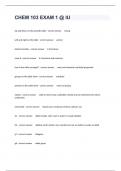
CHEM 103 EXAM 1 @ IU Comprehensive Questions And Detailed Answers.
Up and down on the periodic table - correct answer Group Left and right on the table - correct answer period Atomic Number - correct answer # of protons mass # - correct answer # of protons and neutrons how is the table arranged? - correct answer mass and chemical reactivity/properties groups on the table show - correct answer reactivity periods on the table show - correct answer mass increasing metals - correct answer solid at room temp, malleable, ductile (can be stretched into wires), conductive nonmetals - correct answer liquid, poor conductors (minus carbon), etc. G1 - correct answer Alkali metals, soft, react w water to create alkaline G2 - correct answer alkaline earth metals, very reactive but not as violent w water as alkali g7 - correct answer halogens g8 - correct answer noble gases intensive properties - correct answer don't rely on sample size; temperature, melting point extensive property - correct answer rely on sample size; length, volume physical property - correct answer no change in the actual element; temperature, color, odor, solubility chemical property - correct answer change in chemical make up; rusting, combustion, tarnishing, cooking/burning Law of Conservation of Mass - correct answer the law that states that mass cannot be created or destroyed in ordinary chemical and physical changes law of definite proportions - correct answer a chemical compound contains the same elements in exactly the same proportions by mass regardless of the size of the sample or source of the compound Law of Multiple Proportions - correct answer whenever two elements form more than one compound, the different masses of one element that combine with the same mass of the other element are in the ratio of small whole numbers Dalton's Atomic Theory - correct answer States that matter is composed of extremely small particles called atoms, whole numbers of atoms combine in chemical rxns, only rearrange atoms they cannot be destroyed Cathode Ray Experiment - correct answer An experiment that showed that electrons had a negative charge Oil Drop Experiment - correct answer A drop of oil was placed in a cylinder with negative and positive plates, the drops were charged using an x-ray. Different waves of xrays let the drops fall at different rates. Determined that the mass of the electron is 9.10 x 10^-28 by Robert Milikan Plum Pudding Model - correct answer J.J Thomsons model of an atom, in which he thought electrons were randomly distributed within a positively charged cloud Gold Foil Experiment - correct answer Conducted by Ernest Rutherford in which alpha particles that were shot at gold foil were deflected when they hit the positive center of gold atoms. The nucleus was discovered as a result of this experiment and electrons are in the outside. Bohr Model - correct answer model of the atom in which electrons move rapidly around the nucleus in paths called orbits Schrodinger - correct answer clouds of probability where e- will be protium - correct answer most common hydrogen isotope, 1 proton no neutrons. mass of 1 deuterium - correct answer An isotope of hydrogen with one proton and one neutron in the nucleus having a mass of 2 tritium - correct answer hydrogen isotope, 1 proton 2 neutrons amu - correct answer mass of all protons and neutrons in an element know the parts of an element on the table - correct answer What properties of the electron were measured in Thomson's cathode ray experiment and Millikan's oil drop experiment? - correct answer Charge-to-mass ratio of the electron; charge of the electron atom's atomic mass - correct answer Thus, the mass of a specific atom in unified atomic mass units atomic WEIGHT - correct answer weighted average of the isotopic masses of the element's naturally occurring isotopes Covalent bonds - correct answer Bonds created by sharing electrons with other atoms. (nonmetals/nonmetals) alkanes - correct answer a hydrocarbon containing only single covalent bonds (c-c) alkenes - correct answer Hydrocarbons with one or more carbon-carbon double bonds (c=c) cycloalkanes - correct answer Saturated hydrocarbons with carbon atoms joined in a ring carboxylic acid - correct answer R-COOH alcohols - correct answer R-OH ionic bonds - correct answer Formed when one or more electrons are transferred from one atom to another (metals/nonmetals) cation - correct answer A positively charged ion (lose e-) anion - correct answer A negatively charged ion (gain e-) ionic compound - correct answer A compound that consists of positive and negative ions in equal amounts cation charges - correct answer diatomic elements - correct answer N2, O2, F2, Br2, Cl2, I2, H2,

Geschreven voor
- Instelling
- CHEM 103.
- Vak
- CHEM 103.
Documentinformatie
- Geüpload op
- 22 juli 2024
- Aantal pagina's
- 4
- Geschreven in
- 2023/2024
- Type
- Tentamen (uitwerkingen)
- Bevat
- Vragen en antwoorden
Onderwerpen
-
chem 103 exam 1 iu

Ook beschikbaar in voordeelbundel