Unseen crime practice essay 3
The Mysterious Affair at Styles
Agatha Christie
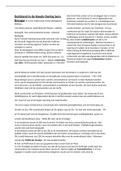
Plan
SETTING; cosy setting ‘in the village’ and by ‘the park gates’, country-house, makes for more
sensational crime, Christie’s message that crime can take place anywhere
SUSPECTS; interrogatives ‘Where had he been? How did he intend to explain his absence?’
demonstrate possible opportunity, ‘my poor wife’ lack of feeling, trope of Golden Age for
husband to be a suspect
INTERROGATION; Hastings doesn’t trust Mr Inglethorp, asking ‘Where have you been?’ and
‘How did you hear the news?’ (direct address), he tries to cover himself ‘She was so self-
sacrificing’, makes him more of a suspect
DETECTIVE & SIDEKICK; the homodiegetic narrator, Hastings, ‘I related the whole story,
keeping back nothing, and omitting no circumstance’, with his superior, Poirot (‘I wanted his
help’, figure of repute) every irrelevancy has a bearing on the whole in an intuitionist
investigation
Response
This extract, encompassing the reactions of several characters to the central crime in The
Mysterious Affair at Styles, is notable for its introduction of the classic relationship between the
detective and his sidekick, elements of interrogation, and consideration of a suspect’s possible guilt.
The setting of the murder mystery is customary of the Golden Age of crime fiction, taking place in an
isolated and cosy village as opposed to a more realistic backdrop, such as an urban area.
Indeed, we are immediately immersed in a setting that juxtaposes our traditional
expectations of crime; we find ourselves ‘in the village’ near some ‘park gates’. The use of ‘the’ as
the article rather than ‘a’ emphasises the provincial nature of the backdrop to the crime, implying a
tight-knit community in which everyone knows each other. The view that this an unusual backdrop
to crime is supported by Widdowson (2004) who comments that ‘real-life crime has generally been
considered to be a product of the city’. Yet Christie not only prefers a rural setting in this extract, but
also one that is apparently affluent as the ‘park gates’ and the crime scene of a country manor
suggest an element of prosperity about the village, which is again ironic given that criminals are
generally presented as being financially motivated in crime fiction. It is perhaps an element of social
commentary on Christie’s part that crime can take place anywhere and is not limited to desperate
individuals in the seedy criminal underbelly of cities, as was depicted by American writers of hard-
boiled crime fiction at the time.
The nature of the criminal is equally contested by Christie as the first apparent suspect
introduced in the novel is none other than the husband of the victim, Mr Inglethorp. Given his
ownership of the grand country manor, it seems obvious to say that he would not be financially
motivated in committing the crime, while the fact that he is suspected of murdering his wife is
extremely shocking. It could possibly encompass another one of Christie’s social messages in which
she suggests that all humans are capable of committing crime, regardless of background or an
outward disposition of kindliness. From an alternative perspective, it is just a trope of Golden Age
fiction for a family member to be suspected of the crime. He fulfils the stock character perfectly,
remarking ‘My poor wife!’; the adjective ‘poor’ makes it an empty adjective, one that could perhaps
indicate a façade to hide his responsibility for the crime. In any case, the internal interrogatives
The Mysterious Affair at Styles
Agatha Christie
Plan
SETTING; cosy setting ‘in the village’ and by ‘the park gates’, country-house, makes for more
sensational crime, Christie’s message that crime can take place anywhere
SUSPECTS; interrogatives ‘Where had he been? How did he intend to explain his absence?’
demonstrate possible opportunity, ‘my poor wife’ lack of feeling, trope of Golden Age for
husband to be a suspect
INTERROGATION; Hastings doesn’t trust Mr Inglethorp, asking ‘Where have you been?’ and
‘How did you hear the news?’ (direct address), he tries to cover himself ‘She was so self-
sacrificing’, makes him more of a suspect
DETECTIVE & SIDEKICK; the homodiegetic narrator, Hastings, ‘I related the whole story,
keeping back nothing, and omitting no circumstance’, with his superior, Poirot (‘I wanted his
help’, figure of repute) every irrelevancy has a bearing on the whole in an intuitionist
investigation
Response
This extract, encompassing the reactions of several characters to the central crime in The
Mysterious Affair at Styles, is notable for its introduction of the classic relationship between the
detective and his sidekick, elements of interrogation, and consideration of a suspect’s possible guilt.
The setting of the murder mystery is customary of the Golden Age of crime fiction, taking place in an
isolated and cosy village as opposed to a more realistic backdrop, such as an urban area.
Indeed, we are immediately immersed in a setting that juxtaposes our traditional
expectations of crime; we find ourselves ‘in the village’ near some ‘park gates’. The use of ‘the’ as
the article rather than ‘a’ emphasises the provincial nature of the backdrop to the crime, implying a
tight-knit community in which everyone knows each other. The view that this an unusual backdrop
to crime is supported by Widdowson (2004) who comments that ‘real-life crime has generally been
considered to be a product of the city’. Yet Christie not only prefers a rural setting in this extract, but
also one that is apparently affluent as the ‘park gates’ and the crime scene of a country manor
suggest an element of prosperity about the village, which is again ironic given that criminals are
generally presented as being financially motivated in crime fiction. It is perhaps an element of social
commentary on Christie’s part that crime can take place anywhere and is not limited to desperate
individuals in the seedy criminal underbelly of cities, as was depicted by American writers of hard-
boiled crime fiction at the time.
The nature of the criminal is equally contested by Christie as the first apparent suspect
introduced in the novel is none other than the husband of the victim, Mr Inglethorp. Given his
ownership of the grand country manor, it seems obvious to say that he would not be financially
motivated in committing the crime, while the fact that he is suspected of murdering his wife is
extremely shocking. It could possibly encompass another one of Christie’s social messages in which
she suggests that all humans are capable of committing crime, regardless of background or an
outward disposition of kindliness. From an alternative perspective, it is just a trope of Golden Age
fiction for a family member to be suspected of the crime. He fulfils the stock character perfectly,
remarking ‘My poor wife!’; the adjective ‘poor’ makes it an empty adjective, one that could perhaps
indicate a façade to hide his responsibility for the crime. In any case, the internal interrogatives