

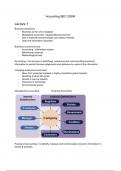
Accounting BEC 22806
Lecture 1
Business economics
- Business as the unit of analysis
- Managerial economics / Applied Microeconomics
- Use of methods and techniques, less theory-oriented
- Data and information important
Business economics tools
- Accounting - information system
- Behavioural sciences
- Methodological tools
Accounting = the process of identifying, measuring and communicating economic
information to permit informed judgements and decisions by users of the information
Changing business environment:
- Move from protected markets to highly competitive global markets
- Declining product life-cycles
- Growth in service industry
- Advances in technology
- Environmental issues
Management accounting Financial accounting
Purpose of accounting = to identify, measure and communicate economic information to
decide & evaluate.
, Management accounting Financial accounting
Planning Financial report
Control Fiscal report
Organisation Social report
Communication Environmental report
Motivation
Goals of management accounting:
● Cost allocation for inventory valuation and profit measurement
● Relevant information for decision makers / managers
● Information for planning, control and performance management
Goals of financial accounting:
● Cost allocation for inventory valuation and profit measurement
● True and fair view on financial position that is uniform and consistent
● Decision-making of external stakeholders
Income statement
,Notes:
- In the short run fixed costs are irrelevant
- Selling price should be more than the variable costs
Costs = sacrifices of assets which are unavoidable, measurable and foreseeable
Cost price = cost per unit output
Long-run decisions: integral cost price, but also in relation to strategy
Short-run decisions: differential costs of variable costs
Decision-making process
Costs = a monetary measure of the resources sacrificed or forgone to achieve a specific
objective.
Type of costs: Cost allocation:
Purposes of management accounting:
● Profit measurement and inventory valuation
● Decision-making
● Planning, control of performance
, Cost object = any activity for which a separate measurement of cost is required
Cost collection system:
1. Accumulates costs by classifying them into categories, such as type of expense
(labour or materials) or by cost behaviour (fixed or variable)
2. Assigns costs to cost objects
Direct costs = can be specifically and exclusively identified with a given cost object
Indirect costs = ‘overheads’ cannot be specifically and exclusively identified with a given cost
object
● Assigned to cost objects on the basis of cost allocation
Cost allocation = the process of assigning costs to cost objects where a direct measure of
the resource consumed by these cost objects does not exist
Manufacturing and non-manufacturing costs
Period and product costs
● Valuation of completed unsold products and partly completed products or services is
a problem for profit measurement and inventory valuation
● In merchandising organizations, all costs except the cost of the good purchased are
regarded as period cost
Lecture 1
Business economics
- Business as the unit of analysis
- Managerial economics / Applied Microeconomics
- Use of methods and techniques, less theory-oriented
- Data and information important
Business economics tools
- Accounting - information system
- Behavioural sciences
- Methodological tools
Accounting = the process of identifying, measuring and communicating economic
information to permit informed judgements and decisions by users of the information
Changing business environment:
- Move from protected markets to highly competitive global markets
- Declining product life-cycles
- Growth in service industry
- Advances in technology
- Environmental issues
Management accounting Financial accounting
Purpose of accounting = to identify, measure and communicate economic information to
decide & evaluate.
, Management accounting Financial accounting
Planning Financial report
Control Fiscal report
Organisation Social report
Communication Environmental report
Motivation
Goals of management accounting:
● Cost allocation for inventory valuation and profit measurement
● Relevant information for decision makers / managers
● Information for planning, control and performance management
Goals of financial accounting:
● Cost allocation for inventory valuation and profit measurement
● True and fair view on financial position that is uniform and consistent
● Decision-making of external stakeholders
Income statement
,Notes:
- In the short run fixed costs are irrelevant
- Selling price should be more than the variable costs
Costs = sacrifices of assets which are unavoidable, measurable and foreseeable
Cost price = cost per unit output
Long-run decisions: integral cost price, but also in relation to strategy
Short-run decisions: differential costs of variable costs
Decision-making process
Costs = a monetary measure of the resources sacrificed or forgone to achieve a specific
objective.
Type of costs: Cost allocation:
Purposes of management accounting:
● Profit measurement and inventory valuation
● Decision-making
● Planning, control of performance
, Cost object = any activity for which a separate measurement of cost is required
Cost collection system:
1. Accumulates costs by classifying them into categories, such as type of expense
(labour or materials) or by cost behaviour (fixed or variable)
2. Assigns costs to cost objects
Direct costs = can be specifically and exclusively identified with a given cost object
Indirect costs = ‘overheads’ cannot be specifically and exclusively identified with a given cost
object
● Assigned to cost objects on the basis of cost allocation
Cost allocation = the process of assigning costs to cost objects where a direct measure of
the resource consumed by these cost objects does not exist
Manufacturing and non-manufacturing costs
Period and product costs
● Valuation of completed unsold products and partly completed products or services is
a problem for profit measurement and inventory valuation
● In merchandising organizations, all costs except the cost of the good purchased are
regarded as period cost



