Bio 172 animals exam Questions with Complete Correct Answers | Grade A+
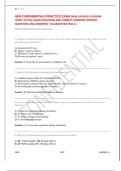
Which of the following is (are) unique to animals? A) the structural carbohydrate, chitin B) nervous and muscular tissue C) heterotrophy D) gametes Ans: B) nervous and muscular tissue What do all deuterostomes have in common? A) Adults are bilaterally symmetrical. B) Embryos have pharyngeal pouches that may or may not form gill slits. C) All have a spinal column. D) The pore (blastopore) formed during gastrulation becomes the anus. Ans: D) The pore (blastopore) formed during gastrulation becomes the anus. An organism that has cephalization probably also A) is bilaterally symmetrical. B) has a coelom. C) is segmented. D) is diploblastic. Ans: A) is bilaterally symmetrical. The first cell resulting from fusion of sperm and egg is a A) zygote. B) gonad. C) primary oocyte. D) planula. Ans: A) zygote. 5. Which of the following is not a phylum in the lophotochozoa? A) Nematoda B) Mollusca C) Platyhelminthes D) Annelida Ans: A) Nematoda Parasitic tremetodes and cestodes are members of the A) Nematoda B) Mollusca C) Platyhelminthes D) Annelida Ans: C) Platyhelminthes 7. Sponges have how many tissue types? A) 0 B) 1 C) 2 D) 3 Ans: A)

Geschreven voor
- Instelling
- Bio 172
- Vak
- Bio 172
Documentinformatie
- Geüpload op
- 9 juli 2024
- Aantal pagina's
- 20
- Geschreven in
- 2023/2024
- Type
- Tentamen (uitwerkingen)
- Bevat
- Vragen en antwoorden
Onderwerpen
-
bio 172 animals exam questions with complete corr

Ook beschikbaar in voordeelbundel