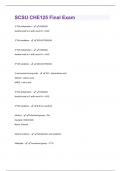
SCSU CHE125 Final Exam Questions and Answers with complete solution
1⁰ OH dehydration - H2SO4/Δ double bond to C with most H's + H2O 1⁰ OH oxidation - K2Cr2O7/H2SO4 2⁰ OH dehydration - H2SO4/Δ double bond to C with most H's + H2O 2⁰ OH oxidation - K2Cr2O7/H2SO4 3 memorized strong acids - HCl = hydrochloric acid H2SO4 = sulfuric acid HNO3 = nitric acid 3⁰ OH dehydration - H2SO4/Δ double bond to C with most H's + H2O 3⁰ OH oxidation - N.R (no reaction) Alcohol - Functional group: −OH Example: CH3CH2OH Name: Ethanol Alcohol reations - Dehydration and oxidation Aldehyde - Functional group: −*C*HExample: CH3CH Name: Ethanal *bold* = double bonded to O Amine - Functional group: −NH2 Example: CH3CH2NH2 Name: Ethanamine Amphiprotic - A substance that can act as either an acid or a base Aniline - C6H5−NH2 *or* C6H7N Benzaldehyde - C6H5−COH *or* C7H6O Benzene - C6H6 Benzoic acid - C6H5−COOH *or* C7H6O2 Butane - C4H10 Butene - H2*CC*H2CH2CH3 *bold* = double bond Butyl - −CH2CH2CH2CH3 Butyne - H3C*CC*CH3 *bold* = triple bondCarboxyl group - −COOH Carboxylic acid - Functional group: −C−OH Example: CH3COH Name: Acetic acid *bold* = double bonded to O Cis - Cyclic ether - Decane - C10H22 Decene - H2*CC*H2CH2CH2CH2CH2CH2CH3 *bold* = double bond Decyne - H3CCH2CH2CH2*CC*CH2CH2CH2CH3 *bold* = triple bond Density of water - 1.0g / mL Depronated form - Conjugate base form Dilution - M1V1 = M2V2 Diprotic acid - Can donate up to 2 protons (H+) Equation when H+ ions are added - H+ + A- → HAEquation when OH- ions are added - OH- + HA → H2O + AEster - Functional group: −*C*−OR Example: CH3COCH2CH3 Name: Ethyl acetate *bold* = double bonded to O Ethane - C2H6 Ethene - H2*CC*H2 *bold* = double bond Ethyl - −CHCH2CH3 Ethyne - H*CC*H *bold* = triple bond Henderson-Hasselbalch equation - pH = pKa + log([A-]/[HA]) HEPES are synthetic amine compounds that are often used to make buffers for biochemical studies. What is the pH of a 1.0 L buffer solution that is 0.250 M HEPES acid form and 0.050 M HEPES base form? pKa for HEPES acid is 7.55. If 10 mL of 1.0 M NaOH is added to the above buffer, what will be the new pH of the buffer? Assume the total volume will be 1010 mL - pH = 7.55 + log(0.050M/0.250M) = 6.85 NaOH + HEPES → H2O + HEPES 0.250 0.050 -0.01 +0.01 0.240 0.060pH = 7.55 + log(0.060M/0.240M) = 6.85 Heptane - C7H16 Heptene - H2*CC*H2CH2CH2CH2CH2CH3 *bold* = double bond Heptyne - H3CCH2*CC*CH2CH2CH3 *bold* = triple bond Hexane - C6H14 Hexene - H2*CC*H2CH2CH2CH2CH3 *bold* = double bond Hexyne - H3CCH2*CC*CH2CH3 *bold* = triple bond How many grams of NaCl are needed to make 250 mL of a 0.90% (w/v) solution? - 2.3g NaCl How to determine if structures are constitutional isomers? - If they have the same molecular formula, they are constitutional isomers How to determine if structures are the same compound - If they have the same name, they are the same compound Hydroxyl group - −OH Isobutyl - −-CH2*CH*CH3

Geschreven voor
- Instelling
- SCSU CHE125
- Vak
- SCSU CHE125
Documentinformatie
- Geüpload op
- 29 juni 2024
- Aantal pagina's
- 11
- Geschreven in
- 2023/2024
- Type
- Tentamen (uitwerkingen)
- Bevat
- Vragen en antwoorden
Onderwerpen
-
scsu che125

Ook beschikbaar in voordeelbundel