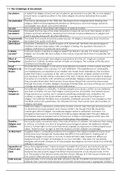
11: The Challenge of Secularism
Secularism A belief that religion should not be included in government or public life; no one religion
should have a superior position in the state; religion should be restrained from public
power
Secularisation The theory developed in the 1950s-60s. Developed from enlightenment thinking that
religious belief would progressively decline as democracy and technology advance.
Sociologists now doubt such a liner decline
Secular Not connected or associated with religious or spiritual matters
Procedural The belief that the role of the state should be to take into account the interests of all its
Secularism citizens and their institutions, meaning that it should not give preference to religion but
treat it equally along with all other institutions
Programmatic The belief that society should be purely secular. All religious views/practices should be
Secularism excluded from public institutions
Steve Bruce Describes Christianity as a pale shadow of its former self. He thinks the percentage of
Christians will soon drop below 10%. As religion is fading, this questions the place of
religious institutions in public life and culture
Is Britain If secular means a decline in religious belief then Britain is secular. If it means keeping
secular? religion out of public life and culture or the nature of government then it is probably not
secular.
Effect of Immigration has brought new religious populations into the U.K. Anglican numbers
Immigration decline but Catholic numbers remain virtually unchanged. The number of Pentecostal
Christians and Muslims grow
Freud - He believed that religion is a lie and a mass delusion to protect us from nature and fate.
Religion is an He thought religion was a product of 'wish fulfillment'. The experiences of vulnerability
illusion and helplessness we experience as children are made more tolerable by the invented
belief that there is a purpose to life, with a moral code from a higher wisdom and that
any injustices in this life will be corrected in the next. A divine force is invented to replace
the sense of uncertainty with something controllable. Religious ideas are prized because
they provide information that humans crave about things that cannot be discovered
through the study of reality. Religion assuages infantile fears we have of things we cannot
change and represses negative human behaviours
Freud - He believed religion is unhealthy. It divides people and causes conflict as non-believers
Religion is are seen as inferior. He saw that religion is produced by uncertainty and anxiety about
dangerous things beyond our control, but it created something unreliable and unhealthy. He
outlined a utopia of the future where society is governed without the influence of
religion. He believed the Bible was completely unreliable and said it was dangerous that
the Bible cannot be questioned. He criticised the fact that human laws are founded on
religious principles
Dawkins Believed religion is repressive, particularly towards woman (also through denying access
to abortions) and gay people, and causes conflict. He thought that life should be
meaningful without religion. He believed religion leads to extremism and terror. It is
dangerous because it is non-thinking and discourages independent thought. Believes
that before science people had no choice but to take a mythological world view. But
not science is a more reliable source of truths about the universe
Dawkins - He is particularly concerned about the indoctrination of children. He believed that raising
Religion and a child as a Catholic is a form of long-term psychological abuse. He believed children
Children have a 'human right not to have their minds crippled by exposure to other people's bad
ideas'. Parents have 'no right to limit the horizons of their children's knowledge'
Jo Marchant Suggests there is compelling evidence that suggests that religious beliefs and practices
bring about psychologically measurable benefits to the participants. 'feeling part of
something bigger may help us not only to deal with life's daily hassles but diffuse our
deepest source of angst: knowledge of our own mortality'. She does not necessarily
disagree with Freud's analysis as to why people are religious, but she comes to a radically
different conclusion
Separation of Since the enlightenment, there has been the belief that Church and state should be
Church and separate. Reason and law should replace religious authority in governing the state. The
State National Secular Society argue that Britain should become a truly secular state. In the
U.K. The queen is the head of state and the church, Bishops sit in the house of lords and
the church offers services such as marriage and funerals
Faith Schools Approximately 1/3 of schools are faith schools in the UK. The British Humanist Association
believes that a secular state should not fund faith schools because it segregates children
Secularism A belief that religion should not be included in government or public life; no one religion
should have a superior position in the state; religion should be restrained from public
power
Secularisation The theory developed in the 1950s-60s. Developed from enlightenment thinking that
religious belief would progressively decline as democracy and technology advance.
Sociologists now doubt such a liner decline
Secular Not connected or associated with religious or spiritual matters
Procedural The belief that the role of the state should be to take into account the interests of all its
Secularism citizens and their institutions, meaning that it should not give preference to religion but
treat it equally along with all other institutions
Programmatic The belief that society should be purely secular. All religious views/practices should be
Secularism excluded from public institutions
Steve Bruce Describes Christianity as a pale shadow of its former self. He thinks the percentage of
Christians will soon drop below 10%. As religion is fading, this questions the place of
religious institutions in public life and culture
Is Britain If secular means a decline in religious belief then Britain is secular. If it means keeping
secular? religion out of public life and culture or the nature of government then it is probably not
secular.
Effect of Immigration has brought new religious populations into the U.K. Anglican numbers
Immigration decline but Catholic numbers remain virtually unchanged. The number of Pentecostal
Christians and Muslims grow
Freud - He believed that religion is a lie and a mass delusion to protect us from nature and fate.
Religion is an He thought religion was a product of 'wish fulfillment'. The experiences of vulnerability
illusion and helplessness we experience as children are made more tolerable by the invented
belief that there is a purpose to life, with a moral code from a higher wisdom and that
any injustices in this life will be corrected in the next. A divine force is invented to replace
the sense of uncertainty with something controllable. Religious ideas are prized because
they provide information that humans crave about things that cannot be discovered
through the study of reality. Religion assuages infantile fears we have of things we cannot
change and represses negative human behaviours
Freud - He believed religion is unhealthy. It divides people and causes conflict as non-believers
Religion is are seen as inferior. He saw that religion is produced by uncertainty and anxiety about
dangerous things beyond our control, but it created something unreliable and unhealthy. He
outlined a utopia of the future where society is governed without the influence of
religion. He believed the Bible was completely unreliable and said it was dangerous that
the Bible cannot be questioned. He criticised the fact that human laws are founded on
religious principles
Dawkins Believed religion is repressive, particularly towards woman (also through denying access
to abortions) and gay people, and causes conflict. He thought that life should be
meaningful without religion. He believed religion leads to extremism and terror. It is
dangerous because it is non-thinking and discourages independent thought. Believes
that before science people had no choice but to take a mythological world view. But
not science is a more reliable source of truths about the universe
Dawkins - He is particularly concerned about the indoctrination of children. He believed that raising
Religion and a child as a Catholic is a form of long-term psychological abuse. He believed children
Children have a 'human right not to have their minds crippled by exposure to other people's bad
ideas'. Parents have 'no right to limit the horizons of their children's knowledge'
Jo Marchant Suggests there is compelling evidence that suggests that religious beliefs and practices
bring about psychologically measurable benefits to the participants. 'feeling part of
something bigger may help us not only to deal with life's daily hassles but diffuse our
deepest source of angst: knowledge of our own mortality'. She does not necessarily
disagree with Freud's analysis as to why people are religious, but she comes to a radically
different conclusion
Separation of Since the enlightenment, there has been the belief that Church and state should be
Church and separate. Reason and law should replace religious authority in governing the state. The
State National Secular Society argue that Britain should become a truly secular state. In the
U.K. The queen is the head of state and the church, Bishops sit in the house of lords and
the church offers services such as marriage and funerals
Faith Schools Approximately 1/3 of schools are faith schools in the UK. The British Humanist Association
believes that a secular state should not fund faith schools because it segregates children