CC HTN EXAM QUESTIONS CORRECTLY ANSWERED.
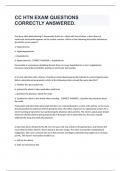
CC HTN EXAM QUESTIONS CORRECTLY ANSWERED. One hour after administering IV furosemide (Lasix) to a client with heart failure, a short burst of ventricular tachycardia appears on the cardiac monitor. Which of the following electrolyte imbalances should the nurse suspect? a. Hypocalcemia b. Hypermagnesemia c. Hypokalemia d. Hypernatremia - CORRECT ANSWER c. Hypokalemia Furosemide is a potassium-depleting diuretic than can cause hypokalemia. In turn, hypokalemia increases myocardial excitability, leading to ventricular tachycardia. A 57-year-old client with a history of asthma is prescribed propranolol (Inderal) to control hypertension. Before administered propranolol, which of the following actions should the nurse take first? a. Monitor the apical pulse rate b. Instruct the client to take medication with food c. Question the physician about the order d. Caution the client to rise slowly when standing - CORRECT ANSWER c. Question the physician about the order Propranolol and other beta-adrenergic blockers are contraindicated in a client with asthma, so the nurse should question the physician before giving the dose. The other responses are appropriate actions for a client receiving propranolol, but questioning the physician takes priority. The client's apical pulse should always be checked before giving propranolol; if the pulse rate is extremely low, the nurse should withhold the drug and notify the physician. A client has driven himself to the ER. He is 50 years old, has a history of hypertension, and informs the nurse that his father died of a heart attack at 60 years of age. The client is presently complaining of indigestion. The nurse connects him to an ECG monitor and begins administering oxygen at 2 L/minute per NC. The nurse's next action would be to: a. Call for the doctor b. Start an intravenous line c. Obtain a portable chest radiograph d. Draw blood for laboratory studies - CORRECT ANSWER b. Start an intravenous line Advanced cardiac life support recommends that at least one or two intravenous lines be inserted in one or both of the antecubital spaces. Calling the physician, obtaining a portable chest radiograph, and drawing blood are important but secondary to starting the intravenous line. A nurse is assessing the blood pressure of a client diagnosed with primary hypertension. The nurse ensures accurate measurement by avoiding which of the following? a. Seating the client with arm bared, supported, and at heart level. b. Measuring the blood pressure after the client has been seated quietly for 5 minutes. c. Using a cuff with a rubber bladder that encircles at least 80% of the limb. d. Taking a blood pressure within 15 minutes after nicotine or caffeine ingestion. - CORRECT ANSWER d. Taking a blood pressure within 15 minutes after nicotine or caffeine ingestion. BP should be taken with the client seated with the arm bared, positioned with support and at heart level. The client should sit with the legs on the floor, feet uncrossed, and not speak during the recording. The client should not have smoked tobacco or taken in caffeine in the 30 minutes preceding the measurement. The client should rest quietly for 5 minutes before the reading is taken. The cuff bladder should encircle at least 80% of the limb being measured. Gauges other than a mercury sphygmomanometer should be calibrated every 6 months to ensure accuracy.

Geschreven voor
- Instelling
- Ccs
- Vak
- Ccs
Documentinformatie
- Geüpload op
- 25 juni 2024
- Aantal pagina's
- 6
- Geschreven in
- 2023/2024
- Type
- Tentamen (uitwerkingen)
- Bevat
- Vragen en antwoorden
Onderwerpen
-
ccs
-
cc htn exam questions correctly answered

Ook beschikbaar in voordeelbundel