Contact Avi, an A* student, for A-Level Maths, Philosophy & Economics tutoring –
+447881294948 (WhatsApp). 1 FREE session included with this purchase.
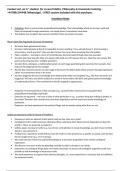
Innatism Notes
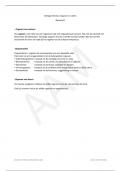
Definition: there is some innate propositional knowledge. This is knowledge which we are born with and
have not acquired through experience, we simply know it and always have done.
The debate over innatism also concerns whether there are innate concepts.
Plato’s Slave Boy Argument (in favour of innatism)
He knows basic geometrical truths.
Socrates’ initial paradox is that it is impossible to learn anything. If you already know it, then learning is
unnecessary, and if you don’t, then you don’t know how to go about acquiring the information.
Plato’s solution – learning is a form of remembering. Demonstrated through slave boy example.
Socrates asks how long the sides of a square with total area of 8 square feet are. Slave boy can answer this
just by answering Socrates’ multiple questions.
Socrates then undergoes a mathematical proof, at each stage questioning the slave boy (for example, how
long are the diagonals of this triangle)
But the boy correctly answers at each stage of the proof. He didn’t attain these answers through experience,
rather recovered them from in his mind.
Socrates triggered the boy’s knowledge from before birth which was forgotten (e.g., like how memories are
triggered). We had a soul which existed in a world of forms before this birth and gained perfect knowledge
of mathematical forms. This transferred to this life trapped in appearances.
- Response: he had experience of the concepts (e.g., square) before hand and so truly gained that
propositional knowledge empirically
- Extension of argument – we have an idea of what perfection is e.g., a perfect thing but nothing is perfect in
the world. Therefore this cannot have come from experience and we must have innate knowledge of
perfection.
- Response: we have experienced non-perfect things and are merely saying what they are not
Leibniz on necessary truths (in favour of innatism)
Necessary truths are abstract truths which must be true, they are a priori.
Contingent truths could have been otherwise (they could have been false) and are dependent on how the
world is. These are generally a posteriori.
Leibniz argues necessary truths (e.g., law of non-contradiction) is innate knowledge, you don’t have to think
about it, you just know it.
Furthermore, experience would tell you how the truth is in the present (on a specific occasion), and not how
the fact ought to be (e.g., 2+2=4 always).
We could not have inferred or gained knowledge of a necessary proposition from merely contingent
experience.
We discover necessary truths by attending carefully to what is already in our minds.
Experience of contingent things does not involve necessity; no amount of contingent experiences will ever
provide us with knowledge of necessary truths.
We need experience to express these abstract thoughts. So, sense experience is necessary but not sufficient
for necessary truths.
+447881294948 (WhatsApp). 1 FREE session included with this purchase.
Innatism Notes
Definition: there is some innate propositional knowledge. This is knowledge which we are born with and
have not acquired through experience, we simply know it and always have done.
The debate over innatism also concerns whether there are innate concepts.
Plato’s Slave Boy Argument (in favour of innatism)
He knows basic geometrical truths.
Socrates’ initial paradox is that it is impossible to learn anything. If you already know it, then learning is
unnecessary, and if you don’t, then you don’t know how to go about acquiring the information.
Plato’s solution – learning is a form of remembering. Demonstrated through slave boy example.
Socrates asks how long the sides of a square with total area of 8 square feet are. Slave boy can answer this
just by answering Socrates’ multiple questions.
Socrates then undergoes a mathematical proof, at each stage questioning the slave boy (for example, how
long are the diagonals of this triangle)
But the boy correctly answers at each stage of the proof. He didn’t attain these answers through experience,
rather recovered them from in his mind.
Socrates triggered the boy’s knowledge from before birth which was forgotten (e.g., like how memories are
triggered). We had a soul which existed in a world of forms before this birth and gained perfect knowledge
of mathematical forms. This transferred to this life trapped in appearances.
- Response: he had experience of the concepts (e.g., square) before hand and so truly gained that
propositional knowledge empirically
- Extension of argument – we have an idea of what perfection is e.g., a perfect thing but nothing is perfect in
the world. Therefore this cannot have come from experience and we must have innate knowledge of
perfection.
- Response: we have experienced non-perfect things and are merely saying what they are not
Leibniz on necessary truths (in favour of innatism)
Necessary truths are abstract truths which must be true, they are a priori.
Contingent truths could have been otherwise (they could have been false) and are dependent on how the
world is. These are generally a posteriori.
Leibniz argues necessary truths (e.g., law of non-contradiction) is innate knowledge, you don’t have to think
about it, you just know it.
Furthermore, experience would tell you how the truth is in the present (on a specific occasion), and not how
the fact ought to be (e.g., 2+2=4 always).
We could not have inferred or gained knowledge of a necessary proposition from merely contingent
experience.
We discover necessary truths by attending carefully to what is already in our minds.
Experience of contingent things does not involve necessity; no amount of contingent experiences will ever
provide us with knowledge of necessary truths.
We need experience to express these abstract thoughts. So, sense experience is necessary but not sufficient
for necessary truths.